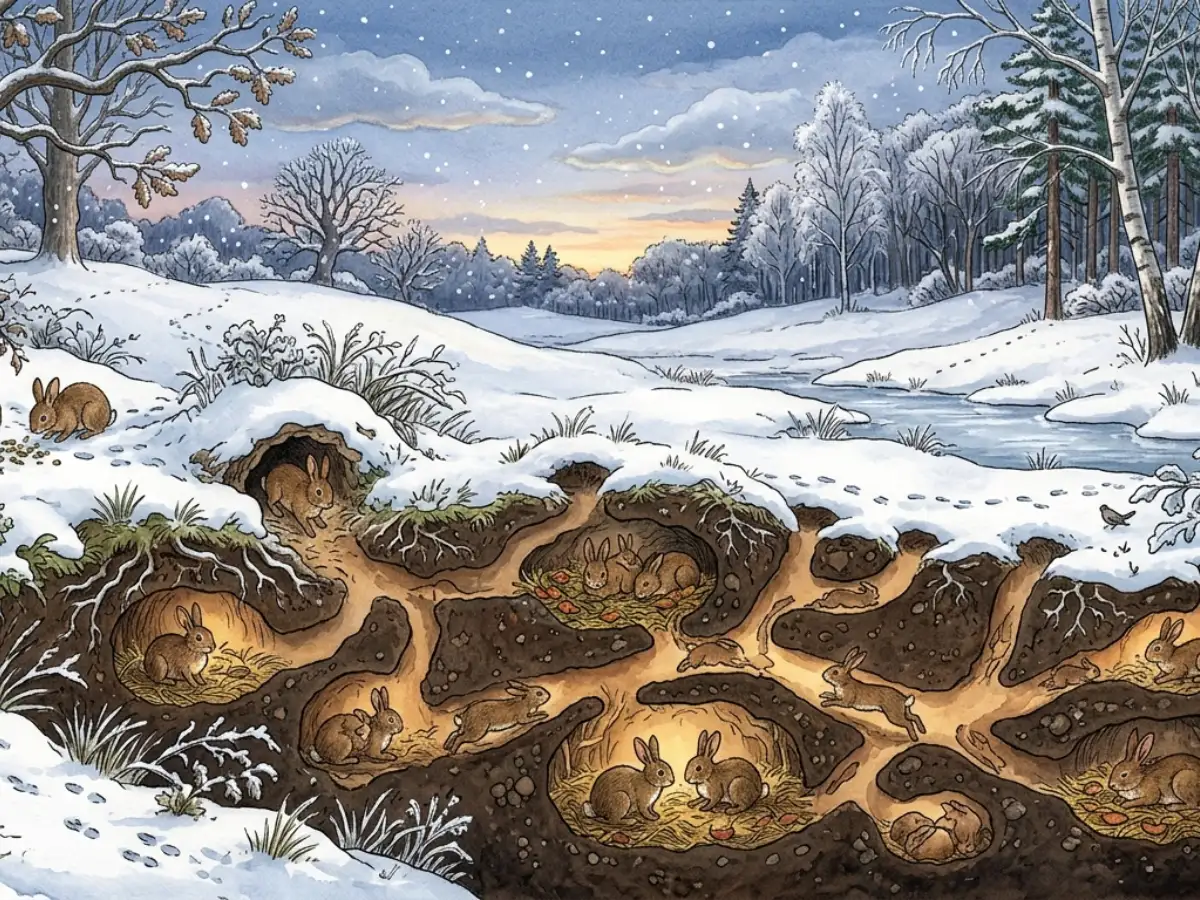
While a hole created by rabbits during the winter season may seem inconspicuous from the outside, no different from any other disturbed patches of soil in one’s backyard and close to a row of bushes, underground, there lies a world in itself that brings together temperature, humidity, and animal activity in unexpected ways. Rather than imagining holes concealing some deadly threat, it turns out that science sees something much less thrilling yet more organic at work.
As per the advice offered by the Royal Society for the Protection of Birds regarding animal holes, it can be difficult to identify which species is responsible for creating the hole because different types of wildlife use subterranean dens. However, what makes the rabbit warrens unique during winter is that they serve as thermal refuges, which keep the animal alive in bad weather but enable parasite survival.
Why rabbit burrows matter in winter
PubMed research on pygmy rabbits shows that burrows play an essential role in reducing the energy that rabbits require to regulate their body temperatures during the cold seasons. Practically, the burrows offer protection from cold weather by creating insulation within the tunnels where the rabbits remain to maintain energy levels during the cold months.
This makes burrows biologically relevant since the tunnels are not just passages but habitats for the animals where they can seek refuge. Researchers on subterranean mammals using PubMed studies have proven that the tunnels are constantly managed by animals according to temperature, lighting, and other environmental factors. Ultimately, the burrows become shared ecological spaces rather than mere temporary shelters.
The process of management poses another level of vulnerability when the animals occupying the burrows become infested with parasites or infectious diseases.
The real “silent subletter” is mites
Researchers investigating animal health studies suggest that the main hidden threat associated with rabbits' burrows during the winter is caused by mites rather than poison.
Veterinary studies focusing on infectious rabbit diseases, published in the National Library of Medicine, mentioned one type of infection, which causes infestation –Psoroptes cuniculi, or simply ear mites. These studies stressed not only the importance of curing an affected animal, but also dealing with the environment, since infections such as mites can be transferred via beddings, nests, and even the environment.
Moreover, one article concerning rabbits' mange in winter, published in the National Library of Medicine, provided a reason to investigate the issue during cold weather. Mange is usually transferred due to direct and indirect contact of the mite with the environment. During winters, cases of mange become more frequent because low temperatures and high levels of humidity are beneficial for their survival.
This information helps understand why winter is considered a critical season for studying rabbits' burrows. Burrows are underground habitats that trap moisture inside them.
How winter conditions help parasites survive
Further evidence for the link between cool and humid shelters and the survival of parasites comes from further laboratory research. For example, according to a study conducted by Sarcoptes scabiei – the mite which causes mange – which was published in the National Library of Medicine, the mites survived longer in cold and humid environments. Immature mites could survive up to 21 days at about 50°F with extremely high humidity.
This environmental persistence is believed to be one of the reasons why the winter burrow is important. However, the burrow does not cause the parasite's development; rather, it allows the parasites to survive between hosts.
The research on the environmental role of wombats' burrows, published in the National Library of Medicine, came to the same conclusion. It was found that the burrows have relatively constant humidity and temperature, with parasites surviving longer away from their hosts in winter. Although wombats have no relation to rabbits, the same ecological principle applies to both animals. Burrows serve as environmental storage sites for parasites.
Not every backyard hole belongs to a rabbit
Experts in wildlife biology stress the need not to jump to conclusions when it comes to the identity of every burrow. As per Iowa State University Extension and Outreach, other wildlife such as chipmunks, skunks, raccoons, and woodchucks utilize subterranean dens during winter.
The importance of distinguishing between these species is important as each poses its own threats and characteristics. Identification from the presence of a hole does not provide sufficient information about the species occupying the place.
Ecological studies on rabbits documented by PubMed also show that burrow systems affect rabbit movements and the selection of shelters. The systems are used continuously, thus providing chances for parasitic encounters.
How scientists study burrows today
It is not necessary for scientists to excavate burrows anymore to find out whether they are being used. According to a 2021 study cited by PubMed, it is possible to spot radiant heat produced by active burrows using thermal cameras, including rabbit warrens.
Non-invasive testing makes it easier for researchers to study the habitat of burrowing animals as well as learn about the impact of temperature constancy, humidity, and multiple animal visits on parasite persistence under the ground.
In conclusion, the "silent subletter" in rabbit burrows should not be something dangerous; rather, this phenomenon may be explained by mites and other ectoparasites finding an ideal habitat in cool, humid, reused burrows during winter. Rabbit warrens are life-saving tools for their owners, yet they are also a good example of one secluded place being home to two different creatures.