The story of Jyrobike, according to its CEO Rob Bodill, is a neat
illustration of “how people without a hardware background can get into
hardware”. In 2012, Bodill, an Australian entrepreneur living in
England, went to the US in search of new technologies that he could
bring to market on the other side of the Atlantic. When he found what
he was looking for, he got more than just permission to distribute the
product in Europe: he was offered the chance to own it outright.
The product, invented and commercialised by students at Dartmouth
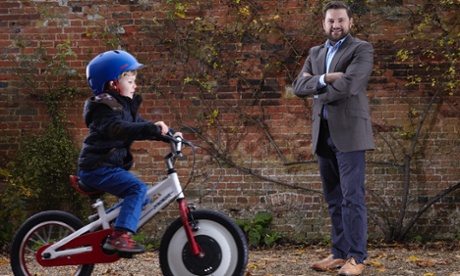
University, was a clever piece of engineering called the Gyrobike (the
“G” later became a “J”). Bodill explains: “It is the application of a
gyroscope – a spinning disc or what’s called a flywheel – that sits
inside the front wheel of a bicycle. It creates a stabilising field
very like gravity around the bicycle, so that when a rider starts to
tip or wobble, the bike corrects that tip and keeps them upright. We
see this as a new category in cycling,” he says. “An auto-balance
bicycle.”
It’s not just kids learning to cycle who can benefit from the
technology. “It can also be used to teach teenagers and adults who
find cycling difficult for various reasons such as dyspraxia, a
balance disorder, or autism, which also affects coordination.
Yesterday, we were at a training session with a little girl called
Lucy who has both and finds it incredibly difficult to ride a bike. We
were in a park for 10 minutes and she was pedalling. Her parents were
over the moon.
“It’s also good for older people who have lost confidence,” he adds.
“People who used to ride but haven’t in 10 years and want some
reassurance.”
The original US version was only a partial realisation of the overall
concept – just the front wheel. Over the past two years, as well as
refining the wheel, Bodill has been developing a full Jyrobike and an
app to go with it. But since he had no product design skills – his
expertise is in marketing – he had to find someone else to do the work
for him.
He thought of recruiting his own team but quickly nixed the idea.
Instead, he farmed out the main tasks to a design consultancy in
London who were able to prototype the different parts of the bike and
bring it up to the manufacturing stage. “The value of selecting a good
partner for hardware is immeasurable,” he says. “I could have ended up
spending three times as much if I’d brought it in-house – and that’s
much higher risk too. Using an external team, you benefit from their
economies of scale. I have access to 40 full-time engineers, battery
experts, etc, and they just dip in and out as needed.”
That’s not to say Bodill, who runs the company from Belfast, didn’t
pull his sleeves up. “That’s the best part of it. I’ve been involved
in each step of the design phase and I know everything about the
product now, from the type of plastic we use to the moulding to the
battery. The amount I’ve learned has been incredible – it’s like a
mini engineering degree.”
The bike and the wheel are currently being manufactured – separately –
in China and Taiwan. Bodill says they’ll hit the shops in the fourth
quarter of 2015. Has this balancing act been worth all the effort?
“Absolutely,” he says. “It’s been the best three years of my life.”