
Globally, in 2014, marketing departments are set to spend $135bn (£84.94bn) on content marketing. According to the Content Marketing Institute, 88% of UK marketers are using content marketing (pdf) activity or tactics in 2014. 31% of budgets are allocated to content. Content has become a big beast.
What is more, the beast continues to grow: a PRCA/YouGov survey of 195 leading PR and marketing industry experts carried out in July and August 2014 revealed that 72% of in-house teams plan to increase spending on content marketing. Video is the most popular type of content, used by 59%.
This rise of content marketing should come as no surprise to anyone who has noticed the almost total collapse in effectiveness of online advertising. “You are more likely to be hit by lightning than click on a banner ad,” says Dr Paul Marsden from digital marketing agency Unique Digital. “There is a one in 3,333 chance of clicking on a banner ad and one in 3,000 chance of being struck by lightning. So if audiences won’t click around content, you need to be the content.”
As more and more organisations have embraced the content marketing revolution so it has become harder than ever before to stand out from the crowd. In this relentless search for quality, marketers are working hard to find the right balance between earned, owned and curated content. It is a hard balance to find.
Content shock
Kenny Ager, head of partnerships & business development at Snack Media reports: “27m pieces of content are shared each day and there are over 100 hours of YouTube video content uploaded every day, in addition to Twitter, Vine, Facebook and other social feeds. Users now have too much content to choose from. As a result, only content that is truly unique, compelling and relevant to the user stands a chance.”
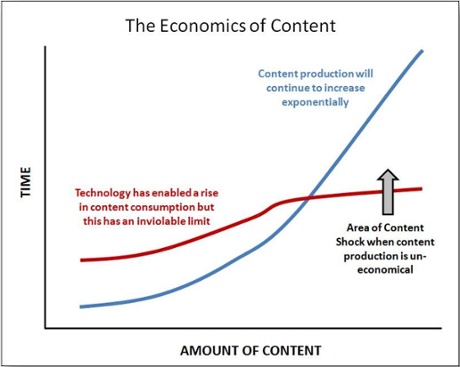
US social media consultant Mark Schaeffer has defined the problem as “content shock”; the amount of content being published is growing exponentially faster than the audiences intended to consume it, while the time available for consumption is a relatively fixed constant.
SEO, brand and long-term ROI
It is well known that the search engines reward quality, but we now are seeing a growing number of examples emerge of the commercial impact of a focus on quality content. Car hire company Hertz created more than 5,000 new web pages across six global domains as part of a major commitment to improve its content quality.
“We created blog content and added high quality, relevant images to the pages,” explains Charlotte Haite, SEO and social manager “Not only did this strategy increase visibility for revenue-generating prime location and city based terms, it also improved user experience and time spent on site. Combined traffic for the key markets of UK, France, Germany, Spain, Netherlands and Italy grew 84% year-on-year in the first three quarters of 2014, with combined revenue for those markets growing 67%.”
Content quality matters not only because it provides stand-out. “Content is your company’s brand in action, in terms of information,” argues Sylvia Jenson, director of EMEA marketing for Oracle Marketing Cloud. “The tone you use, the visuals you use, how smart your company is, all comes across in the information you provide.”
Also, Patrick Albano, head of solutions, Yahoo EMEA, points out that high quality content endures and so offers better long-term return on investment: “More than a third of re-blogs on Tumblr happen over 30 days after the initial post,” he says. “Content lives forever on Tumblr, and this staying power generates higher ROI for marketers through unrivalled earned engagement and dramatically longer awareness and conversion cycles.”
Success through quality
There are many examples of brands that have succeeded through focusing on quality. Red Bull is perhaps the most famous example with its live streaming of the ‘Stratos’ jump by Felix Baumgartner. “A high budget piece of content, sure, but content nonetheless,” comments Geraint John, the owner and founder of MOVE Digital, a search marketing agency in London. “It had the less than tech-savvy logging onto their computers to witness a piece of history. From just 15 Stratos videos in the run-up to live-stream of the jump, Red Bull amassed 360m Youtube hits and its web traffic ballooned as a result.”
Or look at Homebase. Derek Scobie, head of YouTube brand propositions, says: “Homebase created authentic, compelling content with leading UK vlogger Tanya Burr to launch a 12-minute haul video. Then they used paid media and organic distribution to promote the content to its target demographic. The video received 350,000 UK views and over 1.6m minutes were watched by its target audience of women aged 18 and over. The impact? Sales of the products showcased in its YouTube video increased by 46%.”
Whisky brand The Glenlivet invested significantly in high-quality long-format content designed exclusively to talk to drinkers about subjects related to whisky, and it produced a significant return according to David Burgess, UK CEO at Reading Room. “Independent research carried out by a third-party market research company showed that the 50,000 members of the ‘Taste The Glenlivet’ bought more often and were more likely to recommend the drink to their friends.”
It is not only FMCG and retail that can benefit from this strategy. Accountancy firm Grant Thornton has created a content hub – Thinking – on its website which creates quality content on a regular basis. “It is now one of the most popular and most visited areas of our company website,” says Lucy Canning, head of marketing “The number of unique views on the section has increased from 9,000 in October 2012 to 25,600 in October 2014. This came from placing an emphasis on quality over quantity.”
Overcoming obstacles
Few marketers set out to create low quality content. Toby Brown, head of technology at B2B communications consultancy Man Bites Dog, which recently produced ‘Follow The Leader’, a study into content marketing based on interviews with 100 CMOs, marketing and communications directors at the UK’s top 25 legal, accountancy and management consultancy firms, believes there are several reasons why the best of intentions often result in poor quality content.
“There is a tendency for a decision by committee,” he says. “So the original message can get lost as more and more competing voices want a say. In the rush to create content ahead of the competition, marketers are in danger of cutting corners to be first to the post. Then, in the rush to release, some marketers fail to come up with a strategy for packaging and distribution until the last minute.”
Whatever the reason, it will become increasingly damaging to brands’ reputations and sales. Even relying on the best distribution system will not be enough. “People aren’t stupid,” says Matt Cross, deputy managing director at communications agency Hotwire. “If they read a smart headline or tweet, but then the article is irrelevant to them, they won’t finish it. If they don’t finish it they aren’t likely to come back. Good distribution without good content is a con which will quickly backfire. A good rule of thumb is to spend as long promoting your content as you do producing it.”
The next Content Conversation from Outbrain will see some of the industry’s leading experts offering advice on how to avoid these pitfalls, find the right balance between earned, owned and curated, and produce high quality content. To sign up to attend visit here.
Case study: how McLaren produces marketing content so good people pay £10 to watch it
McLaren’s comedy animation series, Tooned, was developed as a joint venture with Oscar-winning company, Framestore, which is better known for creating the groundbreaking visual effects behind the film Gravity.
Simon Whalley, executive producer at Framestore, says: “Tooned was originally commissioned to help warm-up the McLaren brand. But because the series was created as high-end content the content went beyond 4m views on YouTube to organically develop into broadcast content for Sky and a top-selling DVD. People happily pay £10 for Tooned - in effect, buying McLaren’s advertising.”
He continues: “The world wide web is saturated with lo-fi content, making it hard to stand out. But by applying production standards more usually associated with filmmaking, than viral production, Tooned – which is now in its fourth year – has become entertainment with integrity and longevity. It has captured and maintained consumer attention for prolonged periods of time. This enables McLaren to have far more meaningful and enduring relationships with consumers.
“What is more it has even created a new revenue stream via DVD sales. There is potential to develop many more lucrative off-shoots such as gaming and partner sponsorship opportunities,” he concludes. “Of course, McLaren had another compelling reason to place proper investment in Tooned: if its content wasn’t innovative or of high-quality, it would not be a true reflection of the brand’s values.”
More like this
• Content discovery mechanisms drive better engagement on mobile
• What do Latin Americans like reading about most?
• Outbrain rising stars – interview with Mike Saraswat, Ekstasy
This advertisement feature is brought to you by Outbrain, sponsors of the Guardian Media Network’s digital content hub