Right now, as you read this, you’re staring at a screen. You’ll probably end up staring at a different screen later this evening. Even when you get in your car, yup, you’ll almost certainly be looking at another screen.
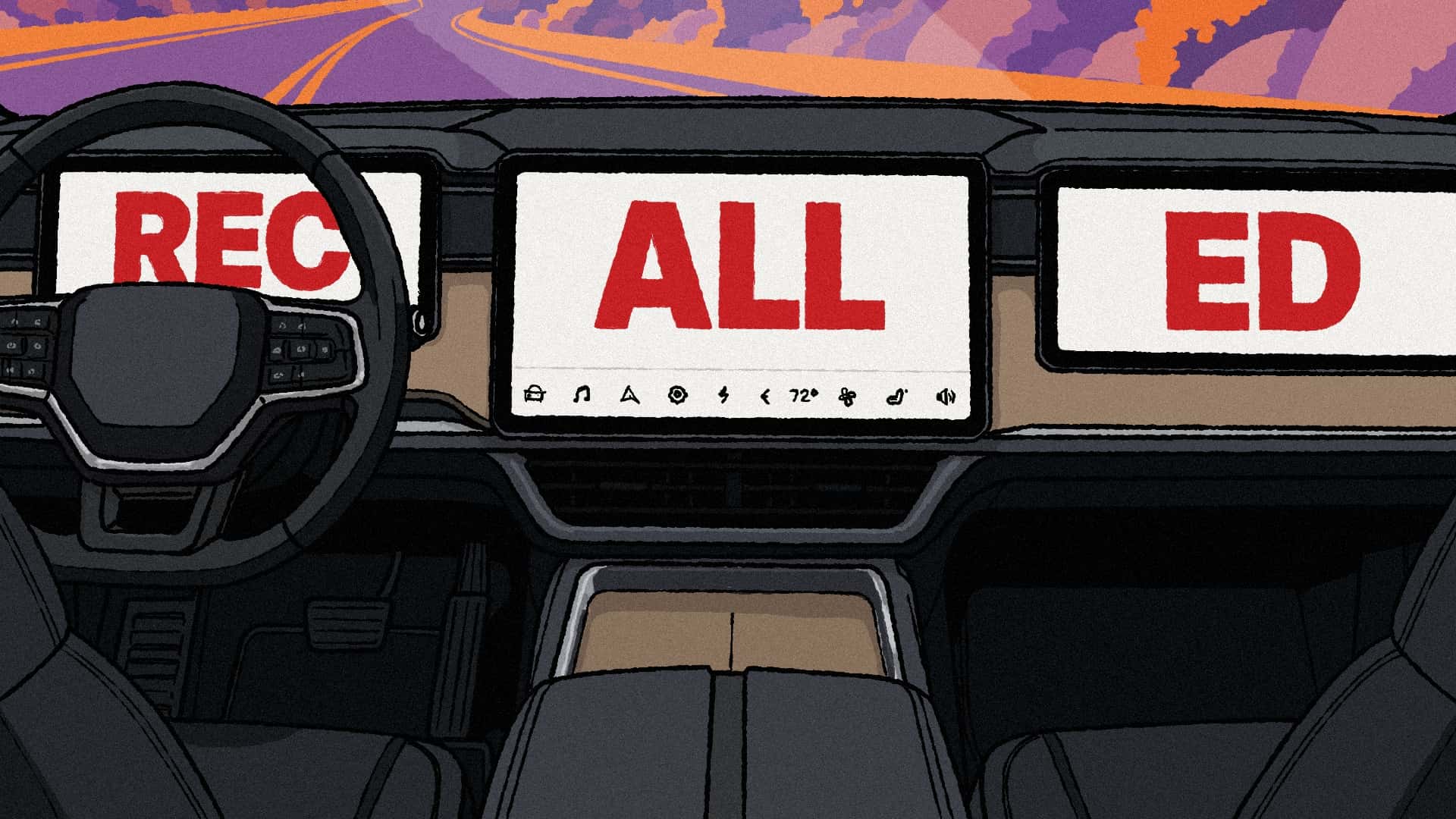
The point is: screens are unavoidable. Even the barest of bare-bones economy cars have massive touchscreens these days. Some have digital instrument clusters. Now there’s even a growing trend of passenger displays; glass from one end of the cabin to the other.
It used to be that screens were a neat gimmick—a clever way to get younger buyers interested in driving. "Look mom, there's a smartphone in my Nissan!" But with screens now encompassing more of the vehicle than ever before, and also controlling more functions, they’re becoming a headache for automakers.
At the time of publishing this story, there are roughly 30 active recalls related to vehicle displays. Don’t be shocked to see more by the end of the year. Those recalls affect roughly 3.8 million vehicles in the US thus far, with issues ranging from rearview camera failures to entire displays going dark—sometimes while driving. Rearview camera displays are an especially sore spot.
Of the nearly 12 million cars Ford has already recalled in 2026, just over 2.0 million are related to faulty backup camera images. On March 3, the automaker recalled 889,950 and 849,310 vehicles, respectively, for a backup camera image that may display incorrectly, or not at all. That recall affected the Ford Bronco, Escape, Edge, and Explorer, as well as the Lincoln Aviator and Lincoln Corsair.
But Ford isn't alone.
Honda recalled 325,588 vehicles over a rearview camera issue where the image may not display. General Motors recalled 276,879 vehicles because the rear camera could show a distorted or blank image. Even Lamborghini wasn't immune; Sant'Agata Bolognese recalled seven supercars because the rearview camera image may not appear. Mamma mia.
Clearly, this isn't an issue limited to one single automaker—or even one type of vehicle. But why are backup camera images suddenly the subject of so many recalls? The answer, though nuanced, largely boils down to recent regulation changes.
While rearview cameras have existed for decades, only lately have they become mandatory equipment on all new passenger vehicles sold in the US. On May 1, 2018, the Federal Motor Vehicle Safety Standard No. 111 made that official. And while, yes, that is already eight years ago, many of the vehicles affected by recent recalls (especially Fords) were engineered and sold roughly around that time.
But why are backup camera images suddenly the subject of so many recalls? The answer, though nuanced, largely boils down to recent regulation changes.
The regulation in question doesn't necessarily require automakers to use a center screen, interestingly, but it does require vehicles to give drivers a clear image of what’s behind them. Since nearly every automaker displays that image through the center infotainment screen, a software issue that causes the display to go black or show a delayed feed can trigger a safety recall—even if the camera itself is working correctly.
And that’s an important distinction. Many of these problems aren't actually caused by the rearview cameras themselves. In many cases, the issue is the software connecting the camera and display to the vehicle's various systems. But backup camera displays aren’t the only issue.
Hyundai recalled 96,310 SUVs for displays that could go blank while driving. Genesis recalled 83,877 cars for the same issue. Nissan recalled 51,589 vehicles for similarly faulty software.
This is even something I’ve experienced personally. I bought a lightly used 2024 BMW 230i late last year, and after just a few months of driving, both my digital instrument cluster and center touchscreen went blank while I was driving on the highway. No speedometer. No fuel gauge. Nothing.
Following multiple hard resets and a few trips to the dealership, my local BMW technicians determined that the entire head unit needed to be replaced (under warranty, thankfully). Other owners have reported similar issues, but thus far, BMW hasn’t issued any recalls.
I reached out to BMW to see if there were any active investigations related to this issue, but a spokesperson told me they weren't able to comment.
Many of these problems aren't actually caused by the rearview cameras themselves. In many cases, the issue is the software connecting the camera and display to the vehicle's various systems.
The reality is that modern cars have more screens than ever before. According to data from consulting firm IHS Markit, as reported by Consumer Reports, touchscreens went from appearing in just over half of all new vehicles sold in the US in 2014 to basically becoming standard equipment. Roughly 98 percent of all new cars sold in the US in 2026 have a screen.
More screens also means more opportunities for something to go wrong. Granted, screens have been in vehicles for decades now, but they’re more embedded in a vehicle’s software than they were in 2016. Backup cameras, parking sensors, and safety systems are all baked into the center screen. When any of those displays stop working, it becomes a major safety issue.
The silver lining is that regulators have started treating software problems the same way they might treat mechanical failures, especially when safety concerns are involved. With the rise of software-defined vehicles, that also means many of these recalls can simply be fixed over the air. Companies like Ford are doing exactly that. The downside, of course, is that one little software bug can now affect multiple systems.
As cars continue to evolve and software becomes more of a priority, the reality is that screens aren’t going anywhere. No matter how much we complain. If anything, automakers are destined to add more technology to their vehicles as they become increasingly more software-driven.
The challenge over the next decade, though, won't simply be adding more technology—it'll be making sure that that technology works every time. So far, there’s room for improvement.