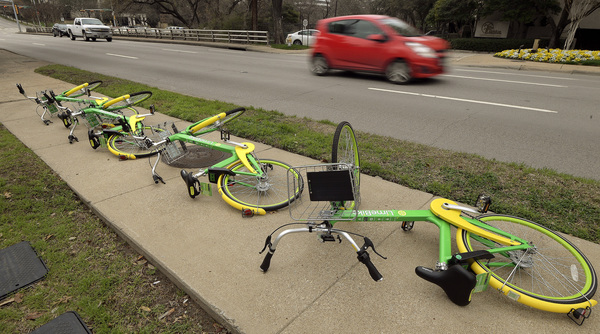
When a cluster of brightly colored dockless bicycles suddenly appeared on the street where Paul Strauss lives in the center of Washington, D.C., he was tempted to go for a ride.
He downloaded the app on his smartphone, the necessary first step to unlocking one of the bikes, then stopped short when he had to enter his credit card information.
Strauss, a 53-year-old lawyer who serves as a shadow senator for the District, says he thought, "Heck, I don't have a helmet." Then other doubts crept in. Who was the company behind this, anyway? How would he shower when he got to work? Though he talked himself out of it, he's since noticed a proliferation of shareable bikes and electric scooters around the city _ sometimes piloted by gleeful users, other times parked like phantoms in the middle of sidewalks or leaning against buildings.
From D.C. and Dallas to Seattle and San Diego, the dockless apocalypse, or "wheelmageddon," has dawned. Just as Wi-Fi untethered Internet users from dialing up for service, new technology allows would-be riders to locate bikes or scooters without searching out a tethered docking station.
And unlike with traditional municipal bike-share services, dockless riders can then just park the bike or scooter at their destination, virtually lock it back up with their smartphone, and get on with their days. When they need to ride again, the app points them to the closest available bike.
Since September, the nation's capital has allowed five companies to deploy their vehicles on city streets, all competing for users with similar services. This pilot program is set to end this month.
But that doesn't mean the end of it. Biking and scooters are "better for traffic, better for the environment, better for the body," said Jonathan M. Rogers, a policy analyst with the District Department of Transportation who rides his own bike to work each day.
Rogers said officials wanted to see if pay-per-minute dockless service would complement the city's existing docked Capital Bikeshare program by bringing in new riders and making shared bicycles available to underserved parts of the city.
So far, Rogers said, that has seemed to be the case. The biggest challenge has been maintaining safe access to sidewalks. Even when riders follow the rules and leave a mandated five-foot clearing around the vehicle, he said, the presence of the vehicle can pose a challenge for anyone _ particularly the sight-impaired or otherwise disabled.
Indeed, frustrated citizens around the country have taken to online neighborhood communities and social media to crusade against such indiscretions.
The tagline of Twitter's @Dockless_Bikeshare_Is_The_Devil sums up the issue: "The problem with dockless bike-share is people park them wherever they want."
As nearly 20,000 dockless bikes appeared on the streets of Dallas late last year, Josh Miller, 40, who works in investment banking, started the @dallasbikemess account on Instagram, both as a joke and to vent steam. Almost instantly, he began to attract followers and to receive snapshots from people angry at the sight of bicycles languishing on the sides of the road and piled up on lawns.
In some ways, we can thank China for the dockless invasion. Dr. Daniel Sperling, founding director of the University of California-Davis Institute of Transportation Studies, said venture capitalists in this country only began to invest in American companies when they saw the success of shareable, dockless bikes there over the last few years. Chinese startups Mobike and Ofo have attracted more than $1 billion in investment and launched millions of bikes in dozens of cities.
"The VC world is seeing for the first time in history that there's an opportunity in the transportation world," said Sperling, the author of the new book, "Three Revolutions: Steering Automated, Shared and Electric Vehicles to a Better Future."
Nor does the VC world seem daunted by troubles with bike-share in places like France, where Hong Kong company Gobee recently pulled out of Paris, citing destruction of its fleet.
Ryan Rzepecki, the founder of an early electric bike share company, Jump, said that in addition to the investment allure, better technology is the other reason dockless is infiltrating the zeitgeist.
When he first started in the business more than a decade ago, he said, cellular modems that allowed the company to keep track of bikes cost over $100. Now, they're less than $20. Today, Uber is said to be considering a $100 million acquisition of Jump, though a company spokesperson wouldn't comment.
Electric scooters, not bicycles, are the domain of Travis VanderZanden, formerly of Uber and Lyft. His start-up, Bird, has raised $15 million in venture capital since dropping its first scooters last fall. "Most people don't want to pedal and sweat," he said.
The investment has allowed him to buy and deploy his motorized scooters in various spots around southern California, and, as of a few weeks ago, in San Francisco, San Jose, and D.C. City officials in Santa Monica have scrambled to cope with the impact of the wildly popular scooters, recently passing an emergency ordinance that allows city workers to impound them if they're blocking the streets.
For his part, Miller, aka @dallasbikemess, is waiting for May, when city officials in his city are scheduled to pass regulations on shared transportation. He said he's happy for any small part he might have played in bringing issues around the bikes to light. After the rules are revealed, he'll likely dial back, or even retire, his Instagram activism. Then, he plans to look for a shared bike in the neighborhood where he works so he can ride to lunch.