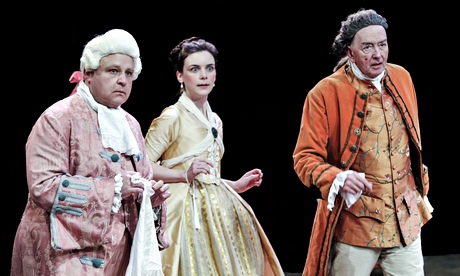
Few artistic directors have so steady a purpose as Andrew Hilton. He has made his central concerns – beady attention to text, hyper-clarity of acting – into a house style at the Tobacco Factory. No clutter, no stars. Now he takes on Sherdian’s The School for Scandal: full of stuff and celebrity-obsessed. It is beautifully recreated, but at a slight distance, rather than, as in the brilliant best of Hilton’s productions, tapping directly into the arteries of the play.
Few works seem simultaneously so up-to-date and so long ago. What could be more 1777 than the folderol: the giant wigs, the pannier skirts, the gasping announcement of a piece of wit? What could be more 2015 than the adoration of celeb glitter, the confident parade of malice, the rapid circulation of tittle-tattle, and the sugary delivery of a particularly disagreeable snippet?
A prologue and epilogue in which a powdered macaroni tweets and does a selfie with the audience gives a 21st-century twist to the backbiting. Both are ingenious but would have been better delivered in seconds not minutes. The body of the play is exquisitely in period: the iron pillars of the Tobacco Factory are half gilded; the costumes are pastel; each speech is delivered with crystalline clarity, though perfectly punctuated with the gasps and oeillades of affected emphasis.
Paul Currier is a tremendously loathsome Snake: he seems to have swallowed up Uriah Heep. Daisy Whalley gets just right the combination of bravado and susceptibility in Lady Teazle. And Fiona Sheehan is a terrific Mrs Candour: hovering with her nasty gobbets like a mother bird feeding worms to her little ones. All of them, though, would be well served by a faster, riskier pace and by half an hour off the running time.
Hilton’s achievement is to find tender places among the prattling and battling. In one marvellous episode the ingenue, who is for the most part merely insipid, sings, alone in a warm circle of light. She is surrounded by darkness but free from the beehive buzz of malice. The moment brilliantly suggests an alternative morality, and the satisfactions of a private life. In that least private but often most intimate of places, a theatre.