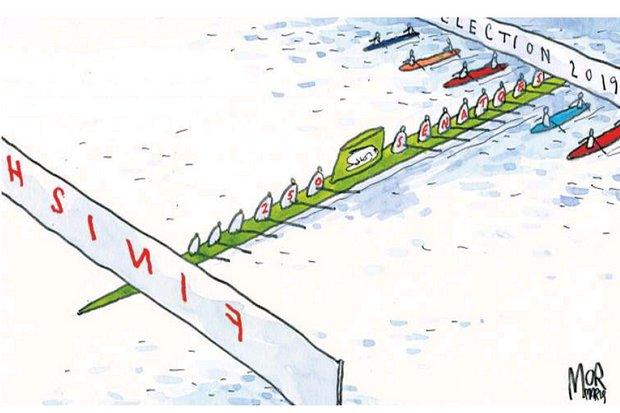
With just another five days to go before Thailand's first general elections in about eight years, the competition among political parties is heating up as each tries to court as many votes as it can from their public.
While there has been a a lot of noise from the political battlefield, the selection process of the 250 regime-picked senators is shrouded in secrecy. The general public remains clueless about the process -- even the identities of the candidates and the names of the senator selection committee members have yet to be revealed.
What we know so far, is that the list of the 400 senator candidates shortlisted by the selection committee chaired by Deputy Prime Minister Prawit Wongsuwon has been completed.
Paritta Wangkiat is a columnist, Bangkok Post.
According to the 2017 charter, the 250 appointed senators will play an important role in voting in the next prime ministers, along with the 500 elected MPs. It is likely the military regime will announce the list of chosen senators within a few days of the March 24 election. With regards to their handpicked senators, there is no question that those appointed will be people the junta can control -- as previously suggested by Gen Prawit.
The deputy prime minister says he confident that the formation of the next government will be "smooth"; after all, the regime will be backed by the 250 senators that the junta itself will handpick. And it is likely that the junta-appointed senators will back Gen Prayut's bid to return as the next premier.
With under-the-table dealings and the absence of transparency, "fairness" is definitely not the name of the Thai political game. Under existing mechanisms, voters have no way of examining the connections between the candidates and their political patrons, as well as the conflicts of interests that may arise after the poll.
The NCPO's decision to enshroud the entire process in secrecy may be driven by the desire to protect their handpicked candidates from public pressure. If their names were to be made public, some may be forced to step down from their current posts. Netizens will also be able to easily check their backgrounds, and their social media accounts may be flooded with the same kind of harassment faced by anti-military politicians.
It really is a privilege for these appointed senators to be able to avoid scrutiny by hiding behind the NCPO. All they have to do is wait on the sidelines until the opportunity comes for them to make a decision that will affect Thailand's future.
By contrast, politicians from the pro-democracy camp are faced with numerous obstacles that range from minor suppression to criminal charges. Online, pro-democracy politicians have been hit by a barrage of attacks by groups which generate fake news and upload inflammatory -- albeit groundless -- posts which portray them in a negative light.
Thanathotn Juangroongruangkit, the leader of the Future Forward Party, for instance, has been accused of being an hardcore anti-monarchist. Some posts have even tried to link him with the fugitive former premier Thaksin Shinawatra -- an accusation that Mr Thanathorn has denied.
This move is nothing the country has never seen before -- in fact, it is the same old trick that conservative groups have used in the past to resist changes to the status quo.
Many Facebook accounts of those "critics" appear to have only been recently made. I cannot find any trace of posts and other online interactions that are usually visible on the Facebook profiles of those who are actually active on Facebook -- which makes me question whether these are accounts that were deliberately set up for political purposes.
Similarly, the Pheu Thai Party has been facing endless criticism online. Some netizens are still sharing video clips of the red-shirt protests in 2010 to "remind" the public that the party was responsible for the chaos. Khunying Sudarat Keyuraphan, Pheu Thai's core leader, has repeatedly tried to convince voters that under her leadership, the party has changed.
But it is becoming more apparent that the political conflict will go beyond fights between the pro- and anti-Thaksin elements, as the forthcoming election is more about the conflict between pro-democracy and pro-military parties.
But those who use the tactic may be disappointed. Some first-time voters who have observed pro-democracy candidates being harassed on social media, have made it clear they will go to the polling stations because they can no longer stand the old-style dirty politics in which politicians trade barbs with each other. This may result in a high turnout rate among first-time voters. If that's the case, I don't think military leaders will be able to remain as calm as they are now.