
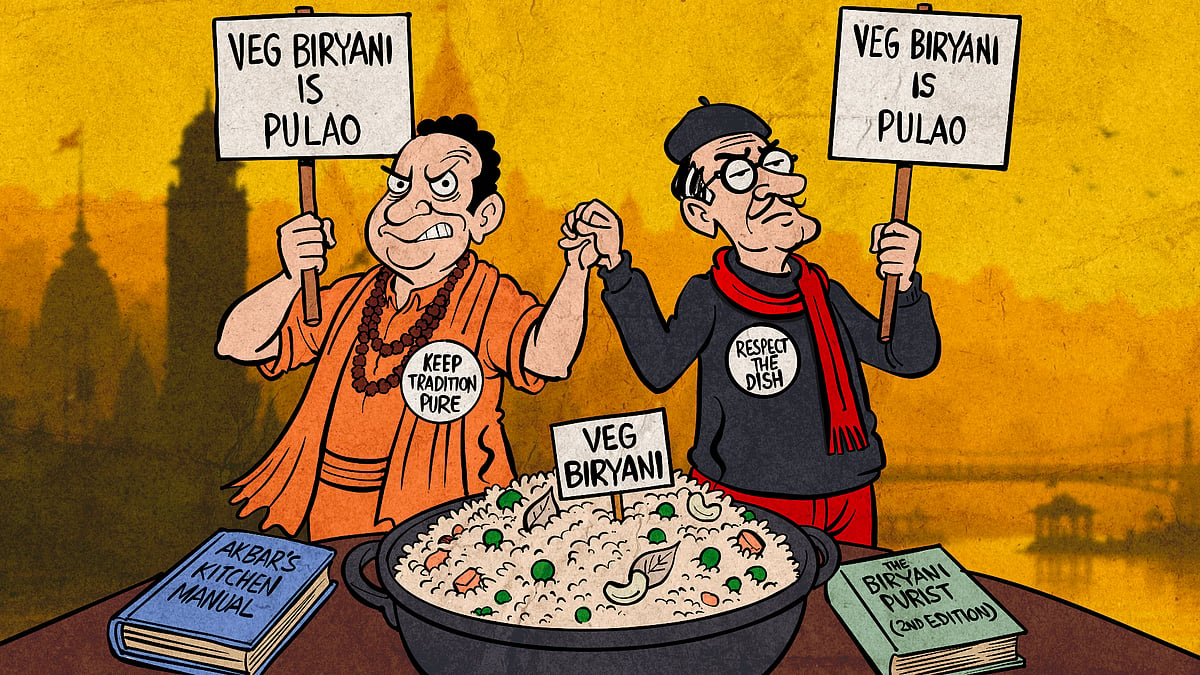
The seers of the Akhand Parshuram Akhada in Haridwar have, in their campaign to rename veg biryani as veg pulao, found themselves in unexpected company: the biryani puritans, who have insisted for years that veg biryani is an oxymoron and what you are eating is pulao. For once, the saffron-robed seer and the insufferable food snob are in complete agreement.
Both sides are united. The word must go.
It is worth savouring how unlikely these bedfellows are. The seer wants the word gone because it drags the taint of meat into a city that has, by long custom, been a vegetarian precinct. The snob wants it gone because, to his ear, calling a vegetable and rice dish biryani is a category error, an insult to the form. One is policing a place. The other is policing a recipe.
Both reach for the same weapon: the name.
Strike the word and you think you have solved something. But what does the word actually hold? Where did it come from, how old is it, and who has it belonged to?
Biryani has never been a fixed thing with a single rule about what may go in the pot. The word itself tells you so. It comes from biryan, to roast, the act of cooking rather than the ingredient cooked.
The earliest written recipes for it are not Indian at all. Here I lean on the work of Neha Vermani, a historian of early modern Mughal South Asia who has spent years inside the culinary manuals of the imperial kitchen, and who shares what she finds generously on X for anyone after a fact rather than a fight. The recipes turn up, she shows, in sixteenth-century cookbooks from the Safavid and late Timurid world, where layered dishes of rice, meat and herbs are written down in detail, and where, tellingly, the dish goes by the name biryan pulao. The two words we are now being told to keep apart began life stuck together.
The first time it surfaces in an Indian manual, she points out, is in Akbar’s reign. Which sent me back to my own copy of the Ain-i-Akbari.
Abu’l Fazl, compiling it around 1590, splits the court’s cooking into three kinds: dishes with no meat, dishes of meat and rice, dishes of meat and spice. Duzdbiryan is listed in the middle kind, and right after it comes Qima Palao. Two different dishes, both built on the same rice and meat. The biryan is the plain one: rice, meat, ghi (ghee), salt, and little else. The palao takes that same base and works it harder, onions and gram, ginger and pepper, cumin, cardamom and cloves. Abu’l Fazl had no opinion on which of the two – the biryan or the palao, was pure. He had an empire to catalogue.
There is a more inconvenient document still, and it sits on the other side of the line the seers are drawing. The Pākadarpaṇa, a Sanskrit treatise on cooking attributed to the legendary king Nala, describes a dish by a name every North Indian thinks they know. Tahari. The safe one. Except in the Pākadarpaṇa the tahari is rice and mudga (moong) and the meat of a hen, cooked together, and the wise men, the text says, call it auspicious. Nobody can tell you for certain how old the treatise is. But there it is, the tahari you think of as the vegetarian cousin, documented with chicken in it.
If the meat can hide inside the vegetarian dish, the vegetable can just as easily sit inside the meat one. The vegetarian version of the biryani is no modern fraud, though I once thought it was. I am a meat-and-fish eater, married to a vegetarian. One of the first things my husband ever cooked for me was a veg biryani. He lives in a mountain village in Uttarakhand, the same state where this signboard quarrel is now playing out, and he had me carry the Shan biryani masala up from Bombay so he could make me a veg biryani. I did not know how to process this. It was the Mughal archive that talked me down, again through Vermani’s work: the manuals record a zir-biryan made with panir, cottage cheese in place of the goat. A meatless biryani was being cooked in an imperial kitchen four hundred years ago, by cooks who weren’t losing sleep over what to call it. If they could make their peace with it, I could too.
Let me be clear about where I stand as I come into this. I love biryani without conditions. Fifteen years of filming travel and food shows will do that to you: a biryani is the one lunch that can feed a hungry unit anywhere in the country, hot and complete and tasty, carried in on a tip from whoever knows the best joint in town. So I have eaten biryani almost everywhere in this country, and I have loved it in forms that would unsettle both the seer and the snob.
A few from this year alone, which I would travel back for.
In Coimbatore, the Kongunadu vellai biryani, the white biryani. The heat is from green chillies, the rice is seeraga samba, short and fragrant, and the depth comes from two spices a northern biryani never meets: kalpasi, the black stone flower, and maratti moggu, the kapok bud, all of it lying in a base of coconut milk. Poetry.
In Bangalore, the biryani at Khazana Food Paradise, a tiny room behind Johnson Market where the meat slides off the bone and the biryani itself comes with a brinjal gravy, and which the regulars just call the best biryani in the city, will tell you that as you sit across a shared table wolfing the biryani down.
And my eternal favourite, the Zamzam in Bombay. Half the people who love it call it the Zamzam biryani and the other half call it the Zamzam pulao, and nobody has ever put down their plate long enough to settle the matter. It is everything at once, offal and mutton and chicken and kofta and a richness of nuts, cooked in vats you scrape the bottom of, hunting for the jewelled bits that have sunk and hidden there.
Three biryanis. Not one of them is the saffron-and-mutton thing the seer and the snob both keep in their heads, and every one of them is, beyond all argument, biryani. That is not a failure of the dish. That is the very character of the dish.
So look at the word they would rather use. Pulao is not the safe, indigenous, satvik cousin of a foreign-sounding biryani. It comes to us from pilaf, palaw, pilav, a word that came down the same roads, in the same caravans. To reach for pulao to escape biryani is to pick up one Persian word to bury another. The road out leads straight back into the country they are running from.
The akhada’s head, Adhir Kaushik, told reporters that biryani is a word that came from Hyderabad. It did not. The word was old and worn smooth long before it reached the Deccan. Hyderabad gave the world one of the great biryani traditions. It did not give the world the word.
The akhada wants the word gone because of where it came from. The puritan wants it gone because of what it has become. They can change the board above the shop. They cannot change what is in the pot. You do not make a thing pure by handing it a new name, you only show everyone how afraid of it you are. So go on. Rename it. Call it pulao, call it whatever lets you sleep. The dish will go on doing the only thing it knows how to do, which is move, and change, and feed whoever is hungry, and travel on like the musafir it has always been, refusing to ever hold still long enough to belong to anyone other than whoever stands hungry before it.
In times of misinformation, you need news you can trust. We’ve got you covered. Subscribe to Newslaundry and power our work.
Newslaundry is a reader-supported, ad-free, independent news outlet based out of New Delhi. Support their journalism, here.