
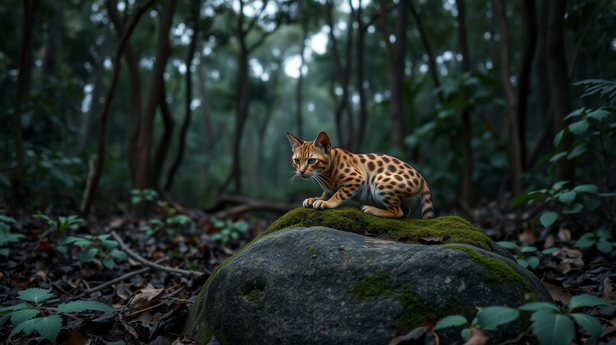
Smaller Than Your Kitten, Deadlier Than You'd Expect
The rusty-spotted cat (Prionailurus rubiginosus) weighs between 0.9 and 1.6 kilograms at full adult size. A domestic cat typically weighs three to five kilograms. This wild feline fits in a human hand and would lose a size comparison to most Indian street kittens. Yet it is a fully functional predator, capable of taking down prey proportionally larger than what lions manage relative to their own body weight. A 2016 field study published in the journal Cat News documented its ambush efficiency in dense scrub habitat, short, explosive sprints followed by precision strikes, a hunting style closer to a leopard's than a domestic cat's.
Where in India It Actually Lives
The rusty-spotted cat is found across a surprisingly wide range of Indian habitat, but its distribution is patchy and poorly mapped. Dense moist forests in Karnataka and Tamil Nadu hold documented populations. So do the dry deciduous stretches of Madhya Pradesh and the thorny scrublands of Rajasthan and Gujarat. Sri Lanka has its own population, genetically distinct from the Indian one. The cat avoids high-altitude terrain and deep primary rainforest, preferring the edge zones where forest meets farmland. That preference for forest margins is partly why it has survived in a country that has lost enormous stretches of contiguous wild habitat, and partly why it keeps ending up in sugarcane fields and village outskirts, confusing the farmers who find it.
Nocturnal, Arboreal, and Exceptionally Hard to See
The rusty-spotted cat is nocturnal and strongly arboreal. It moves through the canopy with the same ease it moves across the ground, which makes camera-trap surveys, the standard method for monitoring elusive wild cats, significantly harder to run. Most camera traps are positioned at ground level. The BBC Natural World team that filmed this species for a documentary in 2018 spent weeks in the field before capturing usable footage. Its coat, a grey-brown base overlaid with rusty-red spots and streaks along the spine, dissolves into dappled leaf litter and bark shadow so completely that trained wildlife researchers have walked within a few metres of a resting individual without seeing it.
Why It Stays Off the Radar
India has the Bengal tiger. It has the snow leopard, the clouded leopard, the Asiatic lion. Conservation funding, research attention, and public imagination cluster around these animals. The rusty-spotted cat is not charismatic in the way that generates documentary commissions or donation drives. It is small, it is shy, and it operates in the dark. The IUCN currently lists it as Near Threatened, a classification that sounds reassuring but reflects data scarcity as much as actual population stability. Researchers at the Wildlife Institute of India have flagged the absence of reliable population estimates as a core problem, there is no agreed number for how many of these cats exist in the wild. The species has no dedicated long-term monitoring programme in India.
What It Actually Eats, and Why That Matters
The diet of the rusty-spotted cat consists primarily of small rodents, frogs, lizards, and insects. In agricultural zones, that diet puts it in direct competition with rats that damage stored grain, which means the cat functions as a natural pest controller in the same village edges where farmers occasionally mistake it for a diseased kitten and remove it from the area. Its ecological role is real and local. The loss of even a small predator from a contained habitat tends to produce rodent population spikes that ripple outward. A cat this size, operating across forest margins and farmland borders, is doing quiet work that benefits the farms around it.
The rusty-spotted cat's obscurity and its ecological usefulness turn out to be the same fact looked at from two directions. It survives by being invisible, and it helps the habitats around it precisely because it is small enough to operate where larger predators cannot. The forests that hold it are not wilderness, they are the complicated, degraded, half-farmed edges that conservation policy rarely prioritises. That is exactly where this feline has always lived.