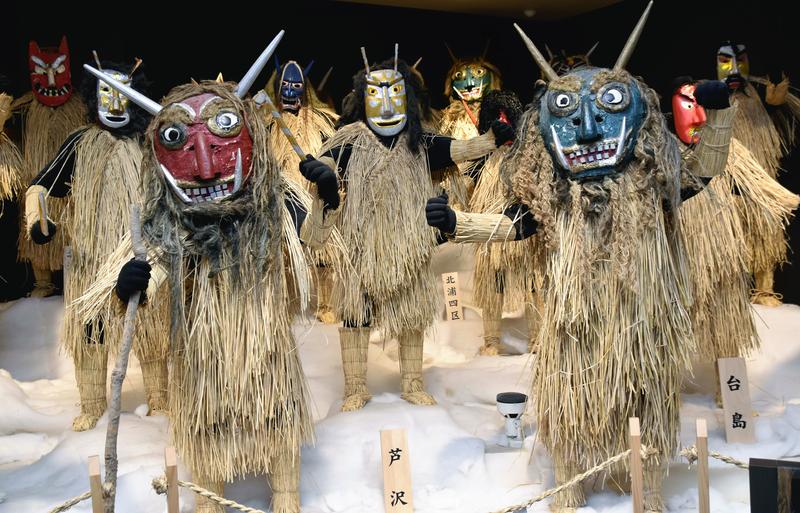
On New Year's Eve, men dressed in masks and disguised as the incarnations of gods go around local houses shouting "Any bad kids?" Namahage is a tradition that has been passed down since ancient times, mainly in Oga Peninsula in Akita Prefecture.
Artist Taro Okamoto (1911–1996) is one of those who were deeply attracted to Namahage. He tried to find the "root of our lost culture" in Namahage. On Feb. 12, 1957, Okamoto visited Akita Prefecture for reporting for the first of article series, "Geijutsu (art) Fudoki (local history report)" in magazine "Geijutsu Shincho."
Namahage masks have various expressions in each village. Okamoto chose the Ashizawa area, a fishing town that faces the Sea of Japan. In response to a call to gather for Okamoto's visit, four young fishermen were assembled at an old family house in the district.
"Okamoto was shooting us with a camera hanging around his neck. I didn't even know his name, so I thought he was a photographer." Yoshishiro Sasabuchi, 88, who performed Namahage in front of Okamoto, recalls. When he was a young man, he did not like to make eye contact.
In 1956, the masks from Ashizawa took second place at the Namahage Competition, which involved young people competing from each district. For the contest, young people from the Ashizawa area gathered together every night and made the masks by hand. Paper was pasted on a big bamboo basket and wooden horns and a nose were attached. They broke ceramic bowls to make powerful eyes, and used loosened hemp ropes for the hair and beard.
Since it was not the real Namahage event, the young people got dressed on the spot and turned into Namahage. Okamoto witnessed this and found it intriguing.
He once said, "The vivid contrast between the strength shown in the faces of the young fishermen wearing the masks and their straw costumes was wonderful." "They are human and beyond human beings at the same time."
In recent Namahage events held in the Ashizawa district, masks usually for tourists were used. However, a youth group revived the use of traditional masks made from bamboo baskets five years ago, unable to forget the Namahage masks they saw when they were children.
Because the masks are handmade, they look a little different from what Okamoto saw, but they carry the same impact and same somewhat lovely expressions.
"I trust the absolute, innocent, primordial emotion of a primitive religion," Okamoto wrote in an article in the Geijutsu Fudoki series. "There you will find the inherent vitality of human beings -- and the most tense confrontation and fusion between man and nature."
Hiroshi Ohsugi, curator of Taro Okamoto Museum of Art, Kawasaki, said: "'What's at the root of human nature' was Okamoto's biggest theme. After seeing Namahage with its uncertain origin, he may have been convinced that he could imagine it." The Namahage that lives in the hearts of the Oga people may be deeply connected to Okamoto's works.
After spending his youth in Paris, Okamoto returned to Japan in 1940 and began paying attention to Japan's culture and natural features. He visited Akita, Iwate, Kyoto, Osaka, Izumo, Shikoku and Nagasaki and recorded scenery with essays and photographs in "Geijutsu Fudoki."
In his last article of the series, "Nihon bunka no fudo (Climate of Japanese culture)," he wrote, "Wherever a person lives and breathes vitally, there can be first-class arts."
The series Geijutsu Fudoki was compiled to be a book, "Nihon Saihakken (Rediscovering Japan) Geijutsu Fudoki," published in 1958. Its cover was a photograph of Namahage from the Oga/Ashizawa districts. More than half a century later, in 2018, the Namahage of the Oga Peninsula was registered as an Intangible Cultural Heritage by UNESCO.
Namahage Museum in Oga displays 152 masks from 60 areas, including Ashizawa. Although the masks Okamoto saw do not exist today, Satoshi Tamaki of the Ashizawa Area Promotion Association, 60, said: "Handmade masks get broken after being used at every event. The masks on display are almost the same [as those used in events] in terms of how they are made and the materials. I guess they were made by referring to masks used in the past."
Namahage appears in various districts in and around the Oga Peninsula on New Year's Eve -- and can also be seen at the "Namahage Sedo Festival" held in Oga City in February for three days from Friday to Sunday, which includes the second Saturday of the month.
Read more from The Japan News at https://japannews.yomiuri.co.jp/