Is theatre good for you? Does art possess a moral power? These questions dominate Philip Massinger's extraordinary 1626 play. And it is those enquiries, rather than Massinger's visible fascination with corrupt rulers, that give the play a ferocious topicality at a time when art is often seen as a form of social engineering.
Sean Holmes's terrific production also poses another fascinating question: who actually is the Roman actor? Is it Paris, the Laurence Olivier of Domitian's dissolute Rome, who prates nobly of theatre's moral force and its capacity to demonstrate "active virtue"? Or is it Domitian? In a sense, he performs the role of cruel emperor. And, when his wife becomes erotically hooked on Paris, Domitian turns actor and stabs his rival in mid-performance, telling the dying Paris: "Twas my plot that thou shouldst die in action."
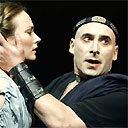
Antony Sher's Domitian significantly seizes on that last word as if the whole drama were a reverberant play on the multiple meanings of "acting" and "action". But Sher, in one of his finest performances, also highlights the theatricality of power. This is clearly a man who relishes playing God. He is first seen atop a vast column with hands divinely upraised, orders instant death with arbitrarily pointing finger, and is clearly shocked to find himself at one point engaged in argument "as if I were a man". Actors may believe that theatre is a force for good - but Sher's wickedly brilliant performance reminds you of the way tyrants, not least Hitler and Mussolini, have appropriated its trappings and relished impersonation.
In contrast, Joe Dixon's Paris puts the case for theatre's uplifting power with idealistic naturalness, while Anna Madeley lends Caesar's wife the naive seductiveness of a stage-door groupie, and Adrian Lee's music evokes the barbaric dissonance of Domitian's Rome in a production that questions theatre's moral power while being damnably entertaining.
· In rep until January 25. Box office: 0870 890 1105.