Welcome to the Friday, July 17, 2026, Brew.
By: Lara Bonatesta
Here’s what’s in store for you as you start your day:
- The role of recall elections in our political system
- Signatures submitted for Colorado initiatives on natural gas for cooking and heating and constitutional right to hunt and fish
- Three statewide candidate filing deadlines in the next two weeks
The role of recall elections in our political system

Today, we're sharing the sixth installment in our project marking America's 250th anniversary: The Blueprints of Democracy.
Recall elections, one of the many types of elections that Ballotpedia covers, have a long history in the United States. These elections are unique in that, rather than voters electing a candidate to office, they decide whether to remove an incumbent from office before their term expires.
As recall elections scholar Joshua Spivak wrote, the Articles of Confederation contained a recall provision, though it was never used. Recalls were debated in the Philadelphia Convention of 1787, and were a part of the Virginia Plan:
It was proposed by Virginia Gov. Edmund Randolph in his presentation of the Virginia Plan on May 29. The plan would have allowed the recall of the members of the first house of the legislature, who were slated to be directly elected by the people. A few weeks later, the convention struck out the recall and to our knowledge, did not discuss it again.
Some state ratifying conventions debated recalls, but the issue of recalling elected officials was largely dormant in American politics until the Progressive Era, when, in December 1902, voters in Los Angeles, California, approved a new city charter that included a recall provision:
Los Angeles voters eventually approved the new City Charter, backing the recall by a ratio of 4 to 1, and after the Legislature ratified it on Jan. 22, 1903, Los Angeles became the first city in the United States to adopt the recall.
Recall elections today
Thirty-nine states permit recalls of at least some local-level officials, and nineteen of those states also allow recalls of state-level officials.
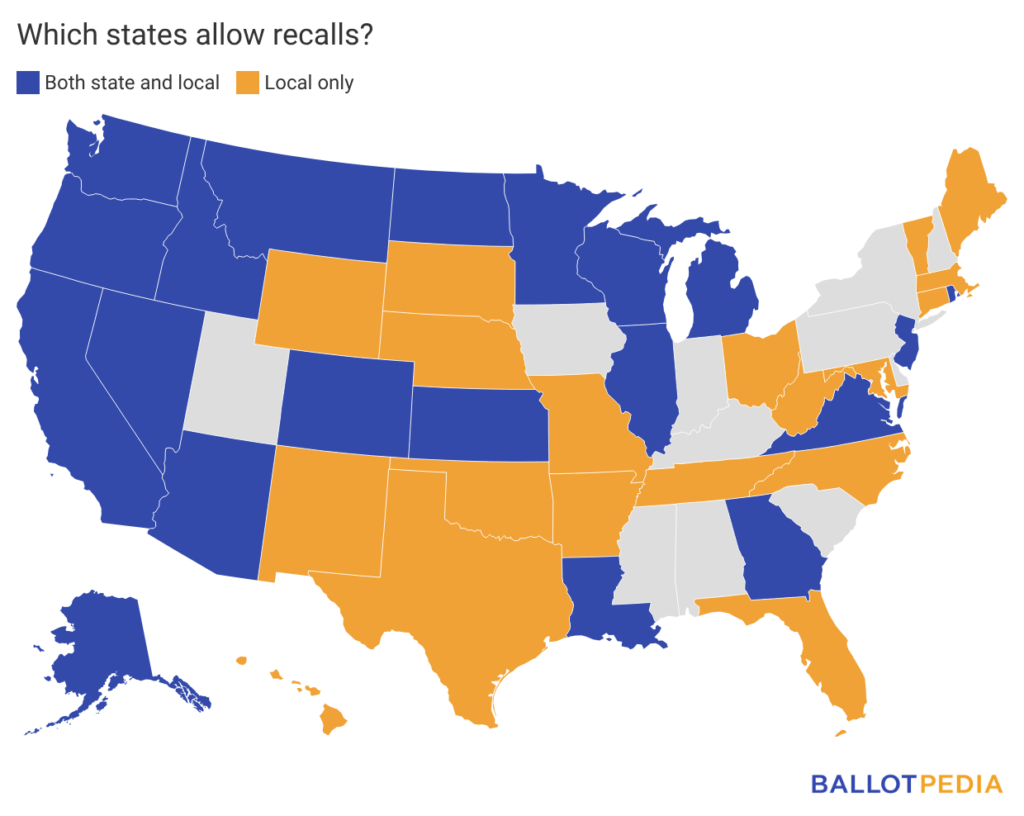
Recalls typically have three phases: Organizers circulate petitions, election officials verify the signatures, and if sufficient valid signatures are gathered, a public vote (or in Virginia, a court hearing) determines whether the targeted official should be removed from office.
Some states have additional requirements, such as requiring organizers to establish specific grounds to recall an official before such an effort can proceed. If voters approve the recall, the official is removed once the results are certified.
How vacancies are filled varies by state. Some appoint a replacement, others hold a concurrent special election, and still others place the replacement election as a separate question on the recall ballot.
Patterns and trends in recall activity
Recalls occur regularly across the country, though the issues driving those recall efforts tend to be focused on local matters rather than national policies. A significant shift emerged with the COVID-19 pandemic, with substantially increased recall activity from 2021 through 2023. The pandemic-related trend saw a notable spike in recalls compared to previous years, reflecting public frustration with government responses, mask requirements, school closures, vaccine regulations, and more.
Beyond pandemic-related recalls, other specific trends have emerged. A smaller but notable trend involved school board recalls related to book policies, as communities became increasingly polarized over school library materials and curriculum decisions. More recently, a new trend has appeared around data center policy, with 25 related recalls documented as of June 2026, suggesting growing community concern about the siting and expansion of data infrastructure.
Notable recalls throughout American history
Successful recall elections offer fascinating windows into the prevailing political environments of their time and location.
1904 – Los Angeles City Council member James Davenport was successfully recalled, but the California Supreme Court invalidated the result in 1905. Davenport's term had already expired, and the court ordered him to receive back pay.
1910-1911 – The recall of Seattle Mayor Hiram Gill took on historical significance because women in Washington gained voting rights between Gill's election and his recall election. Roughly 20,000 of 23,000 registered women voters participated in the successful recall.
High-profile recalls in recent years demonstrate how these efforts continue to be used against officials at all levels of state and local government.
2011-2012 – The effort to recall then-Wisconsin Gov. Scott Walker (R) over his efforts to limit the collective bargaining rights of public employee unions was unsuccessful, occurring just one year after Walker's election.
2019-2021 – Voters rejected an effort aimed at recalling California Gov. Gavin Newsom (D) over allegations that he mishandled the state's response to the coronavirus pandemic, did not do enough to address the state's homelessness rate, and supported sanctuary city policies and water rationing.
2020-2022 – The COVID-19 pandemic sparked multiple simultaneous recall efforts. Three Michigan officeholders – Gov. Gretchen Whitmer (D), Attorney General Dana Nessel (D), and Secretary of State Jocelyn Benson (D) faced a combined 34 recall efforts, all related to pandemic policies. None of them reached the ballot.
More recent recalls demonstrate a partisan edge.
2025 – The Minnesota Supreme Court struck down recalls of 29 Democratic state legislators over their plans to boycott the opening of the state’s legislative session.
2026 – Recall efforts are currently underway against Louisiana Governor Jeff Landry (R) and Attorney General Liz Murrill (R) following the state's decision to redraw its congressional districts after the U.S. Supreme Court’s Louisiana v. Callais decision.
Click here to see our past installments of our Blueprints of Democracy series.
Signatures submitted for Colorado initiatives on natural gas for cooking and heating and constitutional right to hunt and fish
In Colorado, a state with a Democratic trifecta, voters could decide on two citizen initiatives on Nov. 3 that would add a right to purchase and sell natural gas to homes and businesses, and a right to hunt and fish, to the Colorado Constitution.
Advance Colorado – which describes its mission as "[pushing] back on the progressive policies that have put our state on the wrong track" – submitted signatures to the secretary of state’s office on June 24 to put the natural gas amendment on the ballot. The International Order of T. Roosevelt – which describes its mission as “[protecting] our hunting heritage and at-risk wildlife habitats before they are gone” – submitted signatures for the hunting and fishing amendment on July 8.
The secretary of state’s office has until Aug. 21 for the natural gas amendment and Sept. 2 for the hunting and fishing amendment to determine if the petitions contain at least 124,238 valid signatures, equal to 5% of the total number of votes cast for Colorado's secretary of state in the last general election. Colorado has a distribution requirement. For initiated constitutional amendments, campaigns must gather signatures from at least 2% of the registered voters who live in each of the state’s 35 Senate districts.
Here’s a closer look at both of the measures.
Right to Purchase and Sell Natural Gas for Cooking or Heating in Homes and Businesses Amendment
Initiative 177 would add a right to purchase and sell natural gas to homes and businesses to the Colorado Constitution. It would also establish the right for distributors and utilities to sell natural gas.
Michael Fields, the president of Advance Colorado, said, "Natural gas is a clean, reliable and affordable form of energy that more than 70% of Colorado homes use today. That right should be protected."
State House Speaker Julie McCluskie (D), who opposed the initiative, said, "[Initiative 177 is] overly broad, lacks clarity and could upend years of work to craft durable policy that advances our goals of better air quality, more affordable transit and cleaner energy."
The last time voters decided on a statewide ballot measure related to natural gas policy was in 2024. On Nov. 5, 2024, Washington voters approved Initiative 2066 51.7% to 48.3%, which prohibited state and local governments from restricting access to natural gas; prohibited the state building code council from prohibiting, discouraging, or penalizing the use of natural gas; and required gas and utility companies to provide natural gas to any person or corporation, even if other energy services may be available.
Advance Colorado filed and gathered signatures for two additional measures that were certified for the Nov. 3 ballot. Initiative 85 would increase penalties for certain drug crimes related to fentanyl. Initiative 95 would require state and local law enforcement to notify the U.S. Department of Homeland Security within 72 hours after charging an individual when they are not lawfully present in the U.S. or their immigration status cannot be determined after a reasonable effort by officers, and they are charged with a violent crime or have a previous felony conviction.
Right to Hunt and Fish Initiative
Initiative 302 would establish the right of the people to hunt, fish, and otherwise take fish and wildlife, including by traditional methods. It would also specify that the policy of the state of Colorado is that “hunting and fishing are the preferred means of responsibly managing fish and wildlife populations.”
Initiative 302 would be the first citizen initiative concerning a right to hunt and fish. State legislatures have referred all past measures on the topic to the ballot.
Initiative 302 would exclude endangered species, nongame species, and species that are illegal to hunt under federal law from the right to hunt and fish. It states that the constitutional right to hunt and fish would not authorize trespassing on private property, or limit the state’s ability to regulate hunting and fishing.
Luke Hilgemann, the executive director of the International Order of T. Roosevelt, said of the initiative, “Hunting and fishing is part of Colorado’s heritage. It’s something that the state traces its roots back to, and we want to make sure that those are forever protected against an onslaught of threats that have come from the anti-hunting and fishing groups, not only in Colorado, but nationwide.”
Hilgemann referred to an initiative filed in Oregon that would criminalize hunting, fishing, and intentional injury to animals. He said Initiative 302 is a “proactive measure that allows us to be offensive and prevent these types of radical policies from ever taking hold of an amazing place like Colorado.”
Protect Colorado’s Constitution is opposing Initiative 302. David Kane, a member of the organization, said the amendment’s language is too vague and that adding a right to hunt and fish to the state’s constitution is unnecessary: “You could probably ask 10 different people what ‘traditional methods’ are, and you’d get 10 different answers. That’s something that could be left to the interpretation of the courts if it was challenged.”
Kane also said, “This is really not something that falls within democratic principles around constitutions. This would just overload and bloat the Constitution even more. It weakens public trust; it could create potential budgetary chaos, and it kind of creates inequality.”
Twenty-four states have constitutional amendments proclaiming a right to hunt and fish. Between the country's founding in 1776 and the mid-1990s, Vermont was the only state with a right to hunt and fish in its state constitution. Vermont’s constitution has contained these rights since 1777, when the state adopted its first constitution.
Voters in the other 23 states approved ballot measures establishing these rights. In addition to these 24 states, the state constitutions of California and Rhode Island include amendments guaranteeing the right to fish, but not to hunt.
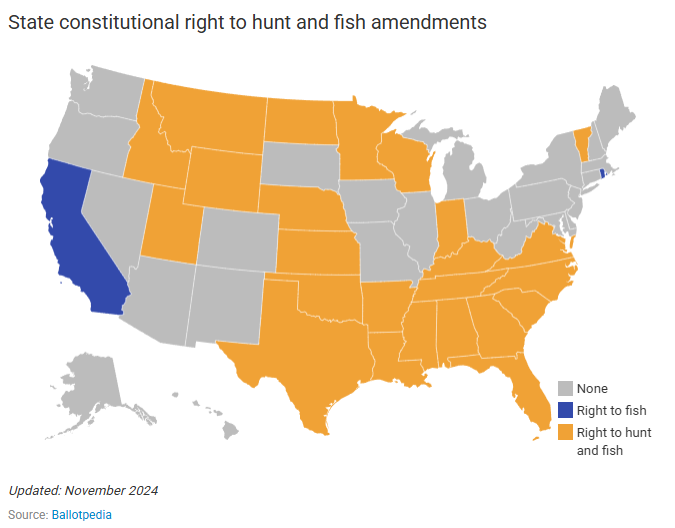
Alabama was the first state to adopt a constitutional right to hunt and fish via ballot measure, when voters approved the state’s Sportsperson's Bill of Rights 81.4% to 18.6% in 1996. Florida was the most recent state to do so when voters approved Amendment 2 67.3% to 32.7% in 2024.
Between 1996 and 2025, 25 measures on the right to hunt and fish appeared on the ballot in 24 states. One measure, in Alabama in 2014, did not implement a right to hunt and fish, but instead amended the state’s constitution to state that the existing right was subject to reasonable regulations to conserve and manage wildlife.
Of the 25 ballot measures, only one was defeated. In 2010, Arizona voters rejected Proposition 109 56.5% to 43.5%.
In Colorado, citizen-initiated constitutional amendments require a 55% vote. Click here to learn more about Colorado’s 2026 ballot measures.
Three statewide candidate filing deadlines in the next two weeks
We're more than halfway through the 2026 primary season, but there are still 20 states to go! Three of those states have candidate filing deadlines in the next two weeks.
The map and bulleted list below show which states have candidate filing deadlines scheduled between July 18 and July 31:
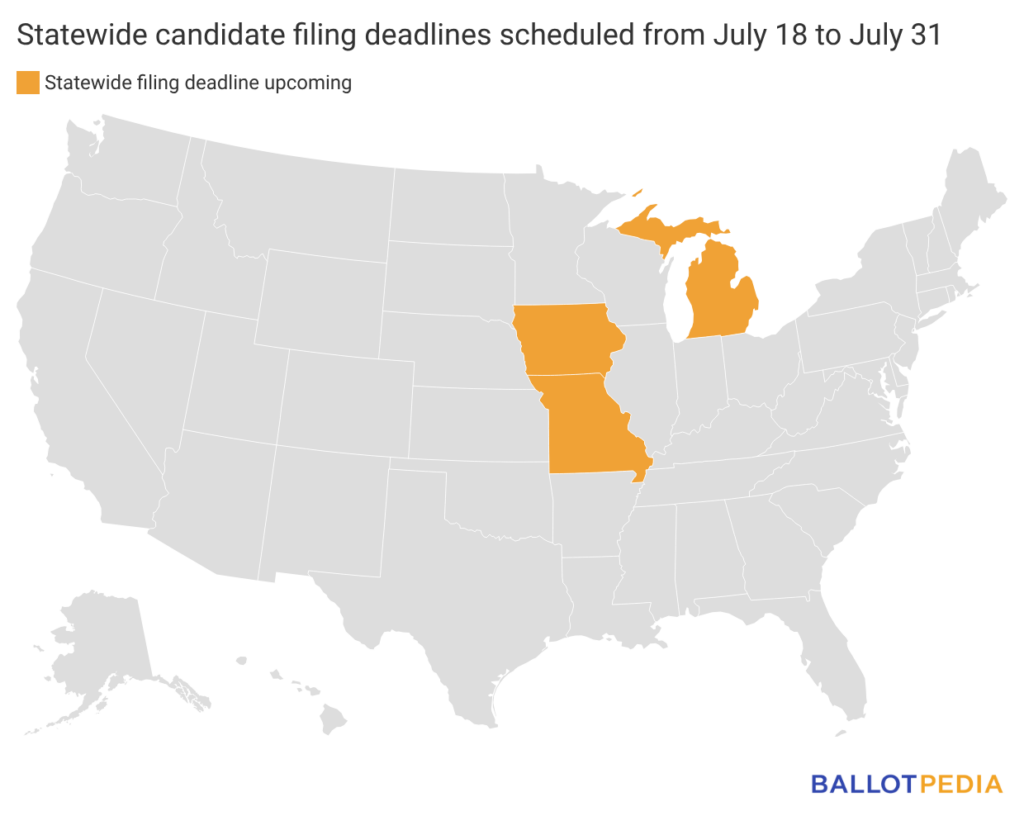
- Iowa : July 22 (statewide judicial retention candidate filing deadline)
- Michigan : July 24 (statewide write-in primary candidate filing deadline)
- Missouri : July 27 (statewide unaffiliated candidate filing deadline)
Looking Back
Seven states had candidate filing deadlines in the past two weeks:
- Colorado : July 9 (statewide general unaffiliated candidate filing deadline)
- Colorado : July 16 (statewide general write-in candidate filing deadline)
- Delaware : July 14 (statewide primary candidate filing deadline)
- Georgia : July 14 (statewide unaffiliated and minor party candidate filing deadline)
- Indiana : July 6 (statewide write-in candidate filing deadline)
- Indiana : July 15 (statewide judicial retention candidate, unaffiliated, and minor party candidate filing deadline)
- Michigan : July 6 (statewide Supreme Court justice incumbent candidate filing deadline)
- Michigan : July 16 (statewide unaffiliated candidate filing deadline and non-incumbent or non-party affiliated supreme court justice candidate filing deadline)
- South Carolina : July 15 (statewide unaffiliated candidate filing deadline)
- Utah : July 15 (statewide judicial retention candidate filing deadline)
Candidates must meet various state-specific filing requirements and deadlines to appear on primary and general election ballots. These regulations, known as ballot access laws, determine whether and how candidates can make it onto the ballot. These laws are set at the state level and apply to candidates running for state and federal offices.
Voting in upcoming elections
There are two statewide elections taking place in the next two weeks:
- Arizona : July 21 statewide primary election
- South Dakota : July 28 statewide primary runoff
Voter participation deadlines
Five states and the Virgin Islands have early voting periods that start in the next two weeks:
- Hawaii : Early voting begins July 27 for the Aug. 8 primary.
- Michigan : Early voting begins July 25 for the Aug. 4 primary.
- Missouri : Early voting begins July 21 for the Aug. 4 primary.
- Virgin Islands : Early voting begins July 20 for the Aug. 1 primary.
- Wisconsin : Early voting begins July 28 for the Aug. 11 primary.
- Wyoming : Early voting begins July 21 for the Aug. 18 primary.
10 states have voter registration deadlines in the next two weeks:
- Alaska : July 19 is the last day to register to vote in the Aug. 18 primary.
- Connecticut : July 24 is the last day to register online or by mail to vote in the Aug. 11 primary.
- Florida : July 20 is the last day to register to vote in the Aug. 18 primary.
- Hawaii : July 29 is the last day to register by mail to vote in the Aug. 8 primary.
- Michigan : July 20 is the last day to register online or by mail to vote in the Aug. 4 primary.
- Minnesota : July 21 is the last day to register online or by mail to vote in the Aug. 11 primary.
- Oklahoma : July 31 is the last day to register to vote in the Aug. 25 primary.
- Virginia : July 24 is the last day to register online or by mail to vote in the Aug. 4 primary.
- Washington : July 27 is the last day to register online or by mail to vote in the Aug. 4 primary.
- Wisconsin : July 22 is the last day to register online or by mail to vote in the Aug. 11 primary.
Six states, Guam, and the Virgin Islands have absentee/mail-in ballot request deadlines in the next two weeks:
- Guam : July 29 is the last day to request a ballot for the Aug. 1 primary.
- Kansas : July 28 is the last day to request a ballot for the Aug. 4 primary.
- Michigan : July 31 is the last day to request a ballot online or by mail for the Aug. 4 primary.
- Missouri : July 22 is the last day to request a ballot online or by mail for the Aug. 4 primary.
- South Dakota : July 27 is the last day to request a ballot for the July 28 primary.
- Tennessee : July 27 is the last day to request a ballot online for the Aug. 6 primary.
- Virgin Islands : July 18 is the last day to request a ballot for the Aug. 1 primary.
- Virginia : July 24 is the last day to request a ballot for the Aug. 4 primary.
Click here to see our list of upcoming election dates and filing deadlines.