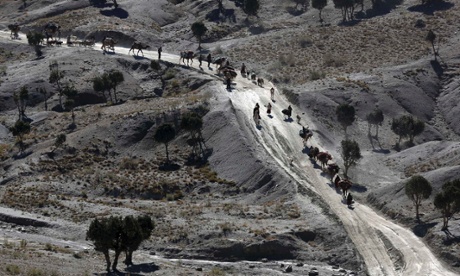
Surrounded by the famous Baba and Hindu Kush mountains, Bamyan Province is located in central Afghanistan and is home to over 400,000 people, 80% of whom reside in rural districts. Waras is the most remote and mountainous part of the province and it takes a gruelling nine hours to reach the provincial capital by road.
Like many remote parts of Afghanistan, poor quality roads are a serious problem. A survey by the government of Afghanistan showed that only 6.5km of the 240km road network in Waras was gravelled and usable. Heavy winter snow and spring rainfall persist for months, and the road to the provincial capital can become very difficult or completely impassable, dramatically increasing journey times and costs.
This situation deprives residents of reliable access to healthcare, markets and other vital services; each year people die as a result, particularly children. But this is not just a humanitarian issue. Weak road infrastructure and the inability to meet public demand have reduced public confidence in local government, but because planning and budgeting in Afghanistan is highly centralised, local governments rarely have the ability to solve these kinds of issues for themselves.
For this reason, the UK’s Department for International Development (DFID) is supporting provincial administrations to deliver vital public services thorough the Supporting Provincial Administration and Delivery (SPAD) Programme, which is implemented directly by the government of Afghanistan with advice from Adam Smith International. To strengthen the local government, Adam Smith International trained officials in financial management and participatory planning for delivering public services. Crucial funds for district-level expenditure were also disbursed.
SPAD serves a dual function. As a pilot for deconcentrated planning and budgeting it has given provincial administrations and line ministries in three provinces experience in conducting meaningful planning, prioritisation and budgeting, but it has also had a tangible impact on service delivery through the funds provided for district-level expenditure.
Using SPAD funding, and following a participatory planning process, the local government in Bamyam was able to repair 51km of the Shetal Road in Waras District. In the short-term, employment was created for hundreds of local people. But more importantly, transport and food costs have reduced and confidence in the local administration has been restored.
“Previously, we had to pay 800 Afghani to travel from our village to the district centre. This price has now decreased to 250 Afghani,” said a village elder.
The road repairs have also helped connect Waras to neighbouring districts and provinces, improving access for farmers to markets and stimulating the local economy. “Thanks to the road repairs, we can now take patients to hospital on time; they won’t die on the way to the hospital as used to be the case,” adds another Waras resident.
Content produced and managed by Adam Smith International