The wait is over. Mexico now knows its complete group-stage schedule for the 2026 FIFA World Cup. El Tri will initiate its campaign in the tournament's opening match on June 11 at Estadio Azteca against South Africa, before taking on South Korea and Czech Republic in a crucial Group A battle for a place in the knockout rounds.
From dates and opponents to host cities and stadiums, here is the full schedule for Mexico's first three matches on home soil at the biggest World Cup ever staged.
Match Schedule, Dates and Game-Hosting Cities, Venues
The following match schedule, key dates and location info. are listed at FIFA's official website for the World Cup:
- Mexico vs South Africa — June 11 (Thursday) at the Estadio Azteca , Mex. City
- 3 p.m. / 5 p.m. (Mexico Local Time / Eastern Standard Time)
- Mexico vs South Korea — June 18 (Thursday) at Estadio Akron , Guadalajara
- 9 p.m. / 11 p.m. (Mexico Local Time / Eastern Standard Time)
- Mexico vs Czech Republic — June 24 (Wednesday) at Estadio Azteca , Mex. City
- 9. p.m. / 11 p.m. (Mexico Local Time / Eastern Standard Time)
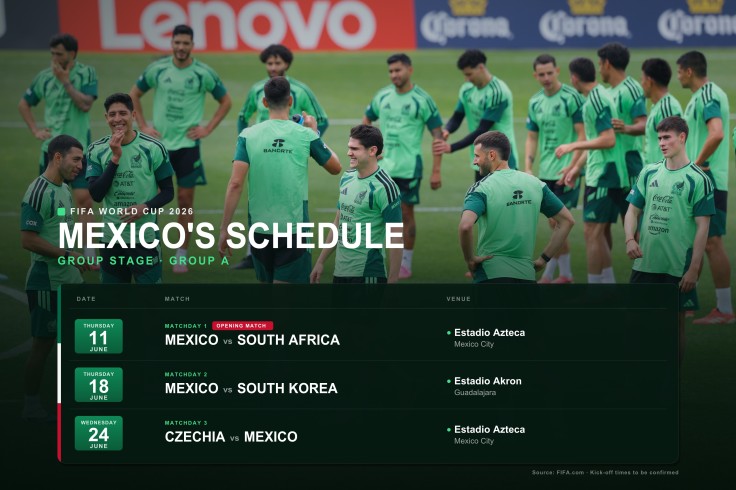
As of early June, most official outlets still advise fans to check the FIFA schedule periodically because kick-off times and some venue assignments can be adjusted as the tournament approaches.
Guides aimed at traveling fans list the Estadio Azteca in Mexico City — renamed for the tournament — and the Estadio Akron in Guadalajara among the hosts for Mexico's group fixtures. The Azteca will become the first stadium in history to host matches at three different World Cups (1970, 1986 and 2026).
Tickets, prices and availability:
Ticket costs for Mexico's World Cup matches vary enormously, the result of FIFA's decision to use dynamic pricing — a surge-pricing model — for the first time at a World Cup. Official group-stage tickets started as low as $60 for a Category 4 seat, while the most expensive tickets, for the final, reach $6,730. But those are floor and ceiling figures across the whole tournament, and the real cost for a given match depends heavily on the fixture. As of April 2026, FIFA's official direct-sale platform listed tickets ranging from roughly $60 to nearly $11,000, depending on the match's popularity, seat category, and timing of purchase.
For host-nation games like Mexico's, demand pushes prices well above the entry level — particularly on the resale market. Across standard group-stage matches, resale prices on secondary platforms have averaged between $650 and $1,100, with even lower-demand neutral fixtures starting around $200 to $250. Marquee matches climb higher still: in Los Angeles, the average cheapest group-stage ticket 60 days before the tournament was about $1,040 on FIFA's official resale market. Fans targeting Mexico's opener at Estadio Azteca should expect premiums at the steeper end of that range.
On availability, the early sales windows have closed and the clock has all but run out on the opener. With Mexico's June 11 curtain-raiser against South Africa now a day away, tickets for that match are effectively gone from primary sale, leaving FIFA's official resale marketplace as the only realistic route in — typically at a steep premium. The major official lotteries — including the Visa Presale and early Random Selection Draws — have concluded, and primary availability is now extremely limited.
A last-minute, first-come, first-served sales phase is currently live as the final window to buy directly from FIFA, and the official FIFA Resale Marketplace is the only authorized platform for verified resale. Inventory moves in real time rather than carrying a fixed "sold out" label, so availability for Mexico's remaining group matches — June 18 against South Korea in Guadalajara and June 24 against Czechia in Mexico City — can shift day to day.
Fans buying secondhand should stick to FIFA's official resale marketplace and avoid unauthorized resellers, which carry no guarantee of valid entry.
Head-to-head history and rivalries
Against South Africa, Mexico arrive as heavy favorites and with the weight of opening the World Cup at home. The two sides have met only on rare occasions at senior level, with no established rivalry; even so, the symbolism of an opening match — Bafana Bafana hosted the 2010 World Cup — all but guarantees a charged atmosphere.
Against South Korea, Mexico carry a longer but intermittent history, including a memorable group-stage clash at the 2018 World Cup in Russia, which the Asian side won. The records show a mix of wins, losses and draws, without the political or regional edge of a clásico, so the fixture is usually framed as a tactical rather than emotional rivalry.
The match-up with Czechia is almost entirely new for this generation; coverage tends to focus on the challenge of testing Europe's disciplined school against El Tri's pace and pressing, with Mexico aiming to finish the group stage as leaders and in front of their own fans.

Star players, strengths and weaknesses
Mexico's squad, led by Javier Aguirre in his third spell in charge of the national team, combines European experience with emerging talent. Previews ahead of 2026 highlight attacking creativity, midfield depth and the home-field factor as key strengths, with the added advantage of Mexico City's altitude.
Raúl Jiménez (Fulham) captains the attack and arrives at his home World Cup after a strong Premier League season. Santiago Giménez (AC Milan) brings the goal-scoring instinct that was missing in Qatar 2022, while Edson Álvarez (Fenerbahçe) anchors the midfield as the pivot, breaking up attacks and protecting the defense. His fitness level across a long tournament is Mexico's most important variable.
Tactical previews often point to defensive transitions and dependence on a small leadership core as potential weaknesses: when Mexico lose the ball high up the pitch, quick counters can expose space behind the full-backs, and any injury to a key midfielder could unbalance the team.
How to watch Mexico's matches (online and on TV)
In the United States
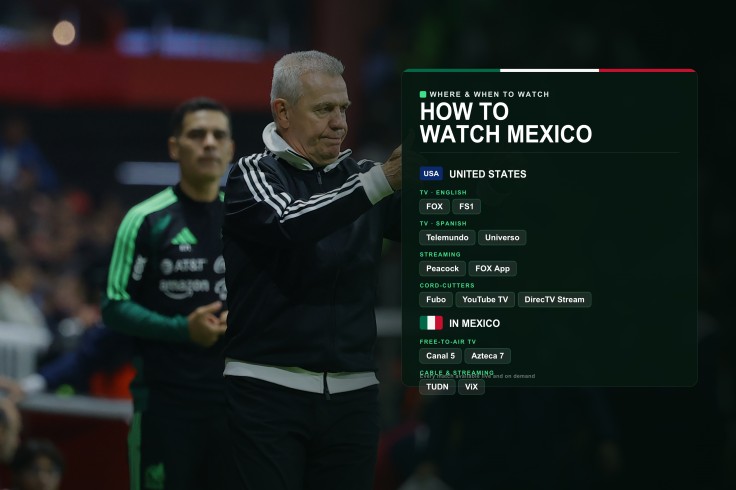
In the U.S., all 104 matches of the 2026 World Cup will air across FOX and FS1 in English and Telemundo and Universo in Spanish, with every game also available via digital platforms. FOX has confirmed that every match will stream live and on-demand within its apps, while Spanish-language coverage will stream on Peacock, Telemundo's digital platform.
Cord-cutting guides recommend services like Fubo, YouTube TV and DirecTV Stream, which carry FOX, FS1, Telemundo and Universo and often promote free trials around major events, allowing fans to stream Mexico's group games without a long-term contract.
In Mexico
In Mexico, broadcast rights traditionally belong to the country's main free-to-air networks: Televisa (Canal 5 / TUDN), TV Azteca (Azteca 7) and ViX. For fans, this typically means a combination of free-to-air channels and authenticated streaming through those broadcasters' apps.