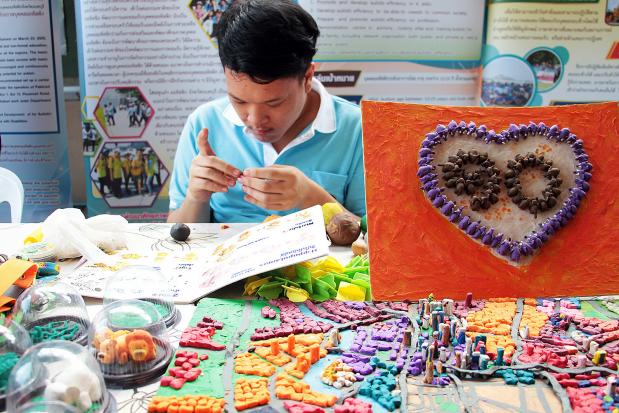
There are more than 300,000 autistic people in Thailand, while only about 200 of them have "proper" jobs and live independent lives.
The lopsided figure is the reason behind the opening of the country's first vocational training centre for people with autism.
Launched on April 2 to mark World Autism Awareness Day, the Charoen Pokphand (CP)-True Autistic Thai Foundation Vocational Training Centre is a result of cooperation between a civic group, the government and private companies.
The centre aims to help more autistic people learn to stand on their own feet.
Located on a 2-rai plot of land owned by the Autistic Thai Foundation in the Taling Chan district of Bangkok, the centre comprises of four buildings with a combined usable space of 2,400 square metres, and two smaller buildings.
The large buildings are for job training, skill and sense training, housing and a computer training room, while the other two buildings are designed to house an art centre and for use in community enterprise promotion activities.
The centre is a result of cooperation between the Bangkok Metropolitan Administration (BMA)'s Department of Empowerment of Persons with Disabilities and companies led by CP Group and True Corporation Plc, according to Chusak Janthayanond, president of the foundation.
There are 50 employees -- most of them with knowledge on how to deal with people with autism, providing job training and other necessary skills.
"For some who are slow learners, we give them as much time as possible as the ultimate goal here is to help them earn a living, which is a sustainable way of helping them. Some may even be able to help support their families," said Mr Chusak.
The newly opened centre includes a coffee shop, "For All Coffee", set up to train members who may later move on to work at True coffee shops after obtaining enough experience at For All Coffee, he said.
Sixty-three autistic people who have passed through the centre now have jobs with companies in the True group.
"However, out of the more than 300,000 autistic people in Thailand, only about 200 of them have a proper job and earn enough to live independently," said Mr Chusak.
"That was why this centre was created with an aim to train people with autism to acquire vocational skills required for their employment. We aim to develop skilled labourers because these people are capable of working well for their employers. They work for money and offer their skills, and we should not offer them just pity, but respect them as a workforce," he said.
Now, the centre has a network of organisations from Australia, Laos, Brunei and the Philippines to share knowledge and experience, which helps staff develop their abilities further, he said.
"Thai society, I believe, now has a better understanding of autism, which is a good sign that more parents with an autistic child will bring their children to proper care facilities where they can gain the skills needed in the workforce instead of hiding them away from society, which is what happened in the past," he said.
One success story is the case of Santhakon "Nong Game" Chatphanit, a 22-year-old autistic man who has been a member of the foundation for three years.
He has been working at a coffee shop with the True Corporation for almost a year.
He earns 9,500 baht a month in salary, plus some overtime payments, and other work benefits that all staff at True Corporation receive.
On weekdays, he usually leaves his home in the Bang Lamphu area around 6.30am and takes a bus to work at the centre in Taling Chan.
At work, he does silk screen printing on shirts, bags, glasses and other materials, which he enjoys, as he finds it easy to learn and fun to create screening designs.
"Here at the centre, aside from the paid work, there are courses in other areas to choose from, as well as opportunities for further learning," he said, adding his day usually ends around 4pm.
Out of his 9,500-baht monthly salary, he keeps just 5,000 baht for his personal spending and gives the rest to his mother.
"I'm very proud of myself. I am no longer a burden on my family and in fact am able to help support the family," he said.
"I hope more of these centres are set up elsewhere in the country to help autistic people learn to help themselves and their families."
Phasini Chatphanit, 45, Nong Game's mother, said she was proud of her son.
Some of the earnings which he hands over to the family go on his 21-year-old brother who is in college, which makes Nong Game feel proud of himself, she said.
"In the past, he often avoided eye contact with people. But now he has gained a lot more self-confidence and self-esteem. He is at ease and friendly with strangers," she said.
She noticed the improvements in her son after he had finished training in communication skills at the centre.
Suphachai Chearavanont, CEO of CP and chairman of the executive committee of True Corporation, said the companies are hiring autistic employees to work in positions that suit their skills, such as baristas at True coffee shops and as officers handling office documents.