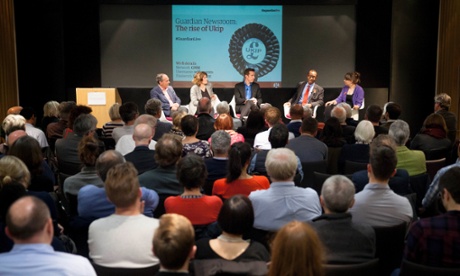
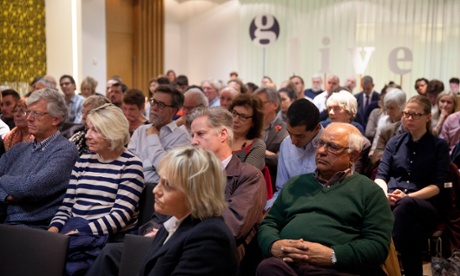
With the air outside popping with fireworks, Guy Fawkes night seemed a fitting moment to discuss a movement that wants to blow up the political establishment. Since the last election, the UK Independence Party has shaken Westminster to the core and could be on course to getting its second MP. With the 2015 election looming, Guardian readers and journalists gathered at King’s Place to discuss the party’s future.
The panel comprised head of news Stuart Millar, columnist Simon Jenkins, foreign affairs commentator Natalie Nougayrède, political correspondent Rowena Mason and columnist Hugh Muir. So what did we learn?
1. Only 1% of Guardian readers support Ukip
Millar kicked off by suggesting that only 1% of Guardian readers identified themselves as Ukip supporters. “Since we have 100 seats here?” he asked looking around. “I’m the one!” bellowed one man at the back, to laughter. A lifelong Labour Party member until the Iraq war, the man said he would never become a member of Ukip, but the party was forging issues to the forefront. “Please don’t be complacent. You may be right, Ukip may never come into power; I hope it doesn’t, in many ways. But I see them as a protest vote.”
One elderly man took the microphone. “What is happening out there? Why do we not have a revolution, with all the poverty?” he said, his voice wavering. “We’re voting for a Tory austerity or a Labour austerity. We don’t do revolutions here; we vote Ukip.”
2. Godfrey Bloom favours a nice bottle of red over nine pints
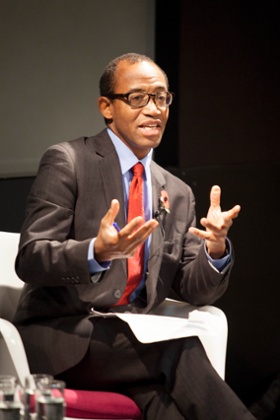
The Guardian’s former diarist Hugh Muir said that if it wasn’t for Ukip, there were some days when the paper wouldn’t have had a diary at all. “There were days when it could have been claimed that the diary was co-authored by Godfrey Bloom and Hugh Muir,” he said.
Controversial former Ukip MEP Bloom once said that he never drank less than nine pints in a single sitting, so Muir started calling him “Godfrey Nine Pints Bloom”. “We struck up a pact, actually, to both drink nine pints, and he would go off and do his job and I’d do mine,” said Muir. “Eventually we went to the RAC Club and ate rather stringy beef and drank a bottle of red together, so he reneged on that as well.”
3. As a political leader, Farage is unprecedented in the UK
Nigel Farage is unique among a sea of samey British politicians; he smokes and drinks and laughs his way through interviews. Simon Jenkins shared an anecdote about watching Farage speak at the London School of Economics:
“There were people hanging from the ceiling and all of them wanted to kill him. Farage came on, spoke very well, was very funny, but ended it with some rather harsh comments about Greece. One woman stood up and introduced herself as the secretary of the Hellenic Society at the LSE. And she just went for him.
“By the time she finished you could hear a pin drop. But Farage came to the front of the platform and said: ‘I’m really sorry I said that. I apologise.’ Total silence; then everyone gave him a round of applause. Now with a normal politician it would never occur to them to do that. He’s a very effective operator.”
4. The EU is watching Farage closely
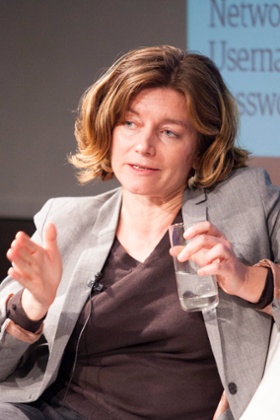
Former executive editor of France’s Le Monde, Natalie Nougayrède says that Europe is watching how Ukip is pushing David Cameron towards ever bigger requests and demands to the EU and European countries. “That irritates a lot of politicians and diplomats,” she said. “EU officials are saying Cameron says different things in private and in public, and that it’s Farage pushing him to those extremes.”
Nougayrède also compared Farage to France’s Marine Le Pen, leader of the right-wing Front National. “Le Pen plays on this image of a woman who smokes, is divorced, always projecting herself as one of the people,” she said. “Le Pen has also portrayed herself as being a victim of the media, being demonised; another thing she has in common with Farage.”
5. Ukip is affecting the political language of the UK
Ukip has had a chaotic couple of years managing the language used by its MEPs when they cross accepted party lines: Godfrey Bloom referring to women as “sluts” and David Silvester blaming flooding on gay marriage. But with its increasing mainstream success, the panel questioned whether the party would tone down the rhetoric to become part of the Westminster establishment?
Rowena Mason thinks that the other parties may instead start to sound more like Ukip. Both sides of politics have adopted stronger language when discussing immigration, she says, and Ed Miliband has begun referring to politicians as “the Westminster elite” as if he’s not one of them.
6. Don’t expect a big Ukip win in 2015 ... but watch 2020
Yes, Ukip may win votes, but the panel believes that the 2015 general election won’t be the party’s year because the numbers aren’t strong enough – a Lord Ashcroft poll revealed that only 51% of current Ukip voters thought they would vote for the party in 2015.
But Mason thinks that 2020 is a viable distance. “By then we can see if they have replaced the Lib Dems as the third party,” she said. “Can they do what they did when they were on the rise? I don’t know if Ukip can fight on two fronts and keep its party united. I’d say that in these days of Twitter and instant news, it is much harder to do that now than it was.”
-
Interested in attending a Guardian Live event? See our full listings and find out how to become a member.