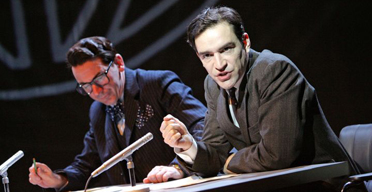
One's reaction to Nicholas Wright's new play will, I suspect, depend on one's age and background. Anyone who remembers James Mossman as a star BBC reporter will be intrigued by Wright's exploration of his baffling suicide. Others, to whom Mossman is an unknown name, may be puzzled as to the play's larger metaphorical meaning.
Wright starts with his hero's death in a Norfolk cottage in 1971 and then backtracks to explore its possible reasons.
He reveals that Mossman worked for MI6 before becoming a brilliant BBC foreign correspondent. But when Mossman fell in love with Louis, an unstable Canadian potter, he swapped overseas reporting for studio work.
A famous Panorama interview, where he was deemed to have harassed Harold Wilson over Vietnam, saw Mossman's BBC star decline to the point where he fronted arts programmes.
But it was the death of Louis, as much as anything, that led to the slow unravelling of Mossman's own life.
To his credit, Wright avoids the romantic cliche that Mossman killed himself out of grief. He suggests that a number of factors may have contributed to Mossman's suicide: not least guilt over his complicity with the BBC in protecting his reputation after Louis's death. In fact, the play offers a salutary reminder of just how closeted the supposedly swinging 60s were for gay men in public life. Wright also captures precisely the internal politics of institutional existence: one brilliant scene shows Mossman being carpeted for his haranguing of Harold Wilson but not so much as to imply surrender to Downing Street pressure.
Sixties buffs will find the play fascinating, especially in its evocation of a style of foreign reporting once summed up as "tieless in Gaza". But I'm not sure that Mossman is a sufficiently iconic figure for his death to carry any large allegorical weight. Wright hints he was a victim not just of personal guilt but of the silken treachery that runs through English life. He leaves open the possibility, however, that Mossman may also have been a sphinx without a secret.
The play is given a perfectly pitched production from Richard Eyre and a commanding performance from Ben Chaplin, who as Mossman exudes patrician insecurity. Paul Ritter as Robin Day, Bruce Alexander as a current affairs apparatchik, and Chris New as the erratic Louis also provide exemplary support. But, much as I enjoyed the evening, it is one that, like Mossman himself, leaves its mysteries unresolved.
· Until June 2. Box office: 020-7452 3000