There’s a reason the first two of the Ten Commandments prohibit worshiping false gods and making false idols. And a reason iconoclasm – the desecration of the monuments of a hated ruler or regime – is one of the oldest and most powerful symbolic forms of political revolt.
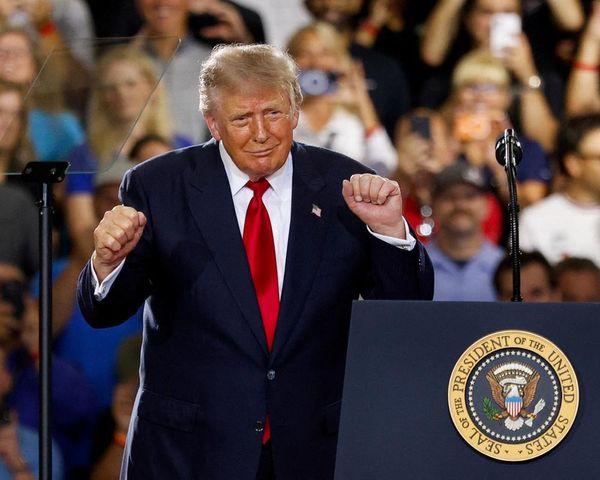
The revolutionary power of iconoclasm is also why Donald Trump – who understands the manipulation of imagery as well as anyone on earth – has had a huge blue and white tarp draped across the facade of the Kennedy Center for the Performing Arts while the letters of his name are pried off under court order.
Sooner or later, the tarp will fall – and with it, more of Trump’s already diminishing prestige.
The Kennedy Center was temporarily renamed The Donald J Trump and the John F Kennedy Center for the Performing Arts in December. Accusing the arts venue’s administration of mismanagement – which they denied – the president sacked the center’s chief and members of its board of directors and replaced them with allies, who immediately installed him as chair. Along with the shake-up in leadership came the layoffs of staff, the flight of artists, an overhaul in programming and a plummet in ticket sales. In February, the board announced the closure of the institution for two years of renovations, beginning 5 July 2026.
Despite the president’s machinations, however, only Congress has the legal power to rename the institution, and renovations were already in the works, to be completed while the place stayed open. Joyce Beatty, an Ohio Democratic representative and ex officio board member, sued the Trump administration. US District Judge Christopher Cooper ruled Trump’s name be taken off the center’s signage, website and even officials’ signatures, and set a deadline of midnight on 12 June, for the removal of the bronze letters from the facade. The judge also blocked the administration from closing the venue for repairs.
Trump’s lawyers put in a last-ditch appeal to pause the deadline, during which scaffolding was slowly erected.
When the appeal failed, the Department of Justice filed a certification that the court order would be obeyed. The crew draped the scaffold with the tarp. In its shadow, workers began the demolition. The only evidence that this was happening is a photograph taken by the AP through a gap at the side.
The words “Donald J Trump” are reportedly gone, but the tarp remains in place. Public witness to an act of iconoclasm – even if a legal, orderly one rather than the wild strike of a mob – is postponed. It is unclear when the drapery will come down – or, for that matter, what will happen to the Kennedy Center going forward.
The destruction of despised structures and monuments does not a revolution make. But it can provide the catharsis that enlivens a resistance movement and tell the world that change is coming.
When the Declaration of Independence was read aloud in the streets of New York on 9 July 1776, patriots toppled the 4,000lb gilded statue of King George III. It was melted down to make more than 42,000 lead bullets that helped oust the king as ruler of the 13 colonies.
The French revolutionaries of 1789 laid siege to the crown’s brutality, the Catholic church’s corruption, and the very bodies of the royals all at once – storming the Bastille prison, trashing Notre Dame Cathedral and other churches across the country, and disinterring the bodies of kings from their tombs beneath the Basilica of St Denis.
During Hungary’s 1956 October Revolution against the Soviet Union, crowds marked Stalin’s birthday by decapitating and practically pulverizing his bronze statue in Budapest, leaving nothing but his boots intact. The 2003 image of Saddam Hussein’s giant, rigid likeness being dragged down with ropes is indelible in modern memory. That war was cataclysmic – leading to millions of deaths and a resurgent Islamic State – but the tyrant’s downfall is something to exalt.
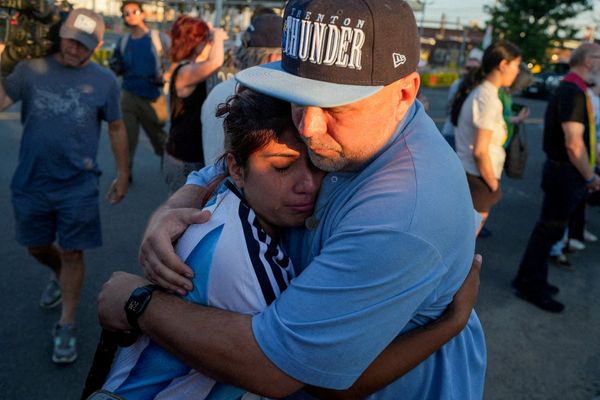
This weekend, lovers of democracy and haters of its enemy in the Oval Office milled around the Kennedy center’s plaza hoping for the big reveal.
Meanwhile, Trump celebrated his birthday (and, oh yeah, the US’s) alongside family and assorted cabinet members, billionaire bros, manosphere luminaries and Maga diehards watching half-naked men pummel each other in a cage on the White House lawn. The spectacle is unlikely to eclipse everything else that’s happening: the war, the rising gas prices, the falling approval ratings, and yes, the humiliation of a name plucked from view, letter by letter.
Trump has so far withheld from his opponents a collective, indeed national, experience of joy, relief and triumph. He has cannily denied history the recorded evidence of an event that may be seen in the future as a step in the decline of his empire. He will keep us on edge for as long as he can.
But the tarp, like the empire, must finally fall. The sheeting may be pulled down by a crew of workers, police, or a gang of vandals. And when it does, the blank space above the name of a beloved and admired president will symbolize the vacuity and, at least this once, the defeated vanity and power of a would-be monarch.
-
Judith Levine is a Brooklyn-based journalist and frequent contributor to the Guardian. Her Substack is Today in Fascism