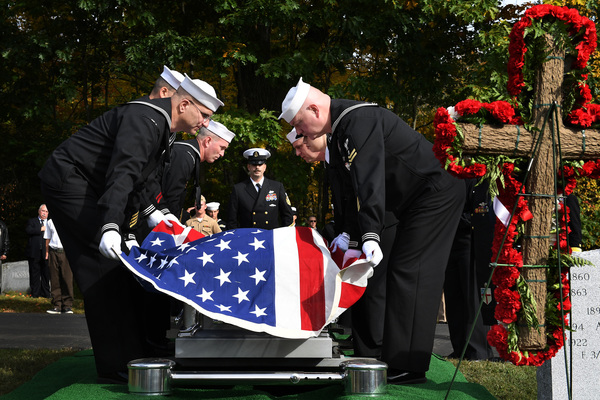
KEENE, N.H. _ Edwin Chester Hopkins' casket was draped with an American flag that had hung above the state Capitol. Boy Scouts saluted as the motorcade weaved around the colonial town square to the cemetery, where a military bugler readied to play taps in the dappled sunlight of a cool autumn day.
It was a grand funeral, one of the most memorable this New England town had witnessed, for a young man who had perished just past his 19th birthday. All that was lacking were the copious tears one would expect for someone whose death was so tragic and premature.
None of the several hundred mourners had met Hopkins, not even his near relatives. He was truly an unknown soldier, but the sense of loss, of what might have been, was still palpable. Hopkins was one of 2,403 Americans killed during the Japanese attack on Pearl Harbor on Dec. 7, 1941, the date that would live in infamy.
His ship, the Oklahoma, suffered five torpedo hits, capsized and rolled over with its mast touching the bottom. By the time crews salvaged it two years later, the nation was in the thick of World War II, and nobody had the time, inclination or technical means to sort out the entangled remains of the 429 crewmen dead.
Hopkins' funeral in mid-October this year was the result of decades of lobbying by family members and POW advocates, as well as leaps in forensic science. As the nation prepares to mark the 75th anniversary of the surprise attack, more and more of those who died that day are finally returning home.
This year alone, the remains of more than 20 sailors from the Oklahoma have been identified and reburied with full military honors _ some at Arlington National Cemetery and others at their hometowns.
Eddie Hopkins was 18 in 1940 when he dropped out of high school and enlisted in the Navy. His older brother, Frank, had joined six months earlier. Their decisions were motivated as much by pragmatism as patriotism.
Although their postcard-perfect hometown, renowned for its brilliant fall foliage, now draws thousands of weekend tourists to its quaint bed-and-breakfasts, back then it was barely recovered from the Great Depression. There were dairy farms, cornfields, a woolen mill and a small company that manufactured crates and buckets, but hardly any jobs for a young man with ambition.
Hopkins wrote on his enlistment papers that he had chosen the Navy because he "wanted to learn a trade." After three months of training in Detroit and Chicago, he earned the rank of fireman third class.
His last communication, dated Sept. 9, 1941, as he was about to board a train to San Francisco harbor, was a postcard of the Oklahoma, the message scrawled in a childish cursive that scrunched up to save space at the bottom, and he mailed with a 1-cent stamp.
"Dear Folks. Here is the picture of the ship I am going to be on. ... We are all ready to leave tonight at nine o'clock, Love Eddie."