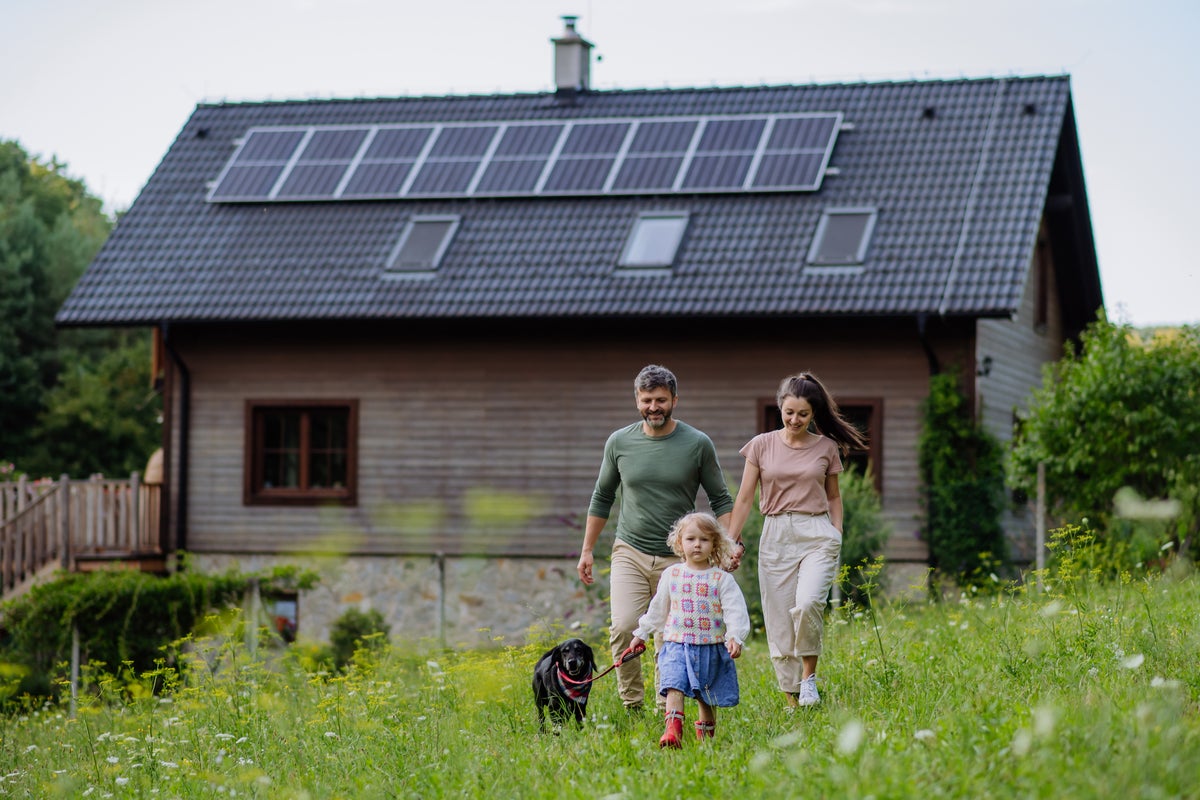
Most people have a broad sense of how solar panels work. You install them on the roof, they generate electricity, and your bills should come down.
But for homeowners considering solar, the installation journey can feel slightly opaque. There is the initial quote, then some kind of survey, then scaffolding appears, and at some point an app starts showing you how much electricity the system is generating. In reality, the process is more structured than that, even if it varies slightly from installer to installer.
The good news is that it is usually less disruptive than many of us may fear. The less obvious news is that quite a lot happens behind the scenes before a single panel goes on the roof.
Get a quote for solar panels for your home
Use our comparison tool to get free quotes from leading solar panel installers.
It starts with a consultation, not an install date
The first step is usually a short consultation, either online or over the phone. Ed Janvrin, director of franchise at OVO, says the company begins with a free consultation lasting around 10 to 30 minutes to discuss the customer’s current energy needs and bills. That early conversation is important because a credible solar panel installer should not jump straight to a fixed price without understanding the property and how the household uses electricity.
At this stage, the installer is usually trying to establish some basics, such as how much electricity the home uses, whether the customer is interested in battery storage, and whether solar is worth exploring at all. It is also often the first point at which a customer receives a rough sense of the potential costs involved.
The first survey is often remote
For many homeowners, the next surprise is that the first survey may not involve a visit. Both solar installers OVO and Sunsave say remote assessments are now a common part of the process. Installers may use satellite imagery, specialist software and photos supplied by the customer to analyse a roof, available space, electricity meter, loft access and possible scaffolding needs.
Janvrin says OVO carries out a virtual survey using software to remotely assess the roof, loft, electricity meter and access points for scaffolding. Alfie Ireland, head of operations at Sunsave, says this kind of remote assessment helps installers work out whether their home is suitable for solar, how many panels are likely to fit on the roof, and how complex the installation may be.
That doesn’t mean the survey is superficial. A good remote assessment should still examine factors such as roof size, orientation, pitch, shading, tile type and any obvious barriers that could affect the design.
Then comes the formal quote
Once the installer has enough information about the property, the homeowner can usually expect a more tailored quote.
This is where the process becomes more concrete. The quote may set out the proposed system size, the likely number of panels, whether a battery is being recommended, and an estimate of savings or payback. Some installers will also talk through the design with the customer on a phone call to explain the rationale and answer questions.
Janvrin says OVO encourages customers to take a few days to review the quote, with “zero pressure to commit”. That is worth bearing in mind more broadly. A good installer should be comfortable with scrutiny. If the company is pushing hard for a quick signature before the design has been properly explained, that’s not a great sign.
The technical survey confirms what the online quote cannot
If a customer decides to move forward, there is usually a second, more detailed layer of checking. In some cases, that means an in-person technical survey. In others, it may involve additional photos of specific parts of the home, such as the loft space, electricity meter or preferred battery location. Often, it is a mix of both.
Janvrin says OVO carries out a one-hour in-person technical survey after a quote is accepted, in order to check for safety hazards and confirm details such as sun exposure. Ireland adds that customers may be asked to send photos of their loft, meter and proposed battery location before installation can go ahead.
This stage is where the installer confirms the on-site realities that a remote assessment cannot fully verify. That may include the condition of the roof, whether it can support the panels, the safest route for wiring, where scaffolding can be placed, and whether the home is genuinely suitable for solar in practice.
This is also the stage where issues such as consumer unit upgrades or grid permissions may come into play. Ireland points out that if an installer designs a system with an inverter larger than 3.68kW, the property will usually need permission from the Distribution Network Operator through a G99 application before it can connect to the grid.
Paperwork and permissions happen in the background
This is the part of the journey that homeowners often have the least involvement with, even though it can shape the timeline significantly.
Once the survey and safety checks are complete, the installer may need to handle paperwork, schedule the installation, and in some cases submit applications to the local grid operator. The customer may not have much to do during this phase, but it can still take time.
Janvrin says that at OVO, paperwork and booking typically take between two and four weeks once the survey process is complete. That helps explain why solar installations are not usually booked in immediately after the quote is accepted.
This stage is also important because it helps determine whether the system will be ready for export payments after installation. If everything is done properly, the customer should emerge with the documents needed to sign up for the Smart Export Guarantee once the system is live.
Installation day is usually shorter than people expect
The physical installation itself is often quicker than the earlier stages. Ireland says that most installations take one to two days, with scaffolding going up a few days beforehand. Janvrin says installations at OVO can take up to five days, depending on factors such as scaffolding, roof complexity and building size.
In practical terms, the work usually involves carefully lifting roof tiles, attaching mounting brackets to the rafters, securing the panels in place, and running cables from the roof to the inverter and, if included, the battery. The system is then connected and tested.
This is also the stage where a household may notice the main disruption. Janvrin says that while OVO connects the system to the customer’s consumer unit, there may be a power outage of around one to two hours.
Even so, the reality is often less dramatic than people expect. The process is usually noisy and a little disruptive, but it is not a major home renovation.
Commissioning is when the system comes to life
For many homeowners, the installation is the visible part. Commissioning is the part they may not have heard of.
This is the stage where the installer tests the system, ensures it is operating correctly, connects it to the grid, and makes sure the homeowner can monitor what it is doing. In other words, this is when the solar installation stops being a collection of components and becomes a working energy system.
Ireland says that installers will test everything thoroughly and commission the system so it is connected to the grid and ready to go. Janvrin adds that technicians will also help customers set up the monitoring app so they can see generation in real time.
This handover is an important part of the process. A good installer shouldn’t simply finish the wiring and leave. They should explain how the system works, how to read the app, and what documents the customer is receiving.
What happens immediately afterwards?
The journey does not end the moment the installer drives away. Ireland says it is best practice for scaffolding to remain in place for a week or two after installation, in case any immediate issues arise. This is a detail many homeowners may not expect, but it makes sense if adjustments are needed shortly after commissioning.
Customers should also receive a handover pack and supporting documentation. Janvrin says OVO leaves customers with a full pack, including the MCS certificate, which allows them to move on to Smart Export Guarantee registration.
At this stage, the homeowner should have a fully functioning solar panel system, visibility into its performance, and the paperwork needed to prove the installation has been completed to the appropriate standard.
Aftercare matters more than many buyers realise
One of the biggest differences between installers often only becomes clear after a system is up and running: the aftercare. Ireland points out that many installers offer workmanship cover of two to five years, even though solar panel systems are expected to last far longer.
This is important because the real installation journey isn’t just the survey day and install day. It’s also about what happens if output drops unexpectedly, if a component needs replacing, or if a homeowner is unsure whether the monitoring data is showing a fault.
Ireland argues that long-term maintenance support is an important part of the package, because many homeowners will not know whether a small drop in performance is normal or whether it signals a bigger problem. That kind of support can make the difference between a system that quietly keeps saving money and one that leaves the homeowner trying to work out warranty claims alone.
How long does the solar installation process take?
There is no single answer, but both installers suggest it is best to think in weeks rather than days.
Janvrin says the entire OVO process usually takes between four and eight weeks from first consultation to completion. For a simpler installation with no major delays, it may be on the shorter side. More complex properties, busier installation calendars, or extra paperwork can extend the timeline.
What matters most is not just speed, but clarity. A good installer should be able to explain what stage you are at, what still needs to happen, and whether any delays are normal.
How long solar panels actually last on a typical UK home as fuel prices soar
How to choose a solar panel installer
How much money can solar panels really save on my energy bills?
Are solar panels worth it in the UK? An expert guide on how they work for your home
How long solar panels actually last on a typical UK home as fuel prices soar
How to choose a solar panel installer – and avoid a bad quote