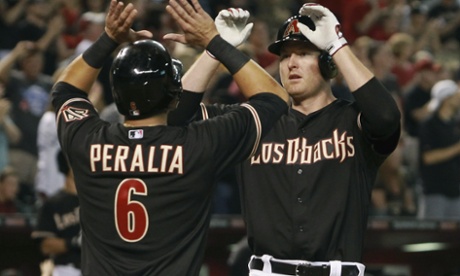
It is the publicly stated opinion of new Arizona Diamondbacks general manager Dave Stewart that he is running one of the only True Baseball Teams in the business.
Stewart was asked on Tuesday by Nick Piecoro of AZCentral.com about his team’s interest in free agent pitcher James Shields, to which Stewart responded that the Diamondbacks would love to have Shields on the roster next year and for years to come. His sales pitch, however, requires a bit of unpacking:
“I think James is a throwback guy by the way he goes about his business and the innings he pitches,” Stewart said. “I think the fact that Tony [La Russa] is here and that we have more baseball people – he probably sees us as a true baseball team vs some of the other teams out here that are geared more toward analytics and those type of things.
We will ignore for the moment that La Russa spent much of his early managerial career being derided and viewed skeptically for not being “baseball people,” given his law degree and his frequent experimentation and innovation with bullpen roles and batting orders. We will ignore for the moment that this seems to be a not-particularly-veiled shot at the new management of the Los Angeles Dodgers, who hired new general manager Andrew Friedman away from the Tampa Bay Rays – Friedman being a much-lionized executive-hero on the pages of baseball blogs across the nation for his analytical approach to the game, the principles of which he learned during his days in the New York finance sector. We will ignore for the moment that, as those blogs have pointed out, there is not a single team in the industry at the moment that does not use analytics of some sort -- the Arizona Diamondbacks included.
Because Stewart has a point.
It’s a very narrow point, communicated very broadly, and it is addressed specifically to Shields and pitchers like Shields. One of the primary spaces that baseball analytics has encroached upon over the last decade or so is the workload of the major league starting pitcher, and the primary fruit of that labor has been an occasionally monomaniacal obsession with pitch counts and innings limits.
This has shown up in a variety of ways, the two most famous being pitcher abuse points, an early attempt to quantify how abused a pitcher’s arm was by his yearly workload (some of the problems with PAP are discussed here) and the so-called “Verducci Effect” proposed by sportswriter Tom Verducci, which essentially held that pitchers 25 years of age or younger should not see an increase of workload greater than 30 innings over their previous year, or they risk serious injury. The Verducci Effect is demonstrably unsupported by actual data.
It’s important to note that both of these flawed models are, in their conception, intended for young, developing arms – not the fully established arms of major league veterans, and certainly not the arm of Shields, a workhorse starter who has thrown over 200 innings each of the past eight seasons. This does not mean the underlying principles are entirely without merit, of course, but neither has it stopped fans and public-facing analysts from applying the lessons of this research (the “100 pitches per start” dictum, especially) liberally and without the nuance that always accompanied it: these are not one-size-fit-all declarations.
Nowhere recently was this on display more than the chatter surrounding San Francisco Giants ace Madison Bumgarner. Bumgarner started games one and five of the World Series against the Kansas City Royals, the latter being a complete game shutout, throwing 106 and 117 pitches in those starts respectively – and then was used out of the pen to close out game seven two days later. The talk during game five was especially revealing – mounting worry with each pitch Bumgarner threw over 100, as reporters and fans alike wondered if, or indeed when, he was going to come out to save his arm. Never mind that Bumgarner was dominant; never mind that his delivery was still clean and easy – he was over 100 pitches, and there was nebulous future baseball to think of. The Giants, of course, were having none of that: “I wasn’t thinking about finishing the game or how many innings I was going to go or pitch count,” Bumgarner said. “I was just wanting to get outs.”
“In fact,” Giants manager Bruce Bochy said, “I was staying away from him every inning, because I was hoping he wouldn’t go, ‘I’m starting to get a little tired.’ There’s no way I would have taken him out unless he would have told me that. We just got on his horse and rode it.”
That attitude, right there, is what Stewart appears to be trying to promote the Diamondbacks as having: absolute trust in the on-the-field staff and the pitcher to work together in establishing and realizing their limits, and then doing what is best for the team to win ballgames. And honestly, that’s a very good attitude for a team to have.
Is this also a bit deceptive on Stewart’s part? Yes. Perhaps more than a bit. Hands on, individualized approaches and modern analytics are not mutually exclusive things. While the effects of front office analysis on baseball operations varies significantly from team to team, there aren’t any clubs that enforce the policy that Stewart is implying exists in contrast to his own – a caricature of management where a pitcher is lifted after his 100th pitch regardless of context or game situation. Even on the clubs strictest about pitch count, there are always exceptions made for context, especially for guys like Shields.
But the reason Stewart, a former agent, is framing the conversation so unreasonably is probably the same reason he was having it with a reporter, not with Shields’s agent – because he wants Shields to sign with Arizona for its culture, and he likely hopes to get him to do so for less money than his agent might negotiate without his client stating preferences. The most effective, tactful way of communicating that? Just happen to talk about how great things would be for Shields in Arizona to the beat guys, say something inflammatory that might appeal to Shields to get it in the national news, and then hope the guy is keeping tabs on his own free agency.
So despite whatever truly-felt disdain Stewart may have for modern analytics, it’s unlikely this is a signal of some grand policy reversal in Arizona, or that it’s the first shot in a sustained barrage against the very concept of sabermetrics by the new Diamondbacks GM. It’s much more plausible that it’s just the most public move in a negotiating process that’s still ongoing.
Good luck to Stewart on that; I don’t think there’s a single suitor for Shields’s services who wouldn’t give him free rein to pitch to his fullest and decide when he’s had enough – the ability to handle a heavy workload in a dependable fashion is, after all, the primary attraction of Shields as a pitcher. But considering that two of the other teams Shields has been most publicly connected to are the Colorado Rockies and Miami Marlins – and considering the role that the Cubs’ new culture and commitment to winning played in the signing of ace Jon Lester – trying to position the Diamondbacks as a welcoming family of like-minded true baseball men is an entirely understandable strategy.
After all, it’s not important to Stewart whether you or I think the Diamondbacks are the only True Baseball Team remaining in the league. He might sound like he’s talking to us, but he’s really talking to Shields. And right or wrong, all he wants is for Shields to think that he’s got a point – and to start thinking seriously about Arizona.