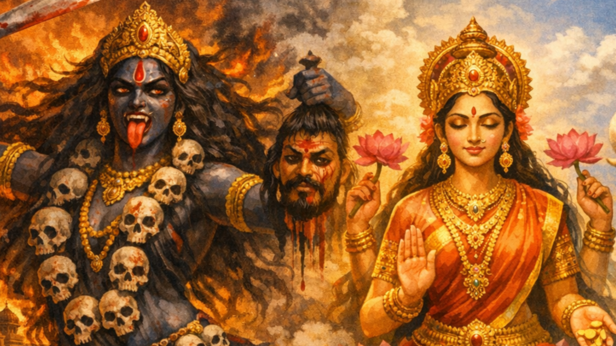
There is something deeply striking about the contrast between Maa Kali and Maa Lakshmi. One appears terrifying, draped in darkness, wearing skulls and standing in raw, unapologetic power. The other radiates calm, seated on a lotus, symbolizing beauty, grace, and abundance. At first glance, they feel like opposites. But when you look deeper, this contrast is not a contradiction. It is a message. Because in Hindu philosophy, nothing divine is random. Every form exists with purpose. And the difference between Kali’s fierceness and Lakshmi’s gentleness reveals something profound not just about the universe, but about the human experience itself.
They Represent Two Forces Life Cannot Exist Without
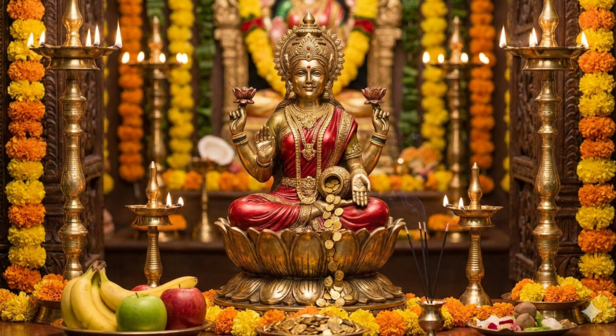
To understand why one is fierce and the other gentle, you have to understand what they represent. Maa Lakshmi is the embodiment of harmony, prosperity, and balance. She is associated not just with wealth, but with inner well-being, moral alignment, and the ability to flourish in life with grace and stability. Her symbolism is rooted in purity and growth, often shown seated on a lotus, representing how goodness can rise even in difficult conditions .
Maa Kali, on the other hand, represents raw, primal power. She is not concerned with comfort or beauty. She is concerned with truth. She is the force that destroys illusion, ego, and everything that prevents growth. Despite her fearsome appearance, she is deeply protective and compassionate, acting as a mother who removes what harms her children . This is the first truth most people miss. Lakshmi sustains life. Kali transforms it.
Fierceness Is Not Anger. It Is Protection
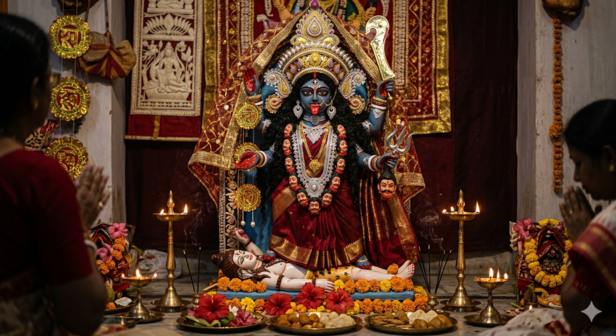
The intensity of Maa Kali is often misunderstood as rage or destruction. But her fierceness is not chaos. It is precision. In mythology, Kali appears when evil becomes too powerful, when balance has completely broken down. Her role is not to maintain order gently. Her role is to restore it forcefully. She emerges as a response to crisis, not comfort, embodying unstoppable energy that eliminates threats at their root . Her terrifying form, the skulls, the weapons, the wild expression, is symbolic. It represents the destruction of ego, ignorance, and false identity. She does not destroy life. She destroys what prevents life from evolving . Lakshmi does not need that intensity. Her role is different. She nurtures, supports, and stabilizes. She brings growth where balance already exists. In simple terms, Kali appears when things fall apart. Lakshmi appears when things are ready to flourish.
The Real Difference Is Timing, Not Nature
One of the deepest insights hidden in this contrast is that Kali and Lakshmi are not opposites in nature. They are expressions of the same divine energy at different moments.
When life is stable, when values are aligned, when there is harmony, the divine expresses itself as Lakshmi. Gentle, giving, abundant. But when life is consumed by imbalance, when ego dominates, when truth is buried, the same divine force becomes Kali. Fierce, unstoppable, and transformative. This means something powerful. The universe does not always respond softly. Sometimes, growth requires disruption. Sometimes, peace can only come after destruction.
What This Reveals About You
This is where the meaning becomes personal. Every human being carries both these energies within them. There are moments when you act like Lakshmi, calm, generous, and balanced. And there are moments when you need Kali, when you must cut away toxic patterns, confront hard truths, and take strong action.
Most people resist this second part. They want peace without transformation. They want growth without discomfort. But the presence of Kali reminds us that not all change is gentle. Some of it is intense, uncomfortable, even frightening. Yet it is necessary. Without Kali, nothing would break. Without Lakshmi, nothing would grow.
Why Both Forms Are Equally Divine
It is easy to feel drawn toward Lakshmi and hesitant toward Kali. One feels comforting. The other feels overwhelming. But Hindu philosophy does not rank these forms. It honours both. Because life itself moves between these two states. Creation and destruction. Stability and change. Beauty and intensity. Kali is not separate from Lakshmi. She is the force that clears the path so Lakshmi can arrive. And Lakshmi is not separate from Kali. She is what remains when transformation is complete.
The Truth Hidden in Plain Sight
The real reason Maa Kali is fierce while Maa Lakshmi remains gentle is not about personality. It is about purpose. One protects by nurturing. The other protects by removing. One builds. The other clears. One sustains. The other transforms. And together, they reveal something that is both simple and difficult to accept. Life is not meant to be only peaceful. It is meant to be balanced.
Conclusion: Not Opposites, But Complements
What looks like contrast is actually completeness. Maa Kali and Maa Lakshmi are not two different truths. They are two sides of the same truth, showing that existence is not just about comfort or destruction, but about the constant movement between the two. Because sometimes, what feels harsh is actually protection. And sometimes, what feels gentle is the result of something powerful that came before it. And when you begin to see both not as opposites, but as necessary, the meaning changes completely. It becomes less about gods. And more about understanding life itself.
Unlock insightful tips and inspiration on personal growth, productivity, and well-being. Stay motivated and updated with the latest at My Life XP.