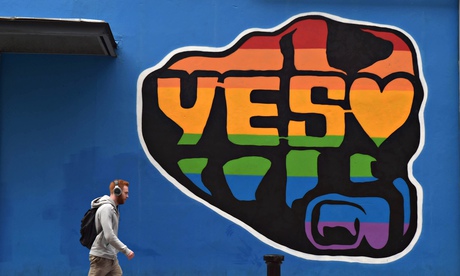
There’s a great deal of referendum talk in the air at the moment. Ireland has just voted to welcome same-sex marriage and, after the recent Conservative victory at the polls, the UK now has the prospect of a vote on whether to continue membership of the European Union. That referendum will seek a simple yes or no answer to staying in.
But wait – should that be a “yes” or “no” answer or a Yes or No answer?
Confused? Well, so was a reader who attempted to work his way through a piece in the Observer a fortnight ago, a curtain-raiser to the then-impending vote on same-sex marriage in Ireland. He wrote after a subeditor had followed our style guide’s instruction that yes and no campaigns should be just that: lower case and with no quote marks.
“Yesterday, I gave up reading the page five article about the Irish referendum about two-thirds of the way through. This wasn’t because it was uninteresting, uninformative or badly written. I had just become exasperated because it was so difficult to read. Every reference to the campaigns, the arguments and the campaigners used either yes or no without the slightest indication that these little words were being used to denote two alternative campaigns. Given that the word no, in English, has a standard use as an adjective or adverb denoting absence or ‘nil’, my mental processes were constantly jerked and derailed as I read.
“Consider this sentence taken from the article: ‘Now no campaigners have booked full-page advertisements to appear...’ At what point does it become clear what ‘no’ means in that sentence? Similarly, the quotation from John Waters: ‘We have no funding whatsoever and are not seeking any…’ Then there’s the [online] headline: ‘US Christians “bankrolling” no campaign in Ireland’s gay marriage referendum’, which I read initially as meaning US Christians weren’t backing either campaign. If these uses are legitimate, then so would be: ‘The Irish no campaign is like no campaigns I have encountered’ – take your pick of which of two possible meanings is intended.”
The reader (who “freely admits to pedantic tendencies”) recalled that stories on the Scottish independence referendum last year often capitalised the words as Yes and No. In truth, a quick search of the archive shows that Observer stories used both, indicating some ambivalence towards the prescriptions of the style guide, which we share with our sister title, the Guardian.
“Thanks in at least part to both the Guardian and the Observer, I have learned that good style is important if one wants to communicate easily and effectively,” wrote our reader. “Please could consideration be given to using Yes/No, ‘yes’/’no’ or some similar distinguishing style when referendums are being reported.”
Observer subeditors are keen to break with style and use initial capitals, but first let’s hear from the style guide editor.
“Where ambiguities such as ‘bankrolling no campaign’ and ‘no campaigners have booked full-page advertisements’ have occurred, that is down to bad editing, not style,” he said, pointing to another piece on the same-sex marriage debate that had employed the following unambiguous terms: the yes campaign, a yes vote, the yes camp, the yes-no battle, yes advocates, the yes side, prominent yes campaigner, a no voter. “In addition to the rich variety of yes-no choices available, there are numerous options to introduce further variety, such as supporters of same-sex marriage, opponents of gay marriage – it’s a long list and it means we don’t need to keep saying yes, no, yes, no over and over again.
“In line with the style guide’s general approach to capital letters, I don’t want to see Yes, No; ‘Yes’, ‘No’; or ‘yes’, ‘no’, appearing 14 or more times in one story, because the capitals (and even worse, quotation marks) clutter up the text and ultimately make the story harder, not easier, to read. Any writer or subeditor should be able to grasp that these stories can be told simply and clearly without having to resort to typography to get them out of trouble.”
The editing staff here are not entirely convinced by this argument, so dear reader, let’s have our own instant referendum. Discounting quotation marks – they are just too fussy – would you rather the Observer used capitals (Yes/No) or stayed with the current style (yes/no)? I can’t promise that your response will be binding, but I will discuss it with editors here. Answers to me by next Sunday, please.
reader@observer.co.uk