Since the first story about the latest outbreak of Ebola appeared in the Guardian on 24 March, there have been a further 700 in print and online.
It is a terrifying disease that seeds panic, both in the three countries where it has killed thousands and in the wider world, where just the breathing of its name brings fear and suspicion.
Reporting on a disease for which there is no known cure, and which kills most who catch it, is challenging for a newspaper that must respect its deadly properties but write about it in a rational way.
Despite the scale of the coverage, few readers have complained to the readers’ editor – in fact it was the seventh best-read item on the Guardian’s site last month. However, one who did said that he had “an ongoing concern about the paper’s blanket use of the term ‘west Africa’ to describe affected areas”.
Felix Wood, executive director of programmes and strategy for AfriKids, said that, while he was pleased that the paper was giving the disease prominence, west Africa “is a large area containing many countries, the majority of which do not have any cases of Ebola”.
He said that in Ghana (no confirmed cases and no borders with infected countries), the organisation has already seen significant damage to its work through people cancelling trips to the country because of fears of Ebola in west Africa.
A fair point, as the three main countries most affected are Guinea – where this outbreak began – Liberia and Sierra Leone. However, the protocols as laid down by Public Health England do relate to west Africa as a whole, not least because there have also been cases in Nigeria, Senegal and Mali.
I asked Sarah Boseley, the Guardian’s health editor, who has anchored the Guardian’s coverage from London, how you report in a way that recognises the fear but does not promote panic.
“We try very hard to be sane and sensible about health and medical science and not overinflate risk. Context is very important – you might (and we did) have a story saying a glass of wine a day increases a woman’s breast cancer risk by 6%. Potentially alarming – but what some might miss is that the 6% is an increase on whatever risk you had to begin with. So if you had a 10% risk of breast cancer, as a very healthy, fit young woman, the increase would be 6% of that 10%. In other words – it’s almost nothing. So it’s important to listen to what people are saying but be rational and look at the underlying scientific evidence. Most scares in the UK are not really scares.
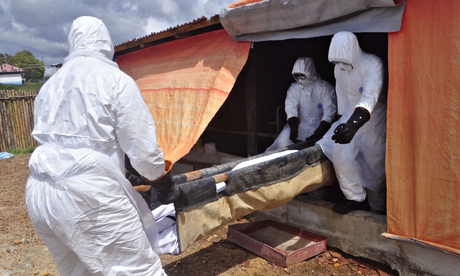
“Ebola is a completely different thing. I don’t think it is possible to overplay the scary nature of this virus in that community, where people live in poverty, crowded together without even easily accessible water to wash their hands. Add to that the shock and horror of nurses and doctors and ambulance teams arriving in spacesuits to treat people or remove them from their homes and you have a story that cannot be overplayed.
“What is very important, though, it seems to me, is to tell it calmly and accurately – otherwise the reaction from readers will be revulsion and fear, which blocks the human impulse to help.
“So I think this is a story about something which rightly justifies huge fear in west Africa, but should not be turned into a UK scare. Too much of that and the barricades come down, it becomes very difficult to travel to and from the affected countries, and health workers are deterred from volunteering (they are the biggest need now).”
Travel and quarantine fears have made reporting from the ground – something the Guardian should do more despite its overall good coverage – really difficult for all news organisations.
The Guardian published a set of internal guidelines at the weekend for travelling to and from west Africa after talks with Public Health England and other health providers. These include the rule that no reporters will be quarantined. This should mean more crucial reporting from the ground of an outbreak expected to last six more months.
• Full disclosure: Chris Elliott is also chair of Concern Worldwide UK, a member of the Disasters Emergency Committee