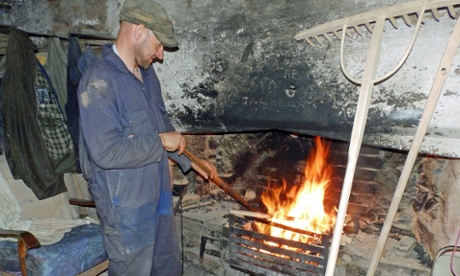
When the Helm Wind howls down the south-western slopes of Fiend’s Fell, there can be few toastier places than the tiny workshop of Rudd’s the rake-makers in Dufton.
At 893m (2,930ft) Fiend’s Fell, as Cross Fell was once known, is the highest Pennine hill. By its configuration it occasionally creates the föhn-type wind – the only named wind in the British Isles – that can, it’s said, “blow the nebs (beaks) off geese”. It certainly draws the flames of the burning offcuts of ash and silver birch roaring up the chimney, shedding a fierce crimson light through the old stone building, which has, according to the date on the lintel, been providing shelter from the blast since 1632.
Nearly as tall as one of his rakes, John Rudd, now 75, and his son Graeme turn out 10,000 rakes a year. His father and grandfather made rakes solely for hay-timing in the upland meadows long cherished for their wildlife, the dazzling mosaic of their wild flowers and the winter food they provided for cattle.
These days farmers mostly make silage, which can still be produced with wet grass kept in silos, so hay rakes are now used for other tasks, such as spreading concrete floors for barns, smoothing golf course bunkers and long jump pits, as well as raking leaves and gravel drives.
“German ash makes the rake shafts,” says Graeme. “We use Yorkshire ash, though, for the heads and bows.” The wood for the bow is boiled and bent into half-hoop so that it can be passed through a hole in the shaft, with the ends then pushed through holes in the rake’s head for extra strength.
“Finally,” Graeme continues, “we fashion the teeth from Swedish silver birch, then suspend the pegs in a tray above boiling water.”
This pre-warming, he gives me to understand, prevents the pegs from shrinking and dropping out. Unlike gap-toothed Tom Rakewell in Hogarth’s paintings, whose mouth reflected his dissolute living, “Rudd’s rakes,” he says, “rarely lose their teeth.”