Analysis: New data released by the Ministry of Health shows the Government's intended path towards vaccinating the adult population, but is it realistic? Marc Daalder reports
Until recently, the Government has been loathe to set any hard targets for the rollout of the Covid-19 vaccine - other than a guarantee that every New Zealander over the age of 16 who wants to be vaccinated can do so by the end of the year.
Last week, the Ministry of Health supplemented that target with two more pieces of data - weekly vaccination targets compiled from District Health Board (DHB) plans that project out to the end of June and then a chart of modelled vaccinations for the remainder of the year. Combined, the DHB plans and ministry model offer new hints at how the Government expects to vaccinate as many as 4.2 million people in the next 36 weeks.
They also highlight likely challenges along the way.
The big scale-up
To begin with, the DHB plans project New Zealand will administer just 1 million more doses in the next two-and-a-half months, on top of the 150,000 to 200,000 already delivered. That leaves us with just 26 weeks, from July 1 to December 31, to administer as many as 7.2 million jabs.
Covid-19 Response Minister Chris Hipkins said multiple times last week that he was confident our slow start in the first half of 2021 wouldn't mean we'll miss our end-of-year vaccination target.
"It's going to be a big job and we're going to have to be scaling up very steeply in the second half of the year. But it is going to be a big undertaking. We'll be working as much as we can to make the trains run on time, but every New Zealander is going to have to play their part in making sure that we get through this in the second half of the year," he said.
The potential for missed appointments and corresponding vaccine wastage could lead to further delays, Hipkins added. But the low numbers of planned vaccinations in the coming months was "dictated by supply and we're not expecting the big supply until the second half of the year".
Director-General of Health Ashley Bloomfield similarly indicated that the end-of-year target was still achievable.
"That is definitely the plan. That is absolutely the plan," he told reporters at a vaccine briefing on Thursday.
"And last year we vaccinated more people in the space of a couple of short months, more people with the flu vaccine than had happened in any prior year, and that was in the middle of a pandemic. So yep, the health system has got an amazing ability to deliver these sorts of programs."
The flu vaccine rollout saw just under 1.8 million jabs administered over three months - although, admittedly, much of the rollout took place under Level 4 and Level 3 conditions.
At the height of this year's Covid-19 vaccine rollout, the Government expects to administer three times as many doses of vaccine in the same amount of time.
That's according to the figures underlying the latest projections for the vaccine rollout, released at that same vaccine briefing. After a previous chart was revealed by the ministry to be little more than lines drawn in Adobe Illustrator - the national director of the rollout said it "was generated as a graphic design rather than a statistical product" - the data behind this chart has been proactively released.
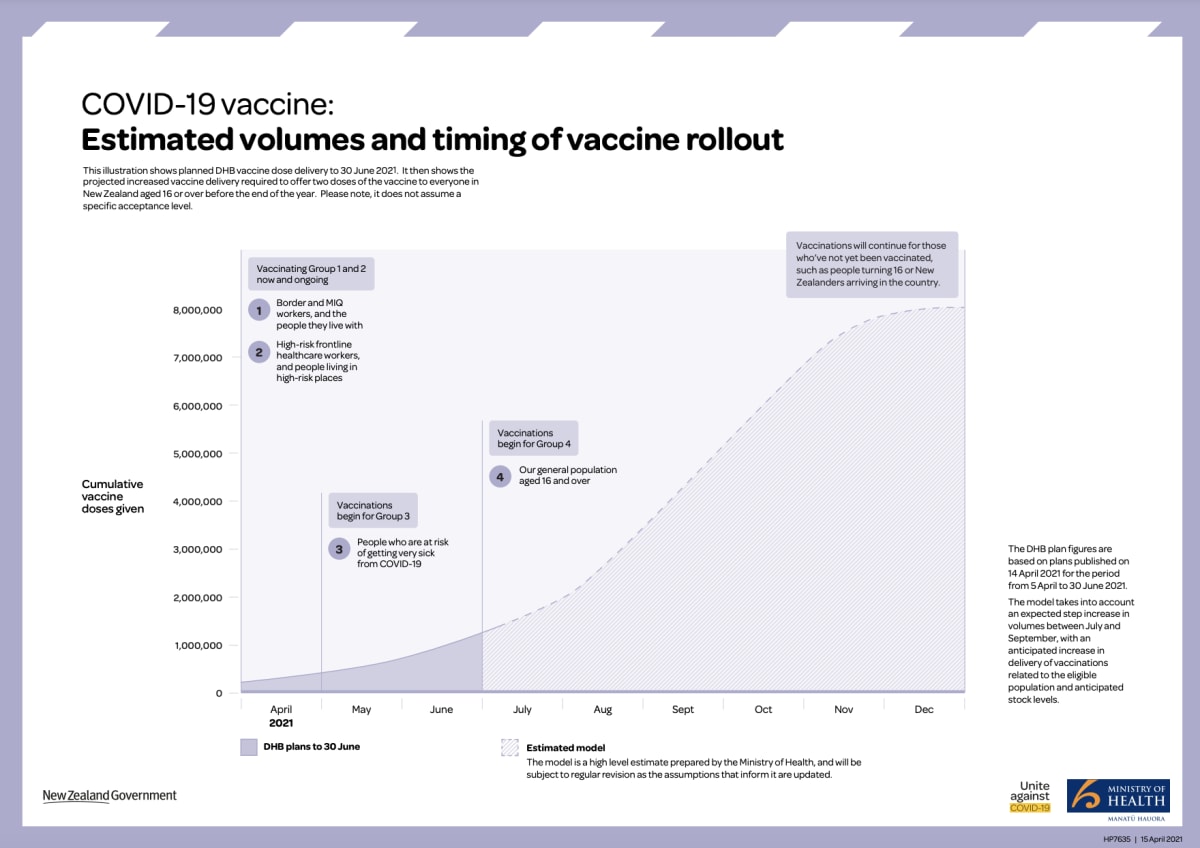
By April 11, according to this data, some 120,000 doses had been administered. DHBs expect to administer another million doses by July 4 and the Ministry of Health's "high level" modelled estimate sees 6.85 million doses being administered through the end of November, after which the rollout is effectively complete.
That would leave us with 8,019,987 doses administered in 2021 - corresponding to 4,009,993.5 people being immunised, if the two-dose Pfizer vaccine is used for the entire rollout.
The seven-week sprint
While the cumulative curve for the rollout looks smooth enough, albeit steep at points, the weekly doses to be administered tell a different story.
New Zealand expects to administer 534,000 doses of vaccine every week for seven weeks in September and October. This is the scale-up that Hipkins was talking about - a gargantuan undertaking that, if successful, would out-perform nearly every other vaccine rollout to-date.
In per capita terms, we're proposing to vaccinate about 10.68 percent of the population - and 12.7 percent of the eligible population - every week for seven weeks straight.
According to statistics compiled by Our World In Data, just 11 countries have vaccinated more than 10 percent of their population in a week. Most of these are small island countries, as well as those that have led the world in their rollouts: Bhutan, Israel, Chile and the United Arab Emirates. Under this rollout plan, New Zealand would be the 12th such country - and it would rank eighth among them.
New Zealand's proposed rollout, however, is far more ambitious than merely vaccinating 10 percent of the population in a single week - it instead intends to carry that on for seven full weeks. Approximately 1.6 million more people will be fully vaccinated by October 31 than had received their second dose at the start of the massive push on September 13.
Our rollout would be nearly unrivalled if we accomplished that. Just four countries - Bhutan, the Seychelles, Gibraltar and the Falkland Islands - have managed to administer doses to more than 75 percent of the population in a seven-week period. The largest of these, Bhutan, has a population seven times smaller than New Zealand's, making us easily the largest country to operationalise a rollout of that scale.
Can we do it?
So, is it possible?
That remains unclear. At last week's vaccine briefing, Bloomfield said the ministry was preparing to scale up to deliver 50,000 to 60,000 vaccines a day. It's not clear if that's a peak value for weekends and holidays - when more people are available to be vaccinated - or an average value that can be sustained over a longer period of time. Either way, it falls well short of the 76,000 shots a day needed for nearly 50 straight days to fulfil those September and October targets.
The restrictions could be a result of staff shortages, logistics issues or supply of the vaccine. A leaked Ministry of Health document from late January showed that, at the height of the expected rollout for frontline workers and their families, between 1,466 and 2,932 vaccinators would be needed to immunise 116,000 people in a week. If those same numbers were carried over to the seven-week sprint, we would need between 6,800 and 13,600 vaccinators.
There are about 5,500 GPs in New Zealand, about 10 times as many nurses and an extra 2,000 to 3,000 vaccinators being trained specifically for the Covid-19 vaccine rollout. While GPs won't be available to vaccinate people 24/7 and most nurses are in similar straits, it would appear the workforce for a significant rollout is available. The ministry can also recruit more vaccinators from a list of retired health professionals that was aggregated in March 2020 to surge intensive care capacity if the Covid-19 outbreak spun out of control.
Even if Bloomfield's 60,000-doses-a-day figure was the cap for the rollout, the end-of-year target is still achievable. The ministry's rollout plan ends on November 21, leaving five weeks of spare room if the programme falls short of the 534,000-doses-a-week sprint.
Assuming the DHB figures through the month of June are accurate, New Zealand will be capable of administering 128,000 doses a week by the time the general population rollout begins in July. Even a modest, linear scale-up - in which 10,400 more people are vaccinated each week than the week prior - could see nearly 7 million doses administered in the last six months of the year without exceeding Bloomfield's 60,000 daily dose limit.
In other words, while the ministry's own modelled rollout sets a high bar, the basic target of vaccinating between 4 and 4.2 million people by the end of the year is not out of reach.
Of course, one thing that could make the rollout easier is if not all of the eligible population wants to get vaccinated. The Government has always been clear about its target: "Anyone who wants to be vaccinated can be before the end of the year". If just 80 percent of the eligible population wants a vaccine, that's 1.6 million fewer doses to administer.
Either way, meeting the end-of-year target will still require a significant scale-up in the rollout, from vaccinating 36,000 a week today to vaccinating more than 50,000 people a day at the peak, in what Bloomfield has described as a "mammoth effort".
"I'm really confident that the health system will be able to deliver that," he said last week. "Day in, day out they deliver an enormous amount of care."