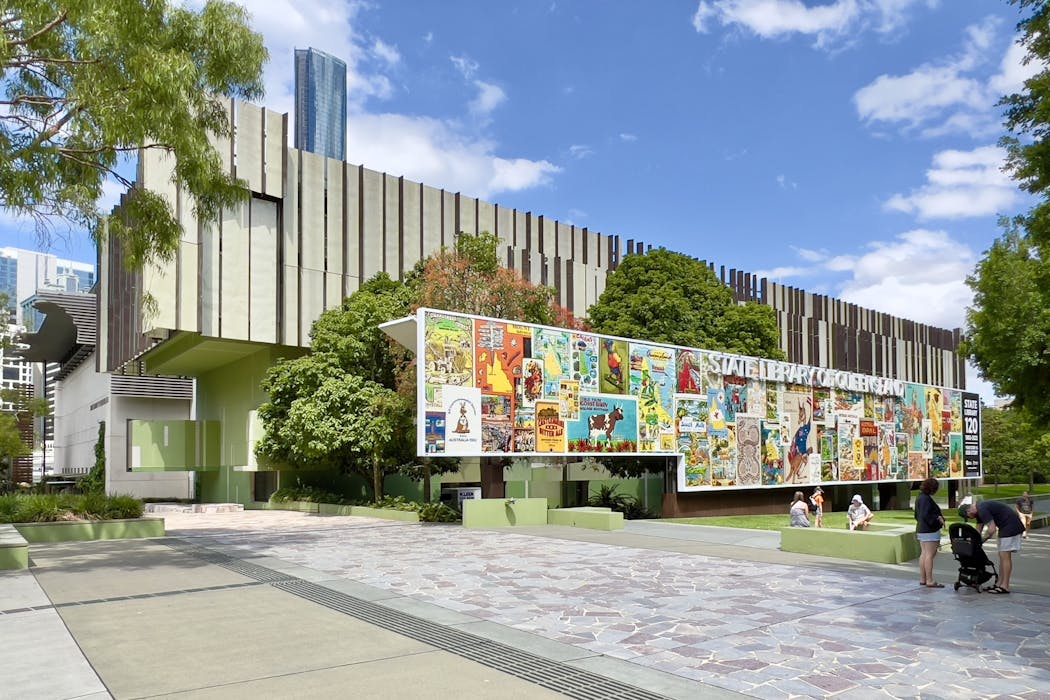
The Queensland government has announced the state’s literary awards will move from their current home at the State Library of Queensland to “an alternative provider” – along with the black&write! fellowships for emerging First Nations writers. The move has been framed in the language of safety and hate speech – and follows recent controversy over an award to a writer outspoken about Israel–Palestine.
A recent review into the State Library of Queensland’s awards programs was prompted by the withdrawal of a A$15,000 fellowship (hours before it was to be awarded) to Martu writer K.A. Ren Wyld, for a fiction manuscript on the Stolen Generations. The government’s concerns included a (since deleted) tweet praising former Hamas leader Yahya Sinwar as a “martyr”.
“Creative diversity and robust debate are important, and central to the value of the arts, however, we’ve taken decisive action to make Queensland safer,” said last week’s statement by Minister for Education and the Arts John-Paul Langroek. He continued: “state-owned buildings will not be a platform for hate speech.”
In a letter to the library’s board last year, Langroek called Wyld’s comments “incompatible with the values of respect, unity and inclusion” expected of the State Library. He argued the award should not be presented in a state-owned venue. The library’s board responded by commissioning a review of the governance of its awards programs.

The review, by Martin Daubney KC, briefly acknowledges that excluding writers because of “controversial political statements” may raise difficult questions under Queensland’s human rights and anti-discrimination laws. But it does not resolve them.
It does recommend the board formulate and adopt a policy (or policies) for awards and fellowship programs, which consider (as part of risk management) background checks – including social-media checks and criminal history checks.
The board is asked to consider requiring each entrant to agree to these checks, and to acknowledge that:
if in receipt of an award, they will not engage (and must not have engaged) in behaviour (including the publication of statements in any media or through social media) which is inconsistent with the award program’s objectives or which would be seen to bring the SLQ and/or the award into disrepute.
This creates a harder issue facing publicly funded literary prizes. Are judges now being asked to assess not only the work, but the writer as well?
A history of controversy
Controversy is not new to these awards.
The Queensland Premier’s Literary Awards, established in 1999 by a Labor government, were abolished in 2012 by Campbell Newman’s Liberal–National state government. It came a year after the controversial shortlisting of a memoir by David Hicks, who trained with Al-Qaeda and was imprisoned in Guantanamo Bay in 2011. (Officially, it was to save money: roughly A$250,000 per year.)
Then-premier Anna Bligh had refused calls to intervene over Hicks’ shortlisting: “Ultimately it’ll be determined on its literary merit and I think it’s important that we not get in the way of that.”
The renamed Queensland Literary Awards were established within months, by volunteers from Queensland’s literary community. They ran the awards for two years, supported by fundraising and money from the Copyright Agency’s Cultural Fund. In 2014, the State Library of Queensland stepped in to administer the program. A year later, Annastacia Palaszczuk’s Labor government brought back public funding.
Now, the awards are once again in the political crossfire – and for now, homeless, though the government says it is “committed to the future of the literary awards”.
Australia’s other states and territories all run similar prizes.
What the review actually recommended
In 2025, a judging panel recommended Wyld for one of the black&write! fellowships, and the state librarian approved the recommendation, after internal checks and a risk assessment, the review records. It shows that staff identified reputational risk after adverse media coverage of Wyld’s public stance and social media commentary on the Israel–Palestine conflict.
The board initially backed the judging process, noting an independent panel had selected the manuscripts on literary merit.
After the minister issued a formal direction under the Libraries Act, however, the board withdrew the fellowship and cancelled the ceremony. Twelve judges resigned in protest.
The review asked a narrower question than the government’s response might suggest: should the State Library be running competitive literary prizes at all?
Under the Libraries Act 1988 (Qld), the library’s core functions concern library services, collections and public access to information. It is “not immediately clear” that literary awards sit easily within that remit, the review found.
It did not recommend removing the awards from the State Library. It recommended clarifying whether they properly belong there, and tightening the governance, risk and venue frameworks.
The awards may be moving, but the terms on which they can be conferred look narrower than before.
How a literary prize became a safety issue
In announcing the decision, Langbroek strikingly reframed the issue not in terms of reputational risk, but of safety and “hate speech”.
The Daubney review, by contrast, is concerned with governance and reputational risk: adverse media coverage, institutional relationships, and the responsibilities of a statutory body that “represents the State”.
The review itself records no finding of unlawful hate speech.
Prize lists regularly include authors who provoke, offend or decline to stay neatly inside the lines.
In 2014, for example, the Prime Minister’s Literary Awards descended into controversy after Tony Abbott reportedly overruled the judges’ decision to award the fiction prize to Steven Carroll. Instead, it was jointly awarded to Richard Flanagan, for his novel The Narrow Road to the Deep North. Furious judge Les Murray called the intervention “nasty”.
Literary prizes often look independent – until the outcome proves politically inconvenient.
What happens next
Where might the Queensland Literary Awards land next?
If they resurface at another publicly funded organisation – a festival, perhaps – the same issue may simply reappear in a different building. Langbroek’s formulation extends to all taxpayer-funded arts and cultural institutions, not just the library.
The controversy that prompted the review concerned a fellowship writer’s social media comments, not the Queensland Literary Awards themselves. Yet it has upended an entire awards system.

Bronwyn Lea does not work for, consult, own shares in or receive funding from any company or organisation that would benefit from this article, and has disclosed no relevant affiliations beyond their academic appointment.
This article was originally published on The Conversation. Read the original article.