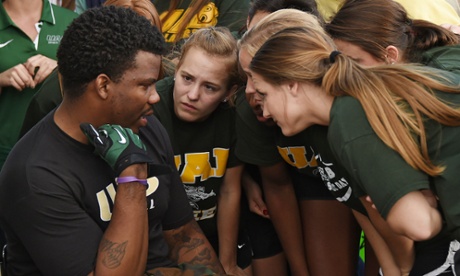
Alabama-Birmingham players left a meeting with Ray Watts in tears on Tuesday after the school president confirmed an inevitability the team had feared for months.
Watts met with the players to deliver the news that the school would be eliminating football, following a year-long study on the financial viability of the program. Fans of other smaller college teams may have reason to be fearful because UAB’s problems are hardly isolated ones.
But before the post mortem got into full swing, there was defiance. Tight end Tristan Henderson delivered an impassioned plea to save the team. “You’re telling me it’s because the numbers didn’t look right? The numbers didn’t look right?” an emotional Henderson asked, as he pointed emphatically at Watts.
Henderson, who served a tour in Iraq and will turn 27 next week, then rallied on behalf of his younger team-mates – some of which are still teenagers. “What are they supposed to do? Some of these cats came from 3,000 miles away and came right here to be a part of this. To be a part of all of this,” Henderson said on a video that has received more than 130,000 hits in less than a day on YouTube. “But you say ‘numbers’?”
As the players exited, they were greeted by hundreds of fans many of whom spent their third consecutive day angrily protesting the decision. The players hugged; the fans cheered. When Watts departed, shielded by a police escort, the supporters booed lustily.
In the aftermath of the first Football Bowl Subdivision/Division I school to terminate football since Pacific in 1995, questions remain. With escalating costs and revenues that have failed to grow at a proportionate rate, will UAB’s case serve as a harbinger for other athletic departments struggling to survive? Or is the predicament at Alabama-Birmingham, an isolated situation – a byproduct of a football-crazed state where fervent support of recent national champions Alabama and Auburn zapped the resources that could have been devoted to a less heralded program?
The university is overseen by the University of Alabama System Board of Trustees – an organisation that is reportedly strongly connected with several powerful Crimson Tide alums. Watts vehemently denied that the board played any role in the decision. The accounts, however, tell a stark contrast between UAB and its neighbours. In 2012-2013, Alabama ranked third among 230 public institutions in total revenue generated by athletics, according to a report from USA Today Sports. Alabama grossed more than $143m for the academic year, while UAB ranked 83rd in revenues at $28.2m. While Alabama reported net profits of more than $27m, UAB barely stayed afloat as expenses nearly equaled revenues at $27.6m.
The fact that college athletic departments are struggling to remain solvent is not a revelation. In 2013, athletic department revenues exceeded expenses at fewer than two dozen schools in the FBS subdivision, the 2013 NCAA Revenues and Expenses report found. Athletic departments such as UAB which struggle to offset the costs fill the gap through subsidies. For the year, UAB received more than $18m in subsidies, the USA Today Sports report found, a figure that represented more than 64% of its revenues.
Supporters of UAB athletics may argue that the program generated higher revenues than Conference USA rival Southern Miss and the University of Nevada – whose highly successful football program has featured Colin Kaepernick, Dontay Moch and Nate Burleson in recent years. But each program, according to the study, was subsidized at a rate below 45% – a figure the board may have factored in its decision.
The decision by administrators comes at the expense of a rising team, which became bowl eligible for the first time this season in more than a decade. When UAB dropped a narrow 23-18 defeat to then-undefeated Marshall on 22 November, 28,355 fans were in attendance at venerable Legion Field. By comparison, UAB only drew 12,621 in a loss to Central Florida in 2007 that dropped the Blazers to 2-8.
Facilities, however, are paramount for up and coming programs if they hope to remain competitive. The same report by the NCAA, two years ago, found that facilities rental and maintenance had accounted for 14% of total athletic department expenditures. The study commissioned by the UAB administration, meanwhile, concluded that the football program needed an additional $22m over the next five years in facility upgrades to continue competing at a high level in Conference USA.
If supporting football is unsustainable for a school that played Mississippi State and Marshall tightly this season, administrators at smaller public institutions are likely taking notice. How much school spirit and goodwill are the programs at Georgia State and Idaho bringing to their respective campuses? Neither ranked in the top 75 in revenue in USA Today’s report. This season, they combined to finish 2-21.
For dormant mid-major programs in search of a new coach, they might find one in Bill Clark. After remarkably leading the Blazers to a 6-6 season, Clark is now looking for a job.