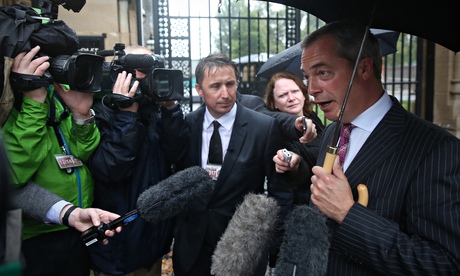
The earthquake was predicted. The aftershocks arrived on cue. Yet, weirdly, none of the media elite huddled inside the London bubble had anything much to say about it – at least via their papers’ leader columns, the hallowed spot where editors (and sometimes proprietors) speak loudest. Clacton? Heywood and Middleton? Once upon a quite recent time Nigel Farage had seemed a bit of a joke, a shyster buffoon who would soon implode. Now he was Frankenstein’s monster, grim stalker of headline territory. Now somebody had to do something about him – except that the press that helped build him up had precious little idea how to pull him down.
“Ukip taps into the rage against Westminster,” said a Guardian editorial as the political dust failed to settle. It’s instructive to inquire where such vitriol – real or assumed – came from. Over to Outrage Central (aka Mail HQ). David Cameron “must finally address the most contentious issue of our time… huge anxiety over continued mass immigration”. And five centimetres to the right, same paper, same page, came Dominic Sandbrook (Malvern College, Balliol Oxford and Jesus Cambridge) addressing those millions of working-class folk who feel themselves “forgotten, ignored and despised by the metropolitan political classes who run this country”.
Yes … well … but … what do these metropolitan legions, including a well-heeled hackocracy quartered just off High Street Ken, actually do about such neglect and contempt, rather than rage on regardless? Surely, as tribunes of the people, they could embrace Farage and his triumphant insurgents? Vote Nigel! Pause for a hollow laugh. The paper most likely to be Ukip’s first catch – a kind of Daily Carswell – is the Express, whose political editor morphed into Farage’s spin doctor and Strasbourg amanuensis. But the Express leader the morning after Clacton offered mush: the “established parties” were “running out of time” to woo back Ukip voters. It was “increasingly likely” that “when the votes are counted in May, Ukip will emerge with number of MPs and a significant share of the vote”. A quavering recital of the bleeding obvious?
Try a mass trawl through matching Fleet Street editorials. Here’s the Daily Telegraph, most dogged of ancestral eurosceptics. “No one should diminish the scale of Ukip’s accomplishment,” it intoned. “But in May 2015 the voters will not be making a protest – they will be choosing a government. And, of the two men who have a realistic prospect of entering Downing Street, it is only David Cameron whose party offers a realistic and pragmatic vision of how to improve their life.” As a faithful Sunday Telegraph editorial argued 24 hours later, there will soon be an “epochal debate between left and right”, with Ukip just a distraction. “There is simply too much at stake” to flirt with Farage.
Yes, yes, but what’s to be actually done now, as time runs out? “Both David Cameron and Ed Miliband have to win over wavering Kippers,” squeaked a muted Bun. “How? By making a promise and actually delivering: simple.” No mention, though, of what that “simple” promise might be. Both main parties “would be better off devising ways to ensure that the people of Britain who have been left behind are brought back into the fold,” the Times concluded, any residual thunder rolling far, far over the horizon. The FT saw “leadership” as the “antidote to protest” in this “age of uncertainty”.
As for Labour, the answer, according to the Mirror, “is to fight on the issues that matter to people, including addressing concerns over immigration – without abandoning good principles and decent values” (a position the Sunday Mirror pushed further, calling for Miliband to mince his last pledge and offer a referendum fast. Meanwhile, in the Guardian’s opinion, “others must muster the courage to take on [Farage] in his own plain-speaking style”. Yet there’s still no very clear notion of when, what or how.
Only the Mail had a seemingly specific policy to peddle. “Mr Cameron must deliver an unequivocal message to Brussels that the EU free movement diktats which have left Britain with little or no control over its borders must be reformed.” Boris Johnson reckons that – as over Schengen with its open borders – we’d be allowed to do something different, to introduce “an Australian-style points regime in which only the brightest and the best would be allowed in”. Could a “forceful” Cameron convince our partners to give him this wizard Oz wheeze? “What is certain is that the choice facing the Tories is stark: find a way of regaining control of our borders, or see more votes bleed away to Ukip and allow Red Ed to enter Downing Street by the back door.”
Well, we’ll see. The Oz formula is a favourite of Nigel’s as well. A harassed Cameron was reported fingering “emergency brakes” and similar wheezes by the Times on Thursday. No doubt, one day, the Mail will get around to explaining why the rest of Europe should rush to Cameron’s rescue; why they’ll be eager to tear up treaty obligations over free movement of labour just before the next general election to save the bacon of one party in the UK’s governing coalition. But hey, at least it’s something to say, however thin, however credulous.
Of course the mighty chorus of Fleet Street columnists isn’t caught in this lip-biting bind. Matthew Parris can (and has) told Clacton which pier to use for a running jump. Peter Hitchens wants dozens of Tory MPs to join Ukip so they can make it a strong third party that can govern in coalition with – er – what’s left of the Conservatives. And there are dozens of variations in between. But columnists are hired to be controversial; editorial columns exist to stake out stable, solid opinions that reflect reader views, staff views, owner views, marketing views.
The Mirror may not put politics first. Its “Ukip earthquake” edition led with something entirely different: “Thousands of kids hit by nude pic hackers.” But Labour party loyalties define it for as long as the working class readers of the north stay on board with Ed. The Telegraph has Torygraph in its DNA. Rupert Murdoch – remember Scotland, only four weeks back? – will want to know who is going to win before he decides who to back. The Mail, a vital part of a seriously big business now boasting 184 million global unique visitors a month, can’t easily flop for Ukip one day then find its business profile fall apart the next. There are challenges and consequences here. Leader columns don’t always lead. On the contrary, they often follow events, of internal necessity. They can be woolly, but not wild.
Which is, perhaps, why the next half-year in British politics and press life will be as intriguing as any in the last half century. Who’ll be elected to govern us next? Ask the pollsters: but they don’t know (though they do know that newspapers were the biggest information source in the Scottish referendum). Who’ll be able to govern effectively once elected? Ask the spin doctors: but they don’t know. How do we get out of this fine mess, please? Ask the leader writers: but they don’t know either. The West Lothian question lies there, without an answer. The Fear and Loathing question is barely posed yet.