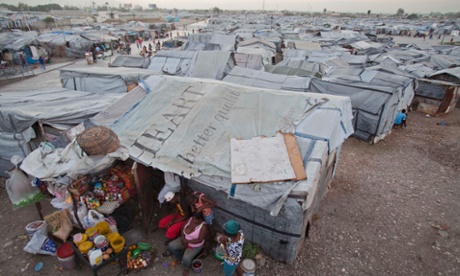
When a powerful earthquake struck Haiti in January 2010, Abasi Deroicier and her four children were left stranded. With her home and small business in ruins, she and her family relocated to the Tabbare Issa refugee camp run by the Red Cross in Port-au-Prince. Soon afterwards, she received an SMS message in Creole to her mobile phone. The message contained a transaction code, which she was able to redeem for $50 at her local remittance shop. The money enabled her to send her children to school and restart her clothing business.
In the days and weeks following the Haiti earthquake, the International Federation of Red Cross and Red Crescent Societies (IFRC) co-ordinated the delivery of buckets, blankets, tarpaulins, kitchen sets and hygiene kits from its global warehouses. It also wanted to provide money to people like Abasi, to enable them to make purchases based on their individual needs.
Transferring cash to those in need is often more useful to recipients than “in kind” aid deliveries like food or blankets. “It recognises the diverse needs of the affected populations”, said Scott DiPretoro, who works in the IFRC’s Panama hub. “It allows them to buy what they have prioritised as being most critical for their individual recovery.” As a result, it is increasingly popular among both providers and recipients. The IFRC responds to an average of 17 disasters each year throughout the Americas. According to an IFRC report, last year 30% of the disaster response and recovery operations in the IFRC Americas Zone included a cash transfer component.
But the instability that permeates in the wake of any disaster makes it unsafe to carry large quantities of cash. “If people find out that you’re going to distribute cash, criminal elements can sometimes get involved so there’s a very real threat to security not only to the Red Cross staff, but also to the beneficiaries that are intended to receive it,” says Scott DiPretoro, who works in the IFRC’s Panama hub.
Digital transfers ensure greater security, speed and accountability. They may also provide a vehicle to promote financial inclusion. “It can be the first time that you introduce someone to the formal banking system,” says Marcella Willis of NetHope, an NGO which enables humanitarian organisations to make smarter use of technology.
Despite its efficacy, transferring cash electronically is not without its problems. Identifying the most appropriate delivery mechanism, contracting the service provider and establishing procedures for its use can take a long time. In Haiti, the IFRC designed a tailor-made digital cash delivery mechanism from scratch to provide funds to beneficiaries like Abasi. The programme was ultimately successful, but the system took months to build and reached far fewer recipients than intended.
These challenges prompted the IFRC to find a safer, quicker and more permanent solution. In 2013 it successfully applied for a Visa Innovation Grant, a fund for development and non-profit organisations seeking to adopt or expand the use of electronic payments to those living below the poverty line. Administered by NetHope, the grant program disburses $500,000 in funding each year.
The IFRC proposed the establishment of a universal electronic cash transfer programme that would operate throughout Latin America and the Caribbean, rather than just across one country. In the event of a disaster it would enable aid workers to distribute prepaid cards quickly to people in need. The cards could then be used by recipients to withdraw cash from an ATM or purchase goods in local shops.
The region is well suited to such a project. More than 80% of Latin Americans live in urban or semi-urban locations, with good access to ATMs and point-of-sale devices.
The programme is progressing well. The IFRC has contracted a service provider to help coordinate cash transfers across the region, trained around 200 Red Cross personnel, and plans to pilot the new disaster response tool soon in order to be prepared for rapid implementation when the next disaster strikes. In a region that has witnessed humanitarian disasters ranging from landslides to cholera, that could come at any moment.
The IFRC project complements others taking place around the world. Last year, the World Food Programme distributed prepaid cards to help feed hundreds of thousands of Syrian refugees.
There’s enormous potential for this initiative. But implementing a cash transfer programme on a global scale presents a variety of challenges. Conflicting financial regulations make the design of a unified processing system difficult. Finding a contractor willing to grapple with the issue, at a reasonable cost, takes time. Aid workers need support and in-depth training in order to use the system effectively.
The IFRC project in Latin America and the Caribbean is a step towards a scaleable, transferable model which could one day be used around the world. “If there was a larger-scale disaster in Asia, we could potentially implement the system based on our experience in the Americas,” DiPretoro said. “If we can standardise it, institutionalise it, it can really revolutionise the way that we provide assistance.”
Content managed and produced by Visa