Closing summary
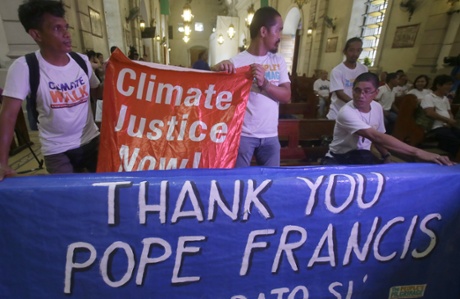
- The Pope has warned of an “unprecedented destruction of ecosystems” and “serious consequences for all of us” if humanity fails to act on climate change, in his encyclical on the environment, published by the Vatican on Thursday.
- Senior Catholic figures in the US and UK have said the Pope’s central message is: what sort of world do we want to leave for future generations?
- The UN secretary general, the World Bank president, plus the heads of the UN climate talks and the UN environment programme have all welcomed the encyclical, along with scores of charities and faith groups.
- Church leaders will brief members of Congress on the encyclical on Thursday, and the White House on Friday on the encyclical. “It is our marching orders for advocacy,” said Joseph Kurtz, the president of the US Conference of Catholic Bishop
Updated
Our Rome correspondent Stephanie Kirchgaessner has filed a new report on the encyclical and reaction to it. Here’s an extract:
Cardinal Peter Turkson, the pope’s top official on social and justice issues, flatly rejected arguments by some conservative politicians in the US that the pope ought to stay out of science.
“Saying that a pope shouldn’t deal with science sounds strange since science is a public domain. It is a subject matter that anyone can get in to,” Turkson said at a press conference on Thursday.
The pontiff’s upcoming document is being hailed as a major intervention in the climate change debate – but what exactly is an encyclical?
In an apparent reference to comments by Republican presidential contender Jeb Bush, who said he did not take economic advice from the pope, Turkson said that politicians had the right to disregard Francis’s statement, but said it was wrong to do so based on the fact that the pope was not a scientist.
“For some time now it has been the attempt of the whole world to kind of try to de-emphasise the artificial split between religion and public life … as if religion plays no role,” he said. Then, quoting an earlier pope, he said the best position was to “encourage dialogue between faith and reason”.
I’m going to finish up the liveblog now and we’ll be switching to rolling news coverage on the Guardian’s environment site.
The secretary-general welcomes the papal encyclical released today by His Holiness Pope Francis which highlights that climate change is one of the principal challenges facing humanity, and that it is a moral issue requiring respectful dialogue with all parts of society. The secretary-general notes the encyclical’s findings that there is “a very solid scientific consensus” showing significant warming of the climate system and that most global warming in recent decades is “mainly a result of human activity”.
Ban called on governments to “place the global common good above national interests and to adopt an ambitious, universal climate agreement” at the UN climate summit in Paris this December.
There are shades of the Pope’s own language there. In the encyclical, he says: “International [climate] negotiations cannot make significant progress due to positions taken by countries which place their national interests above the global common good”.
US church leaders said they saw the message as an urgent call for dialogue and action – one they intend to amplify on social media and in the pulpit.
“It is our marching orders for advocacy,” Joseph Kurtz, the president of the US Conference of Catholic Bishops and the Archbishop of Louisville. “It really brings about a new urgency for us.”
Church leaders will brief members of Congress on Thursday, and the White House tomorrow on the encyclical.
Kurtz deflected criticism from Republican president contenders such as Jeb Bush that the Pope was straying from the pulpit into political terrain.
“I don’t think he is presenting a blue print for saying this is exactly a step by step recipe,” Kurtz said. “He is providing a framework and a moral call as a true moral leader to say take seriously the urgency of this matter.”
Here’s a selection of some more US faith group reaction:
Most Reverend Stephen E. Blaire, Bishop of the Catholic Diocese of Stockton:
This document written for all people of good will challenges institutions and individuals to preserve and respect creation as a gift from God to be used for the benefit of all.
Rabbi Marvin Goodman, Rabbi in Residence, Jewish Community Federation and Endowment Fund, San Francisco:
I’m inspired and grateful for the Pope’s high profile leadership and commitment to environmental justice.
Imam Taha Hassane, Islamic Center of San Diego:
Local and National Muslim Leadership support policies that both halt environmental degradation and repair that which has already occurred. We stand with any leader, secular or spiritual, who is willing to speak out against this issue.
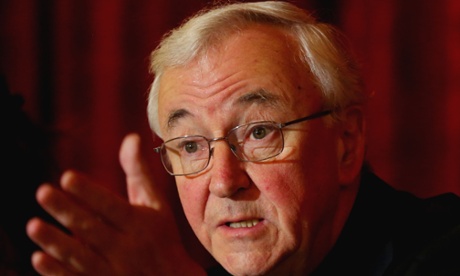
Cardinal Vincent Nichols in the UK has echoed US Archbishop Joseph Edward Kurtz in his view of what the Pope’s central message is: what sort of world do we want to leave for future generations to inherit?
The Press Association reports:
Speaking at Our Lady & St Joseph’s Catholic Primary School, in Poplar, east London, against the backdrop of the skyscrapers of Canary Wharf, Cardinal Vincent Nichols said one of the key messages of the document was asking “what kind of world we want to leave to those who come afterwards”.
The pope’s message challenged the idea that infinite material progress was possible, with more goods and more consumption, that “we have to have the latest phone”, said the cardinal, who is head of the Catholic Church in England and Wales.
The US House of Representatives’ Sustainable Energy and Environment Coalition says – in an apparent reference to climate denial on the US right – that “the political will of many is still askew” when it comes to tackling global warming. It hopes the Pope’s encyclical might change that:
For those unmoved by the science of climate change, we hope that Pope Francis’ encyclical demonstrates the virtue and moral imperative for action. Today’s announcement further aligns the scientific and moral case for climate action, yet the political will of many is still askew. The time to act on climate is now, and failure to do so will further damage the planet, its people, and our principles.
Michael Brune, the executive director of the US-based Sierra Club, which has more than 2m members, and has waged a very effective campaign against coal power plants, said:
Pope Francis’s guidance as a pastor and a teacher shines a light on the moral obligation we all share to address the climate crisis that transcends borders and politics. This Encyclical underscores the need for climate action not just to protect our environment, but to protect humankind and the most vulnerable communities among us. The vision laid out in these teachings serves as inspiration to everyone across the world who seeks a more just, compassionate, and healthy future.
Updated
And talking of short reads, I’ve written a little piece on eight things we learned from the encyclical.
In case you don’t have enough time to read the 100+ page encyclical itself (the length varies depending on the language and font size of the versions kicking around), we’ve published an extract of some key passages here.
Some more reaction from UK charities on how governments meeting in Paris later this year should listen to the Pope.
Adriano Campolina, chief executive of ActionAid International, said:
The Pope’s message highlights the important links between climate change, poverty and overconsumption. They are part of the same problem and any lasting solution to climate change must tackle these fundamental issues.
The powerful truth in Pope Francis’ message reaches far beyond the Catholic Church or climate campaigners. Action on climate requires both environmental and social justice. As negotiators work on a climate deal for Paris, our leaders must show the same moral and political courage that Pope Francis has.
Christian conservation group A Rocha said: “national governments should follow the Pope’s example and take ‘meaningful action’ on climate change”.
One of the most senior figures in the US Catholic church, Joseph Edward Kurtz, Archbishop of Louisville, has been speaking at a US press conference. He said that that perhaps the central message of the encyclical is: what kind of world do we want to leave to those who come after us?
Here are some highlights from Kurtz:
It’s really a very beautiful and very extensive treatment of what Pope Francis has called our common home.
...
The Pope over and over again says that care for the things of this Earth is necessarily bound with care for one another and especially those who are poor. He calls it an interdependency.
...
He speaks on very indivudal choices as well as the public sphere
...
Over and over again he talks about the world as a gift
...
He uses a phrase he’s used very often: to reject a throwaway culture.
...
He talks about very specific things, about slums in which people are forced to live, the lack of clean water, about the consumerism mentality.
And that perhaps this is the centre of his message: what kind of world do we want to leave to those who come after us?
...
Our pope is speaking with a very much pastor’s voice and with a deep respect for the role of science.
…
Three essential areas that our Catholic community is being called to being involved in:
1) to advocate, a local, national and global level, to advocate for the common good. We know that faith if done well, actually enriches public life. And we know that technology tells us what we can do, but we need moral voices that tell us what we should do
2) [the video cut out at this point so I’m afraid I missed his second point]
3) The use of our resources, in whole we build buildings, should honour the Earth
Here’s the Pope himself on that issue of what we leave future generations:
Leaving an inhabitable planet to future generations is, first and foremost, up to us. The issue is one which dramatically affects us, for it has to do with the ultimate meaning of our earthly sojourn.
We may well be leaving to coming generations debris, desolation and filth. The pace of consumption, waste and environmental change has so stretched the planet’s capacity that our contemporary lifestyle, unsustainable as it is, can only precipitate catastrophes, such as those which even now periodically occur in different areas of the world. The effects of the present imbalance can only be reduced by our decisive action, here and now.
We’ve just published a video of the encyclical’s launch this morning:
Summary
- The Pope has warned of an “unprecedented destruction of ecosystems” and “serious consequences for all of us” if humanity fails to act on climate change, in his encyclical on the environment, published by the Vatican on Thursday
- The pontiff said that the world should phase out coal in favour of gas, while renewable energy technology scales up
- He is particularly sceptical and evenly openly hostile at times to technological and business-led solutions to global warming
- The heads of the UN climate talks and the UN environment programme have said the Pope’s intervention should act as a “clarion call” for governments meeting in a bid to work out a climate change deal at a summit in Paris later this year
- The World Bank’s president has welcomed the Pope’s “emphasis on our moral obligation to act” and economist Nicholas Stern says the encyclical is enormously significant
- Cardinal Peter Turkson said it was US Republicans’ “freedom of choice” to ignore the Pope’s call for climate change action, following presidential candidate Jeb Bush saying he wouldn’t take economic advice from the Pope
Updated
World Bank group president Jim Yong Kim said:
Today’s release of Pope Francis’ first encyclical should serve as a stark reminder to all of us of the intrinsic link between climate change and poverty. We know the scientific, business and economic case for action to combat climate change and I welcome the pope’s emphasis on our moral obligation to act.
He added:
The pope’s encyclical comes at a pivotal moment in the lead up to December’s Paris meeting on climate change.
Here’s some more reaction from religious groups, who say people should heed the Pope’s call to action.
Dr Guillermo Kerber of the World Council of Churches, which has previously promised to rule out future investments in fossil fuels, said:
The World Council of Churches welcomes Pope Francis’ encyclical which catalyses what churches and ecumenical organizations have been doing for decades on caring for the earth and climate justice issues. By affirming human induced climate change and its impacts on the poorest and most vulnerable communities, the Encyclical is an important call to urgently act as individuals, citizens and also at the international level to effectively respond to the climate crisis.
Dr. Steven Timmermans, executive director of the Christian Reformed Church in North America, said:
We affirm Pope Francis’ moral framing of the threats posed by climate change. We have too many brothers and sisters around the world living on the edge of poverty whose livelihoods are threatened—and too many little ones in our congregations set to inherit a dangerously broken world—to believe otherwise. For too long the church has been silent about the moral travesty of climate change. Today, the Pope has said, ‘Enough is enough,’ and the Christian Reformed Church welcomes his voice.
Sister Pat McDermott, president of the Sisters of Mercy of the Americas, said:
We welcome Pope Francis’ critique of the current, dominant economic model that prioritizes the market, profit and unharnessed consumption and regards Earth as a resource to be exploited.
Updated
Rev. Mitch Hescox, president of the US-based Evangelical Environmental Network, which lobbies American politicians on environmental issues, welcomed the Pope’s encyclical. He said:
It’s time to make hope happen by fuelling the unstoppable clean energy transition, stopping the ideological battles, and working together.
Creating a new energy economy that benefits all and addresses climate change is not about a political party but living as a disciple of Jesus Christ. We urge all people of good will, especially fellow Christian conservatives to read and study these timely words from Pope Francis.
The New York Times’ Justin Gillis says (fairly, in my opinion) that the Pope is more cautious on the science behind climate change than many scientists.
...amid all his soaring rhetoric, did the pope get the science right?
The short answer from climate and environmental scientists is that he did, at least to the degree possible in a religious document meant for a broad audience. If anything, they say, he may have bent over backward to offer a cautious interpretation of the scientific facts.
For example, a substantial body of published science says that human emissions have caused all the global warming that has occurred over the past century. Yet in his letter, Francis does not go quite that far, citing volcanoes, the sun and other factors that can influence the climate before he concludes that “most global warming in recent decades is due to the great concentration of greenhouse gases” released mainly by human activity.
The world’s most authoritative body on climate science, the UN’s Intergovernmental Panel on Climate Change, found in its landmark report last year that global warming is “unequivocal” and humanity’s role in causing it is “clear”.
The Pope is surprisingly specific on what he does like, and sees as part of the solutions to climate change.
For instance, he name-checks energy storage, something that Tesla’s Elon Musk made waves with over his recent announcement of a home battery, and is seen in some quarters as important to help alleviate the intermittent nature of some renewable power.
Worldwide there is minimal access to clean and renewable energy. There is still a need to develop adequate storage technologies.
And he likes community green energy schemes, akin to one in a UK village that was the site of the country’s biggest anti-fracking protests but now hopes to build a sizeable solar power installation:
In some places, cooperatives are being developed to exploit renewable sources of energy which ensure local self-sufficiency and even the sale of surplus energy. This simple example shows that, while the existing world order proves powerless to assume its responsibilities, local individuals and groups can make a real difference.
Bob Perciasepe of US thinktank Center for Climate and Energy Solutions, has blogged on the unique role the Pope can play in the climate change arena and how he might influence American minds:
Scientists, environmentalists, politicians, business executives, and military leaders have all raised concerns for years about the real risks of climate change. But few individuals are as influential as the pope. By calling on people to act on their conscience, Pope Francis provides a powerful counterpoint to what has become a largely ideologically-driven debate, especially here in the United States.
Nicholas Stern, the economist and author of an influential report on climate change, said the encyclical was of “enormous significance”.
The publication of the Pope’s encyclical is of enormous significance. He has shown great wisdom and leadership. Pope Francis is surely absolutely right that climate change raises vital moral and ethical issues. It is poor people around the world who are most vulnerable to the impacts of climate change, such as an intensification of extreme weather events. And the decisions that we make about managing the risks of climate change matter not only for us, but also for our children, grandchildren and future generations.
He added:
Moral leadership on climate change from the Pope is particularly important because of the failure of many heads of state and government around the world to show political leadership.
And here’s what the Pope himself says about world leaders’ failure to act on climate change and environmental problems:
Many of those who possess more resources and economic or political power seem mostly to be concerned with masking the problems or concealing their symptoms, simply making efforts to reduce some of the negative impacts of climate change.
Updated
The pope’s effort to sever the link between population growth and environmental deterioration should not, however, detract from the importance of what else he has to say. This is the first encyclical to be devoted entirely to environmental issues, though it is certainly not the first time a pope has spoken out on the destruction of the environment.
As the encyclical notes, Paul VI first raised the issue as long ago as 1971, describing it as a “tragic consequence” of uncontrolled human activity. Saint John Paul II and his successor, Benedict XVI, inveighed against mankind’s ill-treatment of nature – or as they viewed it, creation.
Far more explicitly than his predecessors, however, Francis heaps the blame on to the part of humanity that is rich. He accepts that the poorer nations should “acknowledge the scandalous level of consumption in some privileged sectors of their population and … combat corruption more effectively.” They ought also to develop less pollutant sources of energy.
Read more in my analysis of the encyclical, published here.
The Pope suggests that you can’t care about nature and support abortion, which the Catholic church strongly opposes:
Since everything is interrelated, concern for the protection of nature is also incompatible with the justification of abortion. How can we genuinely teach the importance of concern for other vulnerable beings, however troublesome or inconvenient they may be, if we fail to protect a human embryo, even when its presence is uncomfortable and creates difficulties?
The other elephant in the room is birth control and overpopulation, though the Pope seems to have anticipated criticism on that. He takes the line, supported by many environmentalists, that consumption is the problem, not overpopulation. The encyclical says:
To blame population growth instead of extreme and selective consumerism on the part of some, is one way of refusing to face the issues.
Updated
The head of the UN’s environment programme, Achim Steiner, has echoed the UN’s climate chief in saying today’s text should be a clarion call for action.
This encyclical is a clarion call that resonates not only with Catholics, but with all of the Earth’s peoples. Science and religion are aligned on this matter: The time to act is now.
We (UNEP) share Pope Francis’ view that our response to environmental degradation and climate change cannot only be defined by science, technology or economics, but is also a moral imperative. We must not overlook that the world’s poorest and most vulnerable suffer most from the changes we are seeing. Humanity’s environmental stewardship of the planet must recognise the interests of both current and future generations.
Updated
The Pope on biodiversity loss, GM and more
On the loss of species and ecosystems
Each year sees the disappearance of thousands of plant and animal species which we will never know, which our children will never see, because they have been lost for ever. The great majority become extinct for reasons related to human activity.
...
a sober look at our world shows that the degree of human intervention, often in the service of business interests and consumerism, is actually making our earth less rich and beautiful, ever more limited and grey, even as technological advances and consumer goods continue to abound limitlessly. We seem to think that we can substitute an irreplaceable and irretrievable beauty with something which we have created ourselves.
On GM
It is difficult to make a general judgement about genetic modification (GM) ... The risks involved are not always due to the techniques used, but rather to their improper or excessive application ... This is a complex environmental issue
On water quality
One particularly serious problem is the quality of water available to the poor. Every day, unsafe water results in many deaths and the spread of water-related diseases, including those caused by microorganisms and chemical substances.
On fossil fuels
We know that technology based on the use of highly polluting fossil fuels – especially coal, but also oil and, to a lesser degree, gas – needs to be progressively replaced without delay. Until greater progress is made in developing widely accessible sources of renewable energy, it is legitimate to choose the lesser of two evils or to find short-term solutions.
Updated
At the Vatican press conference, Peter Turkson, a Ghanian cardinal of the Catholic church, says US climate sceptics are entitled to their view.
“The other big thing about Republicans and presidential figures saying they will not listen to the Pope is that is their freedom, their freedom of choice,” he said, in an apparent reference to Jeb Bush (see 11:21).
He said “it’s easy to say because the Pope is not a scientist he shouldn’t talk about science”, and said “I would not attach much credibility” to those criticisms.
At 1.30pm BST, Donald William Wuerl, one of five cardinals who lead the US archdiocese, will be holding a press conference on the encyclical. I’ll try to summarise some of it here on the blog.
The pontiff included a personal handwritten note in his communication. It ended with a plea for help: “United in the lord, and please do not forget to pray for me.”
"In bond of unity, charity and peace," Pope entrusts #LaudatoSi to world's bishops w/ personal note, asks prayers: pic.twitter.com/bJ9fXGvbnC
— Rocco Palmo (@roccopalmo) June 18, 2015
On technology and business
One recurring motif throughout the encyclical is a general scepticism or outright hostility to technological solutions to environmental challenges, and to the role that big business should play in tackling climate change.
For example:
Technology, which, linked to business interests, is presented as the only way of solving these problems, in fact proves incapable of seeing the mysterious network of relations between things and so sometimes solves one problem only to create others
...
To seek only a technical remedy to each environmental problem which comes up is to separate what is in reality interconnected and to mask the true and deepest problems of the global system.
He doesn’t like carbon trading either. In this passage he seems to be referring to the only current global carbon trading scheme, the CDM:
The strategy of buying and selling “carbon credits” can lead to a new form of speculation which would not help reduce the emission of polluting gases worldwide. This system seems to provide a quick and easy solution under the guise of a certain commitment to the environment, but in no way does it allow for the radical change which present circumstances require. Rather, it may simply become a ploy which permits maintaining the excessive consumption of some countries and sectors.
And some sections sound like they could have been ghostwritten by Guardian columnist George Monbiot:
Is it realistic to hope that those who are obsessed with maximizing profits will stop to reflect on the environmental damage which they will leave behind for future generations?
The Pope isn’t just concerned about climate change. He has some very colourful turns of phrase about other environmental problems, such as pollution and waste:
The earth, our home, is beginning to look more and more like an immense pile of filth. In many parts of the planet, the elderly lament that once beautiful landscapes are now covered with rubbish.
The Pope on climate change and the science
Here’s the English version of the encyclical on the Vatican’s site.
The Pope makes reference to the huge body of work by national science academies and international bodies such as the IPCC on climate science:
A very solid scientific consensus indicates that we are presently witnessing a disturbing warming of the climatic system.
He warns of serious consequences if we don’t act on climate change:
If present trends continue, this century may well witness extraordinary climate change and an unprecedented destruction of ecosystems, with serious consequences for all of us.
As many studies have already pointed out, the Pope notes that the world’s poor are expected to suffer most from global warming:
It [climate change] represents one of the principal challenges facing humanity in our day. Its worst impact will probably be felt by developing countries in coming decades. Many of the poor live in areas particularly affected by phenomena related to warming, and their means of subsistence are largely dependent on natural reserves and ecosystemic services such as agriculture, fishing and forestry.
The message brought an outpouring of support from environmental groups, climate scientists, and leaders of all religions, eager to counter a series of pre-emptive attacks on the Pope from conservatives.
The response was a first glimpse of a vast and highly organised mobilisation effort around the letter visit, and a papal visit to the US in September.
The Pope will get an another chance to exhort leaders to act – this time in person – when he addresses both houses of Congress.
With that high profile visit in mind, campaigners argued the Pope’s intervention had re-set the parameters of the discussion surrounding climate change, from narrow political agenda to broader morality. The Pope’s message was above religion, they said.
“The Pope’s message applies to all of us,” said Rhea Suh, president of the Natural Resources Defense Council. “He is imploring people of good will everywhere to honour our moral obligation to protect future generations from the dangers of further climate chaos by embracing our ethical duty to act,” she said.
Cafod, the Catholic charity went so far as to suggest that that was the Pope’s design all along.
“The Pope has deliberately released the encyclical in a year of key UN moments that will affect humanity,” said Neil Thomas, director of advocacy. “He is reading the signs of his times and telling us that the human and environmental costs of our current way of life are simply too high.”
Ray Bradley, the climate scientist, said: “He has no political agenda. He speaks from the heart (not the Heartland) with unimpeachable moral authority. Who else can address this issue without the taint of politics? Moreover, Pope Francis has a particular responsibility to those without a voice at the centres of power in affluent countries.
But the Pope’s message is expected to resonate most strongly among the environmental campaigners operating within the Church.
For activist priests and nuns, who have lobbied oil companies and called on their own parishes to divest, the encyclical puts the Vatican’s stamp of approval on years of effort, often at the sidelines.
That on its own has galvanised campaigners, said Sister Joan Brown, a Franciscan in New Mexico who has worked on climate change for more than 20 years.
“I’ve never seen anything like this in the faith community or otherwise,” she said.
The pope’s message set off a flood of new activity that has been more than a year in the planning.
In deference to the Pope, mainstream environmental groups will be operating in the background.
“We’ve been asking environmental groups to hold back on this...so that the message isn’t one that would maybe cause more polarisation, rather than less,” Sister Joan said.
But the Catholic church – and activist wings among other religious communities – are jumping in to try and amplify thePope’s message and build momentum for action on climate.
The archbishop’s office in Atlanta signed up scientists and engineers to help parishes, and parishioners, reduce their carbon footprint. The Bishop of Des Moines is planning to hold a press conference at a wind farm.
The Evangelical Environmental Network also came out strongly behind the Pope.
More than 300 rabbis signed on to a letter calling on Jewish institutions and individuals to divest from “carbon Pharaohs” or coal-based electric power, and buy wind power instead.
Updated
Observers of the climate talks and Christian, development and environment groups have warmly welcomed the Pope’s encyclical.
Former UN general secretary Kofi Annan, said:
As Pope Francis reaffirms, climate change is an all-encompassing threat: it is a threat to our security, our health, and our sources of fresh water and food ... I applaud the Pope for his strong moral and ethical leadership. We need more of such inspired leadership. Will we see it at the climate summit in Paris?
Penny Lawrence, Oxfam’s deputy chief executive, said:
The Pope is right – climate change is a problem for all of humanity that is hitting the world’s poorest hardest. His words could and should add real urgency to efforts to protect people and planet. World leaders meeting at the UN climate talks in Paris later this year should be in no doubt that the world expects them to put aside short-term national interest and move us all closer to a safer and more prosperous future.
Andrew Steer, president and chief executive of the US-based World Resources Institute:
The pope’s message brings moral clarity that the world’s leaders must come together to address this urgent human challenge. This message adds to the global drumbeat of support for urgent climate action. Top scientists, economists, business leaders and the pope can’t all be wrong.
Updated
The encyclical is unimpressed by those who deny the science of climate change:
regrettably, many efforts to seek concrete solutions to the environmental crisis have proved ineffective, not only because of powerful opposition but also because of a more general lack of interest. Obstructionist attitudes, even on the part of believers, can range from denial of the problem to indifference, nonchalant resignation or blind confidence in technical solutions.
The pushback from Republican and the rest of the US right, where climate scepticism is a badge of honour, has already begun. Jeb Bush, the Republican presidential candidate, said yesterday: “I hope I’m not going to get castigated for saying this by my priest back home, but I don’t get economic policy from my bishops or my cardinal or my pope.”
And as our US environment correspondent Suzanne Goldenberg found out last week at a gathering of US climate sceptics, the Pope’s encyclical is at the top of their list of concerns.
The Pope has invited his 6m Twitter followers to take notice of his encyclical today, too:
I invite all to pause to think about the challenges we face regarding care for our common home. #LaudatoSi
— Pope Francis (@Pontifex) June 18, 2015
As a mock movie trailer for the encyclical put it earlier this week, he’s “an easy man to follow and a hard man to silence”.
The Pope on UN climate talks
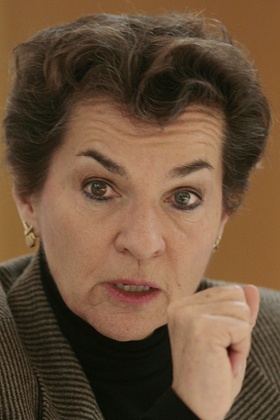
Christiana Figueres, the UN’s climate chief, says the Pope’s intervention should act as a “clarion call” for a strong deal at Paris:
Pope Francis’ encyclical underscores the moral imperative for urgent action on climate change to lift the planet’s most vulnerable populations, protect development, and spur responsible growth. This clarion call should guide the world towards a strong and durable universal climate agreement in Paris at the end of this year. Coupled with the economic imperative, the moral imperative leaves no doubt that we must act on climate change now.
But the Pope isn’t very impressed by more than 20 years of UN climate talks. He says the annual summits have produced “regrettably few” advances on efforts to cut carbon emissions and rein in global warming. The encyclical says:
It is remarkable how weak international political responses have been. The failure of global summits on the environment make it plain that our politics are subject to technology and finance. There are too many special interests, and economic interests easily end up trumping the common good and manipulating information so that their own plans will not be affected.
I’ve just uploaded the English version of the encyclical on Scribd. I’ll be posting some of the highlights here on the live blog shortly.
Updated
John Schellnhuber, Angela Merkel’s climate adviser and a leading climate change scientist, is punning his way through a presentation at the encyclical’s launch, “praying” his Powerpoint will work.
Of the encyclical, he said:
it is very unique in the sense that it brings together two strong powers in the world, namely faith and moral and on the other reason and ingenuity. It’s an environmental crisis but also a social crisis. These two things together pose an enormouse challenge. Only if these two things work together, faith and reason, can we overcome it
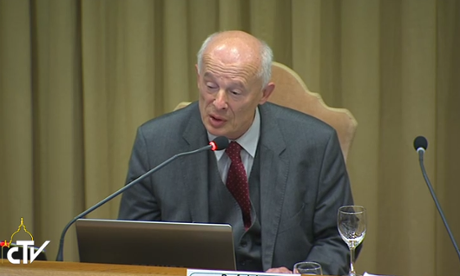
A spokesman for the Vatican told a packed press conference in the Vatican audience hall this morning that in his 25 years there he has worked there, he has never seen as much prolonged, global and intense anticipation for a single document, AP reports.
The press conference is being live-streamed on YouTube:
At 11am the Vatican will publish the Pope’s long-awaited encyclical on the environment, following its leak earlier this week by an Italian magazine.
The more-than-100 page text is wide-ranging, majoring on climate change, but also touching on pollution, biodiversity loss, the oceans, man’s modern relationship with nature, the dangers of relying on the markets and technology, and overconsumption.
In case you’re wondering what an encyclical is, our southern Europe editor John Hooper, has a great Q&A here on their history and the importance the documents carry.
The more than 190 countries involved in the international climate change will be keenly watching the text too – it could have a big impact on the talks ahead of a major summit in Paris later this year.
Updated