Recent polls continue to point to a comfortable Coalition win – polls from the last week or so are summarised in the table below.
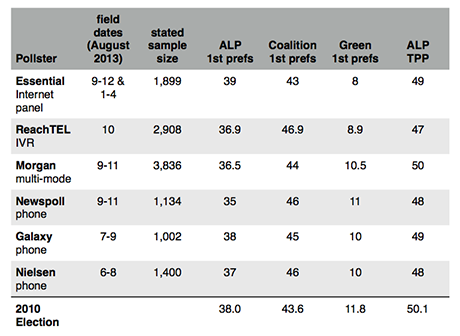
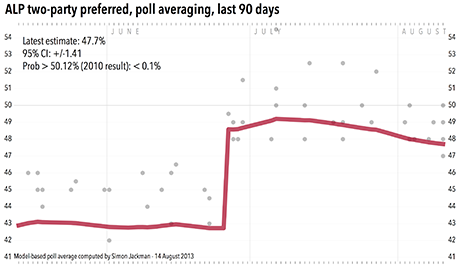
My model-based poll average puts Labor on 47.7% on a two-party preferred basis (ie once the smaller parties' preference votes have been redistributed). This is substantially and unambiguously below the 50.12% two-party preferred result Labor obtained at the 2010 election (see graph below).
Could these polls be underestimating Labor's support? Does landline-based telephone polling, for instance, under-represent Labor if mobile-only voters disproportionately favour the ALP and/or the Greens and they are systematically excluded?
Possibly. But I doubt this is a large source of bias in the polling we're seeing at the moment. My analysis of 2010 polling also suggests the industry does not suffer from anti-Labor bias.
Phone pollsters everywhere are grappling with the mobile-only problem, and have been doing so for some time. Weighting adjustments can help, ensuring that the distributions by age, gender, state, urban/rural, education, and so on all match those in the census.
And it is worth noting that the mobile-only problem existed in 2010 too. Did the pollsters underestimate Labor support then? The table below summarises how some of the major pollsters performed before the 2010 election. Labor ended up winning 37.99% of first preferences, and 50.12% TPP. No major pollster underestimated Labor's TPP share, and on first preferences only Newspoll and JWS underestimated the ALP's share.
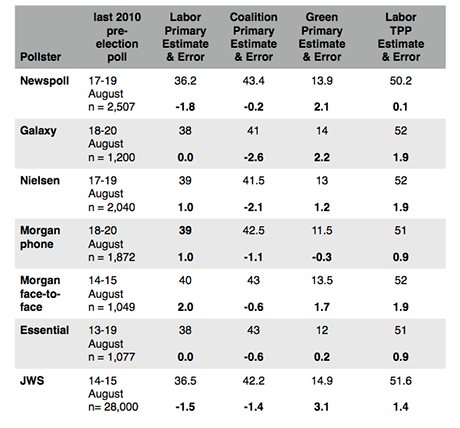
So there doesn't seem to be a problem in the Australian polling industry with underestimating the Labor vote. If anything, the problem in 2010 ran the other way, with the industry collectively tending to overestimate it. Note that a mix of modes are represented in the pollsters I include here: IVR (or "robo-polling"), live phone interviewing, face-to-face, and self-completion by members of internet panels.
My statistical model makes pollster-specific corrections when combining the polls. The accuracy of the pollsters in the 2010 election is an important component of this part of the model.
But even if we assume that collectively the polling industry is totally unbiased, with pollster-specific biases "averaging out" to zero, we get only a slightly higher estimate of Labor vote share: 49.2% +/- 1.1pp, corresponding to a 4% probability that Labor is outperforming its 2010 result (50.12% TPP).
Under either set of assumptions, current polling points to the Coalition almost surely winning. The polls would have to be wrong in a way that we haven't seen in previous Australian election cycles for any other conclusion to hold.