Clark Terry – Pennies from Heaven
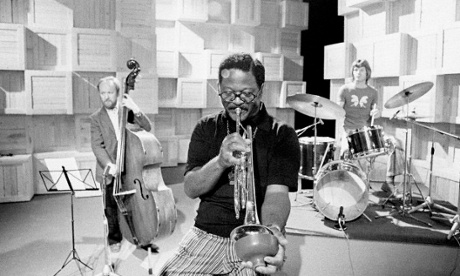
Next time you hear an early Miles Davis track, or a gig by Wynton Marsalis, consider Clark Terry – the congenially brilliant former Duke Ellington trumpeter who influenced both, and who died on 21 February at the age of 94. Maybe Terry’s name isn’t first out of the traps when fans reel off their list of jazz favourites, but he embodied some of the music’s most open virtues, such as generosity, warmth, wit, lack of vanity and pride in craftsmanship. He mentored Miles Davis when they were at school together in St Louis, Missouri, played in Ellington’s and Count Basie’s swing bands, and in 1960 became the first African-American person to be hired for NBC television’s studio orchestra. After years in studio work, Terry began touring in the 70s with some terrific international lineups – including this furiously straight-swinging one at Montreux in 1977, featuring pianist Oscar Peterson, vibraphonist Milt Jackson, and Ronnie Scott in typically laconic form on tenor sax.
Antonio Sánchez – Birdman interview
I touched on drummer Antonio Sánchez’s soundtrack for Birdman in a previous post, but have no apologies for returning to it now that the movie has swept the board at the Oscars. Since then, BBC Radio 3’s Jazz on 3 has interviewed Sánchez about collaborating with Alejandro González Iñárritu. Because the Birdman soundtrack also featured music by other composers, Sánchez wasn’t eligible for an Oscar nomination. But anyone with half an ear open to how crucial his drum sound and his improv skills were to the atmosphere of that movie will know what a miscarriage of justice that was. The full Jazz on 3 Sánchez interview and solo performance is on BBC iPlayer.
Leo Blanco – El Negro y el Blanco
On a chilly night this February, a muffled and wool-hatted Leo Blanco sat at the piano of London’s Vortex jazz club rubbing his hands. He then set off the kind of ebullient trip through contemporary piano methods and byways of traditional and modern Latin-American music that makes his modest international reputation hard to fathom. The Venezuelan musician matches a jazz pianist’s spontaneity with scholarly insights into the most uncliched and unfamiliar tributaries of Latin music. He currently teaches improv methods to classical musicians at Boston’s Berklee College of Music. Blanco has a sweeping self-sufficiency as a solo player, but in the US he plays with all kinds of bands, from orchestras to trios. Case in point: this performance with bassist Fernando Huergo and drummer Pablo Bencid, at Washington’s Kennedy Center in 2008.
Chet Baker – My Funny Valentine
Just to show that being a jazzer doesn’t always mean a rejection of the naff and sentimental, here’s a song that drifted back on to my radar on Valentine’s Day. Chet Baker’s My Funny Valentine made a star of the young trumpeter in the 1950s, and the song became a signature feature of the uneven but sometimes exquisite performances he delivered for the rest of his unquiet life. Baker’s performance is both intimate and distant, a disjunction that represents the story of his life and which may be the reason for its popularity. Watching him sing this at Ronnie Scott’s in the 80s, with his junkie’s haggardness and indolent drawl, it felt a long way from a sentimental song. But it didn’t feel like one when he first did it as a James Dean-style jazz poster boy in the 50s, either.
Troyka – Life Was Transient
This British jazz improv and electronica trio recently released the big-sounding album Ornithophobia. The texture and diversity that Troyka’s gifted pianist, Kit Downes – who made his name in 2008 in a postbop band – has brought as an ensemble player has been intriguing to witness. Guitarist Chris Montague and drummer Joshua Blackmore join him with the same close-listening spirit. It’s a trio devoted to jump-cut restlessness, but without sacrificing an affection for melody.
Jeanette – Porque Te Vas?
Confession time: I listening to a piece of almost painfully nice 70s Spanish pop music for weeks. The Europe-wide hit Porque Te Vas? (Why Are You Leaving?) is the unsettlingly perky anthem in Carlos Saura’s dark 1976 film Cría Cuervos. I wouldn’t really recommend trawling the web to hear more from the London-born Spanish pop singer’s career (although Michael Jackson was reportedly interested in working with her), but I’d certainly recommend watching Cría Cuervos. It is a claustrophobically gripping domestic drama with an anti-Franco undertow, and features Spirit of the Beehive child star Ana Torrent.
Sinikka Langeland – Triumf Att Finnas Till
The ice-bright eloquence of Norwegian folk singer Sinikka Langeland might be just the antidote to Porque Te Vas? Born to Norwegian and Finnish parents, Langeland has developed an interest in both cultures. At 20, she switched from guitar to the kantele (Finnish harp), and her career evolved from performing traditional folk and church music, along with medieval songs, to collaborating with jazz musicians. Langeland’s latest, The Half-Finished Heaven, is out now. Here she is in 2011 with two of the players from that session – saxophonist Trygve Seim and drummer Markku Ounaskari.
Vanilla Fudge – You Keep Me Hangin’ On
At risk of alienating jazz audiences even more, here is another piece of ancient pop music that signed off the Mad Men premiere of its final season. It brought back vivid memories when I watched it recently. New York psychedelic band Vanilla Fudge covered the Motown hit You Keep Me Hangin’ On in 1967, the summer John Coltrane died (although I was barely aware of him at the time). This weird, dirge-like version still exerts the strange pull now that it did then.
Eberhard Weber – The Whopper
The great German bassist and composer Eberhard Weber turned 75 in January. Although he no longer plays, following a stroke in 2007, he was a vibrant presence at his 75th birthday concert in Stuttgart, where Pat Metheny, Jan Garbarek, vibraphonist Gary Burton and others helped him celebrate. In the 70s, Weber was one of the first ECM Records artists, helping to establish the fledgling label’s reputation for a spacious and atmospheric music completely different from the dominant jazz sounds of the time. (The release this month of the album Encore proves he’s still doing it, now as a producer and resampler of his own unique bass solos for Garbarek’s group.) Here he is with Pat Metheny back in the day, sharing bass duties with Steve Swallow on The Whopper, a Metheny composition from the Gary Burton’s 1977 album Passengers.
Matthew Bourne and Franck Vigroux
The pianist-turned-experimental composer Matthew Bourne is joined by Franck Vigroux on electronics along with installation artist Antoine Schmitt, on a live reimagining of Kraftwerk’s 1975 album Radio-Activity. (In March, Bourne joins Radioland on a UK tour that pays tribute to the recording.) They rely on an arsenal of old-school and cutting-edge technology, along with Schmitt’s unfolding computer-generated video.