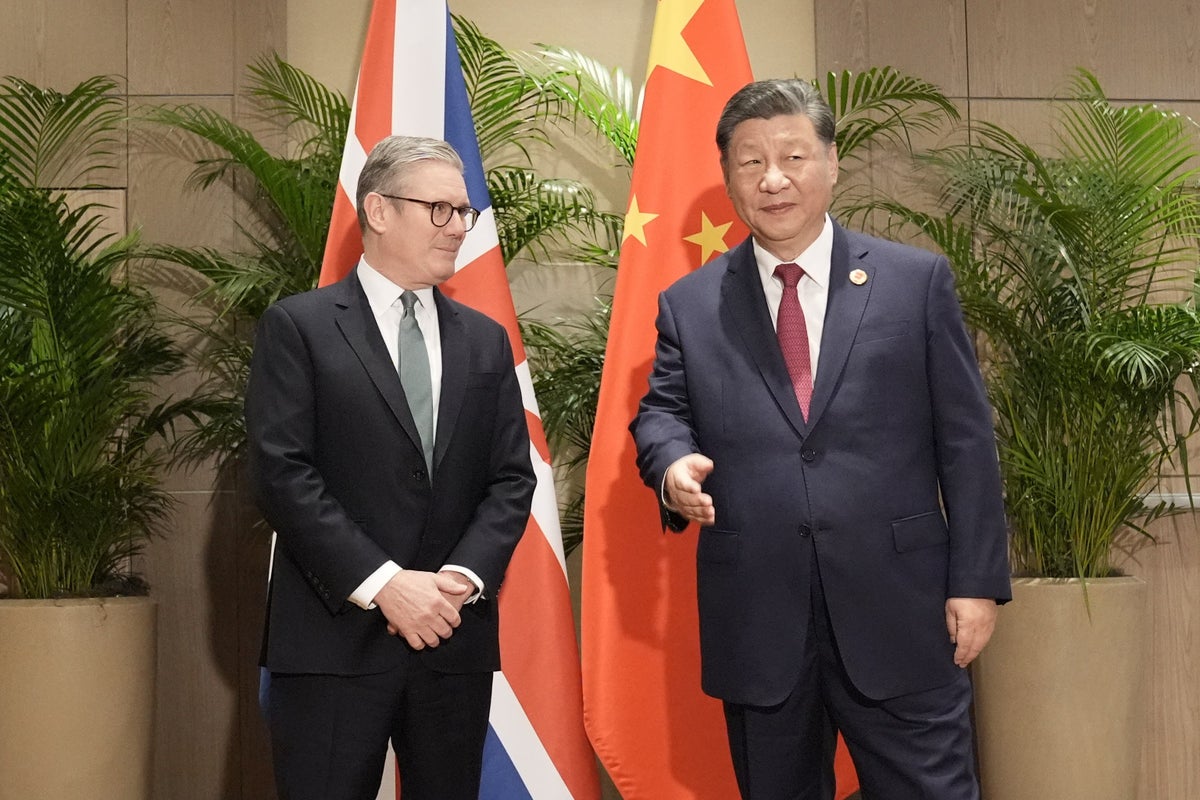
In an ideal world – one in which Britain was still in the European Union, could be confident in the enduring strength of the Atlantic alliance, and look forward to a slow but steady dismantling of barriers to global trade under the auspices of a powerful World Trade Organisation – Sir Keir Starmer’s trip to China would be conducted with a degree of national self-confidence.
Of course, Sir Keir’s talks with Xi Jinping could never be a meeting of equals, given that China is, on some measures, the world’s largest economy, and certainly its pre-eminent industrial power, holding the title of “workshop of the world”, long ago held by imperial Britain.
However, the UK would not be quite so disadvantaged in its quest for investment and cooperation, not to mention pressing the case to remedy human rights abuses, if a combination of Brexit and Donald Trump had not smashed the longstanding foundations of British influence abroad.
That is the context for this mission – Britain’s relative economic and diplomatic isolation. It could hardly be less ideal. As an unusually open economy that depends on trade to make its living, this is a parlous situation to be in. The UK must develop closer links with the world’s pre-eminent and fastest-growing economies.
To his credit, Sir Keir has successfully limited the damage to Britain inflicted by President Trump’s tariff wars; he has “reset” relations with the EU, signed a trade treaty with India, and inherited membership of the trans-Pacific partnership. But it is China that represents the biggest single overseas opportunity to boost economic growth.
As the prime minister puts it, with some understatement, “sticking your head in the sand and ignoring China ... wouldn’t be sensible”. Or, indeed, possible. Britain has little choice.
Sir Keir will be accompanied by a strong team of officials and dozens of businesspeople, and it evokes memories of the similarly high-powered trade mission led by the then prime minister David Cameron in 2013. The idea back then was to further engage China in the rules-based international system; despite differences over human rights, there were great hopes for a new “golden age” in relations.
Since then, much has changed – and for the worse. China is more aggressive in its regional territorial ambitions. It has even gone so far as to forge a “limitless friendship” with Vladimir Putin’s Russia, propping up his war machine. The treatment of Hong Kong has grown ever harsher, and the case of Jimmy Lai highlights just how far China has reneged on its international obligations to that supposedly special administrative region.
There has been no improvement in the treatment of the Uyghur Muslim people, nor of Tibet. The Belt and Road Initiative is a thinly disguised exercise in neocolonialism. Without being paranoid, the scale of Chinese intelligence gathering in the UK is entirely disproportionate to any realistic threat that Britain, even with its allies, poses to this superpower, while the trading relationship is decidedly lopsided, in China’s favour.
The latest of many allegations is that the Chinese hacked the phones of British officials in Downing Street for years, which raises the uncomfortable thought that the Politburo of the Chinese Communist Party knew more about Partygate, among other things, than did the British public. It is eight years since a British prime minister, Theresa May, visited China – given this unfriendly pattern of behaviour, it’s not surprising.
So there will be no silky talk this time around of a “golden age”, but there should be – has to be – some way of balancing the very real need for economic cooperation, while protecting British interests. Sir Keir has demonstrated a flair for foreign affairs in his otherwise underwhelming premiership so far, and he will need to make the most of his skills to put relations on a more fruitful path.
At least he can metaphorically present President Xi with the keys to the new Chinese “super embassy” in the grand surroundings of the former Royal Mint in London. The reciprocal prize will be permission for a new British embassy in Beijing. That should set things off to a good start, and, while working on the many areas of difference, the prime minister should stress that our country represents no threat to strategic Chinese interests, nor vice versa – with the expectation that the spying will be scaled back, political prisoners released, and the trade volumes increased.
Though they would be too polite to say it, and the British too embarrassed to admit it, many countries spy on each other, and it’s incumbent on each to make sure they take the appropriate precautions. That includes British parliamentary staff not falling victim to obvious Chinese traps, and stopping UK universities from turning themselves into propaganda outfits for the CCP.
Yet that is not the end of the prime minister’s diplomatic challenges. Just as with the modest trade deal recently struck with China by the Canadian premier, Mark Carney, any agreement that emerges from this visit may well be greeted by the usual fire and fury from Mr Trump, jealous as ever of the allies he so often treats with a callous disdain. Whatever else he says to the PM, President Xi won’t accuse British troops of cowardice in Afghanistan.
No doubt Sir Keir and his colleagues have already anticipated and sought to defuse such an explosion of anger in the White House – but the threat of a sudden hiking of tariffs, with devastating consequences for UK jobs, tearing up the US-UK “prosperity agreement”, is never more than a Truth Social post away. As they negotiate with their serious-minded, temperate, Chinese counterparts, the British officials might well wonder how it came to be that Beijing, for all its espionage and authoritarianism, became a more reliable, respectful and predictable partner than Washington.
The Chinese may or may not share the US state department’s view that the UK faces “civilisational erasure”, but they don’t think it’s any of their business. During the state banquet, perhaps Sir Keir’s hosts will supply some piece of Confucian wisdom to explain this paradox.
I have not seen Labour turn on itself like this since the 1970s
America is now the unreliable partner the UK really needs to worry about
‘It’s chaos’: Readers on Britain’s broken political system
What’s happening with ICE in America could happen in Britain, too
Shabana Mahmood’s policing shake-up will be felt in our neighbourhoods
Starmer must focus on Labour’s message to stop his party being ripped apart