There has been little to queue round the block for at Ipswich Town during a fallow 13 years in the Championship. The statues of Sir Alf Ramsey and Sir Bobby Robson outside the club’s Portman Road ground are usually left to their own devices at night but the company they kept in the early hours of Wednesday told that something was finally stirring.
“We had fans queueing for tickets from 2am, waiting for us to open the doors for general sale six hours later,” says Lee Hyde, Ipswich’s director of retail operations. “Everyone in town wants one – we could easily have filled another stand with the demand.”
Four stands will have to do, and on Saturday their inhabitants will witness what, to supporters of Ipswich and Norwich City, constitutes the perfect storm. The East Anglian rivals have contested 127 competitive derbies since 1902 and many of them have taken place at more prosperous times. Both clubs see themselves on a higher level but after their Championship play-off semi-final tie, only one will get a shot at unfettered riches. The stakes have never been this high.
It had been coming. As winter became spring, what-ifs and nervous laughter in pubs had turned into earnest theorising over what would happen if the two met. Norwich, initial favourites for automatic promotion, had never quite made a solid case despite superb form under the young Scottish manager Alex Neil; Ipswich, largely written off despite benefiting from the wiles of Mick McCarthy, had entered 2015 at breakneck speed but tailed off to the extent that only an unlikely win for Reading at Derby confirmed sixth place. By then, though, many felt that the die had been cast.
“Everybody around the club had been talking about it in the last few weeks,” says John Wark, the former Ipswich midfielder who now works in a matchday hospitality role at the club. “It was all ‘We’re going to get Norwich’. The only question I had was whether we wanted them over two games or one. There was just this sense it was going to happen.”
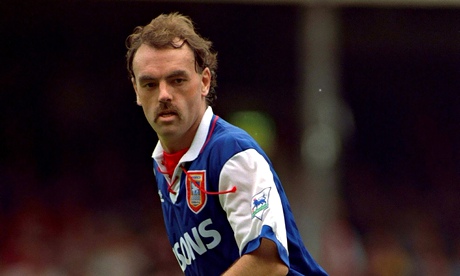
Wark’s hosting engagements at Portman Road need little excuse to become history lessons in the gravity of this fixture. Nobody has bettered the 19 appearances or nine goals he made in the derby during three spells at Ipswich that spanned 22 years. His heyday coincided with that of Ipswich, in the late 70s and early 80s, when both sides regularly met in Division One and the Suffolk team generally came out on top.
“The biggest buzz I had was when we won 4-2 in 1980 and I scored a hat-trick,” he says. “I didn’t have to buy a drink for a week. I’ve had the down-days as well. I was sent off for fouling Darren Eadie in 1995 and we went down 3-0, but I won more than I lost. Those were all vital games but these two will be the biggest in the 40 years since I came here – the biggest for a long, long time.”
It is a rivalry that outsiders tend to view with curiosity, even amusement. The “Old Farm” description that has crept in does, if nothing else, provide some ready accessibility. Though the urban areas have a half-rhyme in common, they are separated by 40 miles and the treacherous, largely single-lane A140 that makes travelling by road between the two seem like an undertaking from another era. In one sense, it is this remoteness that connects them: few significant settlements lie in between and their distance from other major cities has historically forced them to look towards one another. Geographically, no ambiguity has ever existed: there is nobody else to spar with.
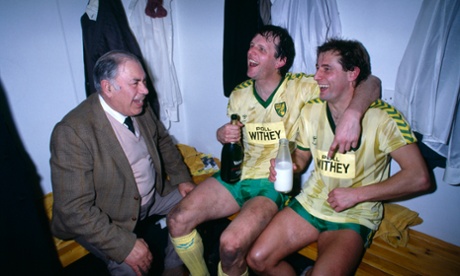
“I suppose the rest of the country think ‘what are this lot going on about?’” says Bryan Gunn, the former Norwich goalkeeper who, like Wark, arrived in East Anglia from Scotland and became part of the furniture.
“But the passion the fans generate is second to none. The teams weren’t in the same division when I joined [Norwich were in Division One in the late 80s, Ipswich in Division Two] so we had to settle for a pre-season friendly in the first few years. You were left in no doubt, straightaway, that only a win would do in those games.”
Wark, who jokes that he “needed a bodyguard” when travelling to Carrow Road for the sides’ league meeting in March, agrees. “When you come down you hear all about it, but I was brought up in Glasgow where they play the biggest derby in the world. I didn’t realise the magnitude of this one until I’d played in it. I was lucky enough to play in Merseyside derbies as well, but this one is as big – the hype in the week before, the atmosphere, everything. It is incredibly intense and I think it just gets better.”
Gunn says that Norwich sense providence in this tie. In perhaps the most significant of all the clubs’ prior meetings they won the 1985 Milk Cup semi-final 2-1 on aggregate, Steve Bruce scoring a late winner at Carrow Road. Norwich went on to beat Sunderland in the final. “That’s what they’d love to do again,” he says. “To beat Ipswich and perhaps face Middlesbrough, another north-eastern side, and repeat history. Norwich have had the bragging rights recently but it’s going to be a real clash of styles and very, very competitive.”
The Canaries have won the last four fixtures, including a 5-1 win at Portman Road in April 2011 that helped hasten their recent spell in the Premier League. They have deserved their supremacy and Ipswich will look further back for inspiration – to Wark’s heroics, to the 1996 derby that was won by a Gunn miskick – “not too many people can walk down both Ipswich and Norwich high streets and get a pat on the back!” – and to the fact that unlikely heroes such as Danny Haynes, matchwinner twice in the late 2000s, invariably crop up on this stage.
When all is done, the queues for play-off final tickets will snake around one of Portman Road or Carrow Road. Around the other, there will be the dawning realisation that the myths, legends and terrace taunts that arise from the 128th and 129th East Anglian derbies may reverberate for decades.