The means for advocacy has changed in the past few years since the dawning of the so-called 4.0 era. Online platforms such as the worldwide Change.org have become increasingly popular, with campaigns being generated by the people themselves to call for the attention of decision-makers and support from fellow members of the public who share the same ideology.
People have signed their name to support different causes, from ending the tampon tax in the UK to banning single-use plastic in Victoria, BC, in Canada. Thailand, too, has seen the public utilising this platform to influence local changes, with past campaigns supporting the continuation of the Bus Rapid Transit (BRT) system, making fighting fish a national aquatic animal, rallying for the impeachment (with an opposing campaign calling for support) of deputy prime minister Gen Prawit Wongsuwan, and many more.
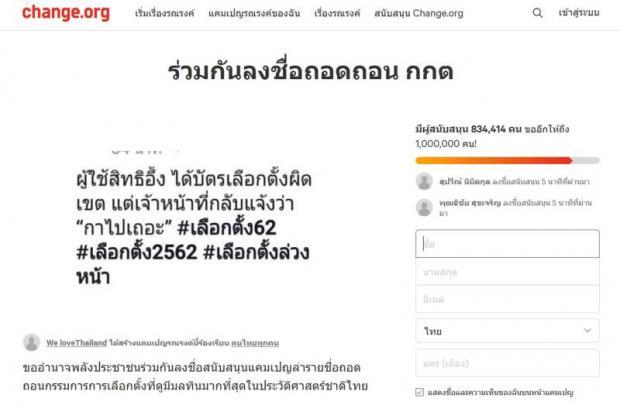
One of the latest campaigns taking Thailand by storm is to impeach the Election Commission. The March 24 election sure left an overwhelmingly negative impression on the public, with many citing poor organisation, confusing numbers, suspected foul play and late arrival of ballots from New Zealand among the reasons that made this one of the most controversial elections in the history of Thailand. The people's discontent is now evident from the staggering amount of signatures -- over 830,000 and counting -- that support this impeachment. It is so far the most-signed petition on Change.org Thailand.
Now that a large portion of the general public has spoken through this online petition, what if any is the legal obligation to recognise it?
"These online petitions have no direct legal effect," said Warisara Sornpet, director of Change.org Thailand. "It's not that once the number of names hit a certain target that things will automatically change, or that by creating a petition and signing it, everything will be over. No, this is rather the start of a social movement borne from the people themselves. What it does may eventually affect the law and policy of the country.
"When a lot of people sign a petition together, it reflects that they are keeping an eye on certain issues. Small, individual voices that band together will collectively make a much louder sound to reach decision-makers."
Some of the cases that were propelled to success by the online platform include the regulation of powdered-milk marketing, putting a stop to the Mae Wong Dam, setting up an animal-protection law, and more. For a campaign to succeed, it requires constant follow-up and many other factors. The amount of signatures does not guarantee anything, and not all campaigns end up a success.
Asst Prof Chanin Maneedam, law lecturer at Bansomdejchaopraya Rajabhat University, said demonstrating the people's power by signing an online petition is still a very good method only if the process of democracy really functions as it should.
"With so many voices from the people, if the government really works and responds to the voice of the public that choose for them to be there, they would realise by now that something is terribly wrong," he said. He pointed to the Computer Crime Act. Despite having gained over 370,000 signatures from people who wish to stop the bill for fear of privacy-violation and abuse, it was eventually passed by the government.
"If parliament really answers to the people, I think they might be scared to see so many names. They may make a change to make things more acceptable by the people," he added.
So how can the people proceed when it comes to the case of the Election Commission? Chanin said it depends on what people want. Legally speaking, if they seek to veto the election results, for example, then they have to file for a case with the EC. But if they're displeased with the EC, they instead have to make an appeal to the office of the National Anti-Corruption Commission (NACC). One person is needed to submit the case to the NACC. If the case is found to be well-grounded, then the legal process may start.
Those who campaign for the EC's impeachment revealed in an online statement that they will also follow through with this formal method, but also ask the public to continue signing the petition, with the aim to hit the million-signature mark. They will submit the case to the NACC at a later date.
The idea of gathering names was influenced by the 2007 Thai constitution that allowed people to bring forth 20,000 signatures to call for the impeachment of those holding political positions, said Chanin. But the current 2017 constitution has changed that procedure. People can now make a direct complaint to the NACC.
At the same time, it should be noted that the public can only propose for the legal process to happen, but in the end they are not the ones who get to make the final decision.
If the public wishes to go ahead with the legal process, it will also require them to do it in the tedious, "analogue" way, which is to print out the documents, sign them, photocopy the ID card, sign the copy, and so forth, Chanin added.
Acknowledging its lack of direct legal effect, Change.org's Thai director, Warisara, said that the platform nevertheless remains a popular means that has become crucial in launching and speeding up many advocacy projects, compared to the more formal way of filing a complaint with the authority.
Many still choose what they think is the best way for their voice to reach decision-makers, despite the method being quite informal.
"We can compare one person quietly filling out a complaint form to having almost one million people expressing their discontent. The past week has already shown what is more effective. If we only have one person filling out a form and nothing else, this movement wouldn't be where it is today. It's a different form of movement that can be done together," Warisara said.
She also feels the platform represents an open space where people can voice their opinion while also respecting differences.
"If anybody disagrees with any of the campaigns, they can set up their own counter campaign on the same platform," she added.
For privacy and security reasons, no identification data of the signatory is requested, aside from their name. So what does this mean for the legitimacy of each name we see appearing on a campaign when none is required to provide proof of identification? Can people just put down any names they want an infinite number of times to boost the campaign?
Warisara explained that, while Change.org asks for no identification, it prevents false signatories via a spam-detection system that can identify those who repeatedly sign on to a campaign from the same IP address. Once the system engineer is alerted, those names will be deleted.
One notable case took place in February last year in the campaign that supported Gen Prawit following his luxury-watches controversy. The alleged campaign saw a rapid increase in number of signatures, with some netizens discovering their names being signed without their consent. According to Warisara, thousands of fake votes were removed upon discovery.
To be free from the influence and control of any corporate entity, Change.org gets its funding from users' donations in order to remain a neutral platform that empowers the general public to get their voices heard.
"This platform, in a sense, is a reflection of our society, that there should be a space for everyone even though they may not share the same ideas, as long as it doesn't violate the laws and rules of our community," Warisara said.