It seems fitting that Paul Lawrie is in contention to win the Open Championship once again. The sad reality of the 1999 grapple for the Claret Jug at Carnoustie is that Jean van de Velde’s collapse has become as retrospectively notable as Lawrie’s triumph.
Regardless of how this Open concludes – and we still assume it will do so, at some point – the storyline will be of a chaotic backdrop rather than a worthy champion. If Friday’s rain-enforced delay was unfortunate, events on Saturday ruined what should have been one of the finest afternoons of British-based sport this summer.
The Open of 2015 will for evermore be reflected upon with shambles as a bedfellow. In glistening sunshine and July warmth, the Old Course was at a standstill for more than 10 hours. For all Mother Nature is a difficult beast to tame, this cannot be regarded as necessary.
As the 7am session lasted only until 7.32am, as 3pm became 4pm, 5pm and, finally, the restarting juncture of 6pm, the troublesome nature of this tournament’s script only intensified. There should be sympathy for the masses of Open volunteers, for players who encountered a day of hanging around and for spectators who still, admirably, filled Old Course stands in the vain hope of witnessing meaningful major championship golf. They were only afforded an evening snapshot.
In that brief morning wave, in which Jason Day dropped two shots and Dustin Johnson, until that point the leader, one, 52 holes were played at a combined total of 21 over par.
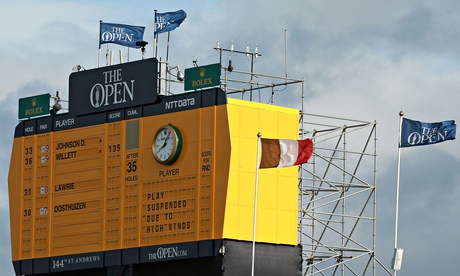
Upon the belated resumption of play, Johnson signed for a second round of 69. At 10 under, he leads by one. Jordan Spieth’s 72 leaves him five adrift at halfway. It is Johnson’s tournament to lose, no doubt, but we have been in this movie before.
Spieth’s assertion that competitors should not have been on the links first thing in the morning had apparent merit, albeit the tournament organisers insisted the wind speed had increased. The matter will come back to haunt – and then some – those in power if Day or Johnson should ultimately fail in their Open quest by a tiny scoring margin. Spieth’s criticism is also damaging for the R&A.
“It is tough to play a round of golf in over 24 hours,” said the 21-year-old, who is hardly known for outspoken sentiment.
Blame will always be attached in such scenarios. In part, that is unfair; even those afforded high office at the R&A, much as they may offer routine impression to the contrary, cannot control weather. Gusting winds have caused trouble on these links before, such as at the 2010 Open and the 2013 women’s equivalent. In the latter case, play was halted at 1pm on day three and did not resume until the next morning.
There is a wider point for debate. Rapidly fast greens have become an accepted, necessary part of major championships as a course defence. That element of menace is required because modern golfers can hit the ball such ludicrous distances. Johnson, hardly coincidentally, is a key example of that and prominent at this, a venue he can reduce to a pitch-and-putt entity. Elsewhere on the Fife coast on Saturday, in precisely the same conditions but on slower greens, amateurs competed as normal.
“I wouldn’t say this is a particularly strong wind for a links course,” said Lee Westwood. “You should be able to play in 40mph winds. When you do set the greens so fast this is likely to happen, especially on exposed greens.”
If putting surfaces could be left at a lesser pace, without the need to cut and roll them with such regularity, gusting wind could be better handled. Johnson and his peers could be seriously tested on a links format. The option, alas, does not exist.
Player discord did not arise only from the fact they were asked to take an allocated 7am start. Westwood and Ian Poulter both clearly believed the chaos that ensued on the par-three 11th – where golf balls were blown around the green with comedic consequences, creating a log-jam back on the tee – should have led to the immediate halting of play. The former Open champion Stewart Cink was one of those who stood for more than half an hour without playing a single shot.
“The only difficult situation that arose from this morning was that only two putts were made on the 11th green while 32 minutes of play happened everywhere else,” said Poulter. “Guys like myself played a hole and a half and other guys haven’t hit a shot. Is that right or wrong? Most people would say that’s wrong.
“Should they have cut [the greens on] holes one to five and 13-18 and not the rest? Should they have cut any greens at all? Louis Oosthuizen had a three-foot putt on 13, then he had a one-foot putt, then he had an eight-foot putt – and didn’t touch the ball once. That’s one of the greens that was cut.
“They don’t want to make poor decisions and don’t want us out there in these conditions. You can understand frustration from everybody really, fans, players and themselves, that they’ve been put in this situation.”
The situation will dominate the narrative of the 144th Open Championship in years to come. Hopefully Johnson, Lawrie et al at least supply an alternative; if they can summon up the spirit of Seve Ballesteros, who made a cherished 65 to triumph on a Lytham & St Annes Monday evening in 1988, then that would do very nicely.