As my train hurtled northbound through the stupefyingly beautiful scenery along Scotland’s east coast on Monday afternoon, the anticipation grew for my first visit to the Home of Golf. By the time the engine eased into Leuchars rail station, before a short bus journey into the university town of St Andrews, those butterflies had only redoubled.
The buzz that precedes the Open is only bigger when the oldest of professional golf’s four major championships is held on these beachside links that represent the sport’s cradle. To experience it for the first time – to drink in the atmosphere and palpable history of an entire town given up to golf after a lifetime of experiencing it over the airwaves – is to be lost in a dream. And that’s before you even get to the grounds.
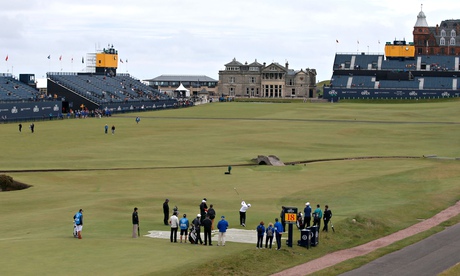
That first look came on Tuesday, when the seagulls overhanging the 10-minute walk to the Old Course from the town centre past rows of stately terraced houses were the first clue to the sensory delight ahead, followed closely by the stiff North Sea breeze along the West Sands beach where the opening sequence of Chariots of Fire was filmed. Once inside the Royal and Ancient Golf Club, you catch a first sight of the world’s most famous course, bathed in grey light and fading into a horizon of rolling hills painted in a thousand hues of green and dotted with speck-like houses.
It is two days before the 144th Open Championship here and the temporary media bunker is already bursting with activity. Even mundane curiosities like the polite stampede to the interview room when Tiger Woods’ name is called – the world No241 can still draw a crowd – feel more weighty and significant at a venue that is almost three times as old as America itself.
Outside the grandstands are dotted with fans – who have paid £30 for admission – plus some of the 1,100 marshals who will patrol the grounds from now through Sunday’s final round, enjoying these few last hours of relative solitude before the tournament begins on Thursday. A course that’s been described as a museum with itself for an exhibit, for the moment, belongs to a select few.
Clusters of spectators following the practice rounds that have been under way since 6.40am move from station to station along pathways flanked by gnarled shrubs and heather. John Daly, who 20 years ago captured the second of his two majors on the Old Course to earn lifetime Open exemption, takes a pull from a cigarette on the third tee and chats up a gaggle of Americans behind the rope who excitedly tell him they were here when he outlasted Italy’s Costantino Rocca in a four-hole play-off.
Daly then stubs out his fag and casually splits the fairway with a gigantic drive into a barely perceptible mist of rain. “Fairway, green, fairway, green,” the 49-year-old wryly deadpans. “Doesn’t this ever get boring for you guys?”
Certainly not for me, but an occasional pilgrim of major golf championships. Famously the course is dotted with 112 bunkers, christened with names both opaque (Spectacles, Strath) and romantic (Lion’s Mouth, Principal’s Nose). Many lurk close to the greens, making the margins infinitesimal. Each has its own story and legacy, from Walkinshaw’s Grave to the aptly named Hell – a 10-foot abyss on the 14th that covers 300 square metres.
There are the glassy double greens connecting seven pairs of holes on the front and back end, the iconic 17th – the Road Hole – frequently said to be the most praised, abused, respected and feared hole in the world, followed closely by the picturesque, seven-century-old Swilcan Bridge on the 18th. You tick these landmarks off internally during your first circuit around the course, almost to confirm that they’re real (they are). These features taken together give the Old Course the simultaneous feeling of Platonic ideal and experiment gone awry.
Aside from a few modern flourishes – camera cranes breaching the horizon, a spectator area where fans can lounge on jumbo-sized pillows and watch on a large screen, food stands hawking roasted pork, rotisserie chicken, fish and chips – the Old Course appears as it has looked for six centuries. The old Scots, they say, played it as they found it. It’s not all different from the course Bernard Darwin painted so eloquently in his iconic Golf Courses of the British Isles more than a century ago.
Equally compelling is the scenery on the periphery: old golf shops that look as if they’ve been there forever – and probably have; the museum across from the famous clubhouse with enough history to occupy an entire day; the cemetery of the cathedral with the graves of Old and Young Tom Morris; a falconer walking the grounds, Harris hawk in tow, charged with chasing away seagulls.
It will begin again on Thursday, the 29th time the Open has been contested along these beachside links. The phenom Jordan Spieth will continue his meteoric ascent in pursuit of a grand slam, Tiger will look to roll back the years in a bid for an unprecedented third title at the Old Course, while Tom Watson will seek to provide one last thrill before riding off into the sunset. The cast of characters may be ever-changing, but the backdrop remains gloriously constant. All this lends to what’s clearly among the singular experiences in sport – one I can’t wait to experience for the first time.