For every Tiger Woods and Rory McIlroy who took the first-day lead at the Open and held on to it through four rounds to win, there has been more than a handful of players who became overnight sensations only to slip away quietly from public consciousness.
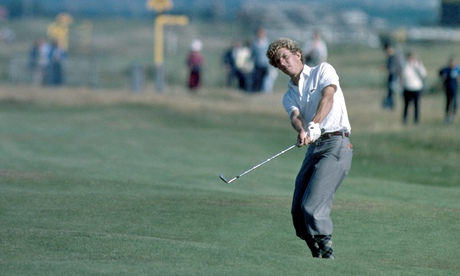
Peter Tupling had the honour at Lee Trevino’s 1972 Open and Wayne Stephens led the way after day one of Mark Calcavecchia’s 1989 triumph at Troon but the man who created the biggest fanfare was the unknown young American Bobby Clampett, who turned up to play Troon in 1982 wearing a pair of white plus-twos which he referred to as “knickers”.
Clampett used irons on most of the downwind tees at a wet, windy and cold Troon and plotted his way round for a five-under 67 and then added a 66 to build on his lead at the end of day two. A pot bunker derailed his progress on the Saturday and though he still clung to the lead going into the final round, a 77 saw him slump into 10th place, which remains his best Open finish.
John Schroeder was another fast starter at Turnberry in 1977 when he was placed in the last group out and finished at around 9.15pm with a four-under 66 and a brickbat for the R&A, which had allowed many marshals and stewards to go home and permitted groundstaff to mow greens behind his threeball in readiness for the next day.
It was soon revealed that the shock overnight leader was the son of Ted Schroeder, the 1949 Wimbledon tennis champion, and interest levels rose further, though as the tournament proceeded he subsided to 10th place overall. That was good enough to get him back to St Andrews the following year when he finished a best-ever seventh and where Isao Aoki of Japan, noted for his toe-in-the-air style putting stroke, was the leader after 18 holes only to slip to ninth. The Hall of Famer never did win a major, though he went close several times.
The Essex-born Scot Bill Longmuir, who still appears on the Seniors Tour, was another with his name in the spotlight when he managed to take the first-day lead twice after coming through local qualifying, in 1979 and again in 1984 when he shared it with Greg Norman and Peter Jacobsen, though he slipped to 55th and 30th respectively.
Thomas Bjorn, the Dane who shared the first-day lead at Royal St George’s in 2011 with the then amateur Tom Lewis, says the way to cope with being the first-day leader is to switch off and forget about it. “You try and stay away from everything that has to do with golf,” he said. “You come and do your work and when you leave you watch every other sport on TV and not golf.
“Sometimes if it’s a really late tee-time the next day it can be a good idea to sit there and watch a few pin positions [on TV] to get those in your head but in general I stay away from the game as soon as I’m away from the golf course because there’s so much going on. If you get too wound up in the golf all the time then your brain gets tired and you don’t have the energy to play. I can’t remember who I shared the lead with.”
Bjorn, who has a decent Open record with a second place at St Andrews in 2000 and at St George’s in 2003, finished fourth in 2011 and Lewis came home in 30th, played the Walker Cup and immediately turned professional.
“The big moments are one of the reasons you work so hard,” said Bjorn, who is geared up for an early start at 6.32am in Thursday’s first threeball with England’s Greg Owen and Rod Pampling of Australia. “I try not to put too much emphasis on the result because you always want to win, but I try to take all the good moments out of being in those positions.”
Only three players have managed to lead after all four rounds in the past 50 Opens, Tom Weiskopf at Troon in 1973 in what was surprisingly the only major he won, Woods at St Andrews in 2000 when he completed the second leg of his Tiger Slam sequence, and McIlroy, who did so at Hoylake last year.
David Toms at Muirfield in 2002 slumped from first to 83rd and last place after sharing the lead with Duffy Waldorf and Carl Pettersson, Graeme McDowell was leading Woods by a shot in 2006 and came home in 61st place but Pampling surpassed them all at the inclement Carnoustie in 1999, when he was the only man in the field to match par on day one but followed it up with an 86 to miss the cut by three shots and finish tied for 100th place.