David Cameron on Friday addressed the country in the wake of his extraordinary election triumph, reviving the “One Nation” rhetoric of the early days of his leadership, and promising prosperity for all. “I would like to reclaim a mantle that we should never have lost,” he said, “the mantle of One Nation, one United Kingdom.” But after a rancorous election that has left the country facing fresh divisions and inflicted deep wounds on the defeated parties, what are the prospects for a united and prosperous One Nation?
Cameron’s “sweet victory” was celebrated on a remarkable day which saw three party leaders resign and the SNP, led by the redoubtable Nicola Sturgeon, wipe out Labour in Scotland to send 56 MPs to Westminster. These are seismic events, the tremors of which are likely to reverberate for a generation or more, potentially reshaping the United Kingdom, flagging up a possible exit from the European Union and a further drastic reduction of the welfare state. The electorate surprised pollsters, politicians and pundits alike. As Nick Clegg said in a moving resignation speech, politics is not only unpredictable; it can be “crushing and unkind”. All the more reason then, that the right lessons are learned by victors and vanquished alike.
Thursday’s election deserves the extravagant adjectives its chroniclers have deployed. It was historic. It may also yet mark a different kind of milestone – a major one on the road to much-needed electoral reform. The SNP won 56 seats with 1.5 million votes. The Greens accrued 1.1 million votes that elected just one MP. Ukip attracted 3.9 million votes, came second in 120 constituencies and third in 364, but its net gain was also a single seat. Nigel Farage is right to call for “real, genuine radical reform”. A constitutional conference is urgently required. It is time for an end to the majoritarian political culture that allows such distortions of the electorate’s will.
The Westminster establishment is still catching its breath, pondering the implications of Thursday’s result. Perspective is vital. The Conservatives took almost 37% of the vote; six out of 10 voters did not give this government a mandate. Labour sunk to just 30% of votes cast, only slightly ahead of Gordon Brown’s achievement in 2010 at the end of his battered government. Instant analysis says it was too right wing for Scotland and too left wing for middle England. The Liberal Democrats, paying a high price for governmental power, replacing protest for pragmatism and ministerial seats, have been almost erased from the House of Commons, losing 49 MPs, now reduced to a rump of eight.
What went wrong for the Lib-Dems is not difficult to fathom. A broken promise on tuition fees, no record of constitutional reform, not enough kudos for the coalition’s positive achievements, a great deal of grief for the consequences of the slash and burn of the cuts, insisted upon by Osborne and validated by Danny Alexander who, in budget after budget, sat next to him. Alexander was unseated, as were several senior figures including Vince Cable and David Laws. The rewards for coalition have been cruel – should the opportunity arise again in the foreseeable future, an unlikely circumstance, most in the party will recoil.
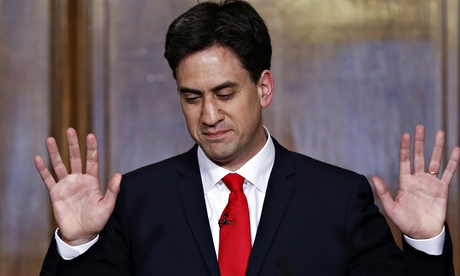
Labour’s inquest will be more contested. Some criticisms levelled at the departed Labour leader ring uncomfortably true after Thursday’s disastrous defeat. They speak of a shaky Miliband who grew too late into the role of party leader. They point to how his resilience and positive qualities – for instance, his willingness to take on vested interests such as press barons and energy companies – were too easily masked by an inability to break out of the role of the Hampstead intellectual, incubated in Westminster, lacking “real world experience”, open to savage mockery in the media.
They detail how he failed effectively to counter the charge that the previous Labour administration, in which he played such a key role, was implicated in the post crash recession. And they lament his inability to project a coherent and positive image of a prosperous Britain in language that appealed to people outside Labour’s traditional heartlands.
But the suggestion that Labour’s defeat is also proof that the country has turned its back on some of the themes he struggled so hard to articulate is premature. Miliband’s arguments for a properly regulated market and financial sector; for action on non-doms; for a fairer share of growth for the majority, and investment in infrastructure at a time when borrowing costs little; and for the need to address the pressing issue of inequality that over the next five years will reveal an increasingly ugly gap in society undermining cohesion, draining prosperity and damaging civic life – all these continue to have a strong resonance. It’s a story that needs to be told by fresh voices with a more coherent narrative to appeal to the aspirational middle class and the white working class that deserted Labour, as well as its core vote.
Proof of that resonance is Labour’s success in London, now the beating heart of the party. The diversity of the new MPs returned to Westminster, the majority of them women, represents the continued desire of many voters for a fairer, more equable society. Labour now has more members at Westminster who are a reflection of its supporters – Dan Jarvis and Naz Shah come to mind – not some rare specially bred political species. But they face a challenge to hasten this process. Paul Nuttall is deputy leader of Ukip, working class, ex-Labour, and a Liverpudlian, very different from posh Nigel, who says that the party is attracting young women disenfranchised from a positive future.
Of course, the Labour campaign was flawed. Issues people care about went virtually unmentioned – immigration, Europe, education. It was too presidential in style. Ed Miliband also reaped the bitter harvest of a leadership campaign he fought with his brother that stretched on for months in 2010. In that time, the Tories established their own narrative, aided by Liam Byrne’s serious gaffe in leaving a note to say the coffers were empty, for which he apologises in today’s Observer. The narrative cemented the story of Labour’s economic incompetence. The party failed to fight back.
Miliband, in his efforts to unite the warring factions divided by Blair and Brown, left and right, rarely trumpeted the party’s many achievements in office, including strong growth, a minimum wage, new schools and hospitals, a revived NHS and a million children lifted out of poverty.
What also did for Labour was David Cameron’s willingness, under the baleful guidance of Lynton Crosby, to undermine the unity of the UK by his deployment of anti-Scottish paranoia in his successful bid to frighten English voters about the dominance of Holyrood in English matters. It is hard to see how the Tories’ mean and divisive campaign has not damaged, perhaps irretrievably, the hopes of those who wish to see the union thrive. But Labour must address its own responsibility for this predicament: decades of neglect and the practise of seeing its own party in Scotland as “a branch office” of Westminster.
For the Tories, David Cameron has won himself a brief second honeymoon as he basks in the glory of a considerable political achievement. Chastened opinion pollsters are launching their own inquiry into how they failed to find the means to factor common sense into their surveys, overlooking the most powerful driving force of all – namely, that governments almost always are given a second term and, in a time of acute financial insecurity, continuity has its own appeal. Better the medicine you know than the unfamiliar antidote. David Cameron persuaded many that his stewardship of the economy produced – with some evidence – notable successes.
Now he has many ministerial posts to fill and patronage cements authority. But it won’t be long before “the bastards” of the Eurosceptic right of the Tory parliamentary party give him grief. A EU referendum is due. Even if Cameron, or Osborne as negotiator, returns from Brussels with significant enough concessions , many backbenchers won’t be happy. On boundary reform, on a British Bill of Rights, on defence, they will exploit the tiny Conservative majority in the Commons to make trouble.
Cameron also has to handle Welsh and Scottish devolution. He made a mess of insisting, post-referendum, on “English laws for English people”. That has to be sorted out, as does a plethora of spending promises made during the campaign, which blew his claim of fiscal probity out of the water – including £8bn on the NHS and no tax or VAT rises for five years. Cameron must have forseen a coalition partner to possibly dilute, cancel or postpone his electoral gifts; that lifeline was snatched away by Thursday’s vote.
Without a coalition, the nasty side of the Conservative party is likely once again to be revealed. This includes its fixation with a small state and an unregulated market, and its admiration for the “wealth creators”, with too little regard to the fact that they are also, too often, wealth hoarders to the detriment of us all. The deepest wounds will once again be inflicted on those who are most vulnerable, on the lowest paid. the disabled and the sick. Sanctions continue, the bedroom tax and zero hours live on. Why should citizens with the least pay the heaviest price for austerity and an absurd Tory fixation on clearing the deficit, at a time of zero interest rates, a goal derided by economists around the world?
Now Labour must reflect on the scale and causes of its shattering defeat. It is time for fresh blood, and the last rites to be pronounced on the tribal Blair-Brown, Miliband v Miliband jousting that has wasted energy and confirmed the view of many voters that politicians reside in a different and unconnected universe.
This process is urgent because no other party is capable of articulating a vision of a united Britain, fair to all, investing in skills, infrastructure and people, encouraging individual innovation but also protecting great public institutions such as the NHS and valuing the role of the state as a catalyst for growth. The country needs a strong, national opposition.
Last Sunday, we wrote of hope and a belief in a fairer society. That hope continues. Labour has ridden through the valley of political despair before. It was there in 1983 and in 1992.
It came back to win a landslide and three elections in a row. Now, more than ever, it needs the conviction that it can and will do the same again – not for the sake of power, but to build a more equal and united kingdom. A One Nation.