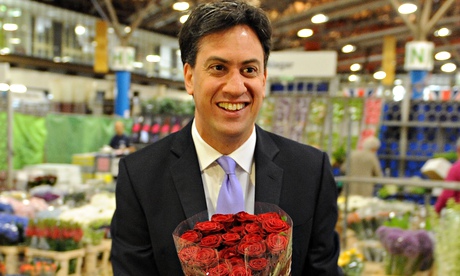
The spectre of a damaging exodus from our shores of the super-rich was conjured up last week after Ed Miliband announced that a Labour government would abolish the non-domicile status enjoyed by 115,000 people. The scheme is an anomaly unique to this country that allows individuals to avoid paying tax on oversees earnings even if permanently resident in the UK. In a poll for Survation, 59% supported abolition, including one in two Conservatives. The Tory campaign, widely seen as narrow and defensive even by some its supporters, took a serious bruising, as George Osborne and David Cameron appeared to defend this privilege of the wealthiest. Labour moved ahead in three out of five polls, though the advantage was tentative. Something seemed to have changed in the election campaign.
While the Tories defended non-doms, deploring how the fleeing billionaires would take their jobs and spending habits with them, Miliband found his voice. It is something he has done sporadically since his election to the leadership five years ago, but failed to build upon. However, last week, he argued forcefully that the issue of non-doms is not primarily about raising more taxes from the rich (non-doms paid £8.2bn in the last financial year, equivalent to 10 million low-paid workers). It was, he said, a matter of social justice and equality, “the right thing to do”. Prosperity for the few has come at the cost of unfairness for the many as the gap between the richest and the rest of us has widened to a chasm.
Old-fashioned morality – why investment in the common good matters – has, for now at least, challenged financial chaos versus competence as a central theme in the campaign. The Conservatives’ position on non-doms has articulated one interpretation of the nature of this country. Labour has responded by providing an alternative. The dividing lines have become clearer and may become clearer still with the publication of the party manifestos this week. Labour’s manifesto will challenge policies championing a market society in which the needs of the 1% take priority. Is it possible that the centre ground is shifting and the glimmer of more progressive politics may be in sight?
As if on cue, Miliband’s non-dom argument has been helped by the fall-out from the merger of Royal Dutch Shell and BG to create a new energy giant. Helge Lund joined BG two months ago, on a £13m pay package. It is reported that he will now receive £25m out of the deal – for doing what is unclear. A number of the 100 plus business leaders who signed a letter a fortnight ago warning of the dangers of a Labour victory have also enjoyed the inflated rewards modern Britain bestows on a stratum of its privileged few. According to the thinktank the High Pay Centre, nine FTSE 100 companies that were signatories paid their CEOs around £5.9m last year, many times that of their average employee.
For too long, the guiding principle behind our economic and social policies was: “What matters is what works.” The wealthy would get richer as a result of deregulation and the cowing of the trade union movement and what trickled down would be redistributed. While significant numbers were lifted out of poverty as this philosophy prevailed, the gap between the richest and the rest widened – and a certain arrogance was validated. It was an attitude that recently allowed Lord Wolfson, who heads the retail chain Next, on a basic £350 an hour, to proclaim that a Next starting wage of £6.70 an hour should be “enough to live on.”
It is Miliband’s ambition that the richest should contribute more. Every individual, he argues, should be valued as a wealth creator, not just the 1%. He is taking risks. His party’s tax proposals for high earners; the freeze on energy prices; scrapping the bedroom tax; increasing the minimum wage; restrictions on zero hours and measures to tackle low investment, low productivity and flat-lining wages; all these represent a departure from the strategy of maintaining loose reins on the market. Miliband correctly argues that the lack of regulation of the market economy cost taxpayers £1tn in bailout money after the 2008 crash. That cannot happen again.
A significant section of the electorate, previously unmoved by the flabbiness of Labour’s one nation message, has clearly taken heed. Labour enjoyed some limited success in the polls, though too fleeting to suggest that the stalemate might be breaking. But for now at least, the party is on the offensive. A tidal wave of criticism about its alleged financial mismanagement of the country during its previous period in office, and its alleged unwillingness to tackle the deficit with sufficient vigour, has been diverted by several counter-currents flowing in its favour.
These include a lacklustre and negative Conservative campaign, orchestrated by the Australian Lynton Crosby and destablised by Cameron’s announcement that he won’t serve a third term (which reached a nadir with Michael Fallon’s poorly judged attack on the “backstabber” Miliband); the threat of Ukip and internal divisions over renegotiations with the EU. The nasty party of Theresa May’s ringing phrase seems to be becoming nastier and nastier, playing into Labour’s hands. Miliband sounded almost statesmanlike last week in dismissing the attack by Fallon, calling it demeaning of national office. Conservative Tim Montgomerie, co-founder of the lobby group, The Good Right, has warned the party is going through “an identity crisis” with its association with individualism, cronyism in big business and “survival of the fittest”. And the Tories seem anxious to borrow from a policy wardrobe that previously they have sneered at as ill-fitting and inappropriate. When Miliband announced an energy price freeze two years ago, Cameron said he was living in “a Marxist universe” for interfering with the market. On Friday, the Tories announced a five-year freeze on rail fares.
At the outset of the campaign Cameron said: “Let sunshine win the day.” A swath of the electorate has yet to see the clouds lift. A stalling standard of living, the expectation of billions of cuts to come, a housing crisis and rising consumer debt cannot be resolved by trickle-down economics. The American philosopher Michael Sandel, author of What Money Can’t Buy, questions the moral limits of the market. He asked: “Who does the economy serve?” He welcomed more discussion of morality in politics and public discourse. Miliband has called for “a new beginning”. Nicola Sturgeon for the SNP in Scotland is making a similar pitch. Will the electorate trust the verities that have informed the policymakers of the immediate past? Or will it risk demanding a Britain that, for the many not the few, “can be better than this”?