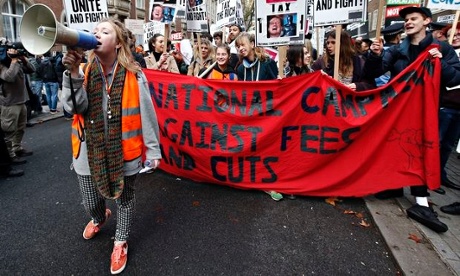
“The difference between me and most student activists is that I do this every day,” says Wirral-born Beth Redmond. “It’s all the time, and it’s very intense.”
I catch up with Beth, one of the organisers of the recent student protest against tuition fees that saw thousands march through London, on the platform of Coventry train station.
We’ve inadvertently taken the same train up from London, on our way to a protest at the University of Warwick, against an alleged attack by police on students at the previous days’ free education demonstration.
We sit down in the student union cafe of Warwick’s Coventry campus to talk. I am expecting Beth to be a fiery, Sid Vicious-esque character, overspilling with anger and resentment at the system. After all, she has a lot to be angry about.
Against a backdrop of £9,000 tuition fees and being among the first generation to be worse off than their parents in a century, she has spent the previous evening watching unsettling video footage of police using pepper spray on student protesters.
In reality, sitting cross-legged on a sofa and speaking with a disarming Merseyside accent, Beth seems calm and relaxed. I ask about her experience of higher education, as a member of Generation 9k.
“I didn’t want to go to university, but felt forced to go,” she explains. “I’m from a working-class background, but passed the 11+ and went to an all-girls grammar school where it was expected that you would go on to get a degree. And my parents really wanted me to go, as they never had the opportunity to.”
If Beth wasn’t keen on the idea of university before attending, the experience of her first years’ study in Essex did nothing to change her mind.
“I felt isolated and alone. I was really resentful of my teachers and I didn’t understand why I was there. I thought it couldn’t be that I hated university because everyone said it was where I should be.”
Mid-way through her first year, Beth got pregnant and had an abortion.
“My doctor’s attitude was that I was a terrible person and I was doing an awful thing. He told me I would have to travel to London to have it done, but wouldn’t allow me to take public transport. I couldn’t afford a cab, so ended up getting a lift with someone I barely knew. I was offered no support afterwards. The whole thing was awful.”

She tells me that it was then that a switch flicked in her mind and she became interested in politics for the first time. She began attending meetings of Workers’ Liberty – a Trotskyist organisation which was among the founders of the Campaign for Free Education, a group within the National Union of Students (NUS) opposing tuition fees – in London at first, and then in Liverpool, where she moved for her second year of university.
“I transferred to Liverpool thinking I would be happier closer to home. But things didn’t improve. I felt really depressed and dropped out at the start of my third year.”
Beth now splits her time between studying graphic design at a further education college in north London and working part-time for Workers’ Liberty.
Despite her own struggles at university, she is at the forefront of the current student campaign for free education as part of the National Campaign Against Fees and Cuts.
“At the last NUS conference, we managed to get a free education motion passed at conference for the first time in about eight years. It was a good victory and we formed a broad coalition with student groups such as the Young Greens and the Student Assembly Against Austerity to organise a demo.”
‘I hate the NUS’
The NUS recently refused to back the free education march in London. What does she make of them?
“I really hate the NUS – I think they’re a bunch of scabs,” comes the blunt response. “But I’ve actually just put my hat in the ring to run to be NUS president.”
I’m surprised. Why?
“The opportunity to give a speech at conference is too good to pass up. My energy won’t be going on campaigning for it though. The time I could spend campaigning could be better spent organising actions.”
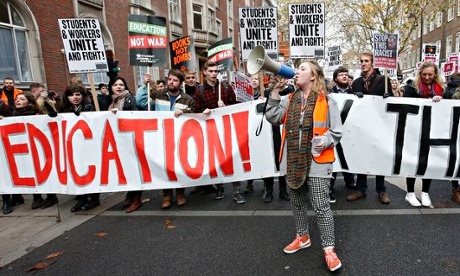
But in theory, you could win, I say. What would you do if you were in charge?
“If I won, the NUS would look a lot different. I’ve seen its roadmap to free education and read all the material, but I still don’t understand it. They should be organising mass student strikes. The NUS is a launch pad for personal careers at the moment, and little else.”
Photos across the media of the recent national protest showed Beth at the front of an army of thousands of students, megaphone in hand as she led them to parliament. I ask if she feels like the Joan of Arc of the student protest world.
“I think it’s important to remember that most of the action and demos up to now would have been organised by men. This time round it is being led by women. We’ve been running around the country empowering female activists, and I think it’s changed the dynamic of this wave of action.”
‘The revolution isn’t going to come from Russell Brand’
A lot of recent protests have been characterised by the presence of a controversial celebrity lefty. I ask what she makes of him.
“The revolution isn’t going to come from Russell Brand. A millionaire writing a book about revolution and selling it for £20 is pretty cheeky. In the past he has said some problematic things about women. Maybe he has changed, it’s hard to know. Time will tell if he really means what he’s saying.”
Will she vote next year? She says yes, she’ll be backing Labour.
“A lot of young people now are turning to the Green Party. But Labour still has a strong connection to the trade unions. The Greens are quite a bourgeois party,” she explains.
I point out that Labour doesn’t support free education.
“We need to put pressure on Labour to change its mind. We don’t want a graduate tax. We don’t want a decrease in fees to £6,000. We don’t want international students to pay more than home students.”
Before we head off to the protest, I ask if, as well providing a practical outlet for her political views, activism and politics has provided her with the community and friendships she so badly needed in her first year of university.
“That’s a big part of it,” she agrees. “You’ll never ever get as close to people as you do when you go through a struggle with them. The relationships you make are amazing and very long lasting.”