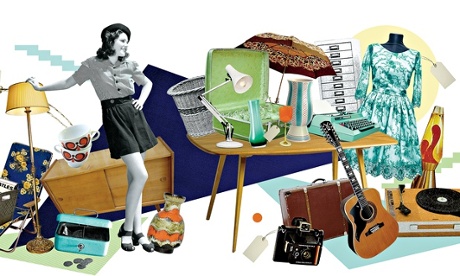
A few years ago, in need of a fast buck, I decided to part with my long-assembled hoard of vintage clothes and jewellery, trifles and whatnots. I quickly found that selling online is boring and admin heavy; life’s too short to quibble over cuff-to-armpit measurements. Washing my hands of the snarks and sharks of the eBay “community”, I signed up for a local vintage fair instead and discovered a different community that I liked a great deal – a bizarre world of wheeler dealers, hobbyists, antique hunters, coin collectors and fabulous old ladies, with its own lingo and a precise hierarchy.
For the professionals, the vintage market is a lucrative business that trades efficiently in nostalgia. For an amateur, it can be a highly entertaining way to cash in the contents of your attic. In the antiques market, items have an intrinsic value, whereas vintage relies on a less quantifiable value derived from collectability or personal memory. Often people encounter something that sparks a childhood memory or reminds them of a loved one, and that feeling is worth something; probably a small negotiable sum. Here’s how to do it.
No pain, no gain
Make no mistake, trading is not for the misty-eyed. You have to get up disgustingly early, usually on a Sunday, pack all your gear, travel to the fair, unpack, set up your stall, spend all day haggling while staying sharp to make sure no one nicks your stuff before packing up again and counting the spoils to see if it was all worth it. But it sure beats eBay, and is guaranteed to leave you richer spiritually and financially.
Get your ducks in a row
Pull out everything you have to sell and assess it. If you’re facing down a mountain of used perfume bottles and high street castoffs, get thee to a car boot sale. To qualify as “vintage” items need to be at least twenty years old, so your cut-off point is (terrifyingly) the early nineties. There are people who try to pass off retro looking Primark dresses with the labels cut out as genuine. These people are unpopular.
If you have any real treasure – familiar brands like Royal Doulton or Wedgwood, old coins, iron keys, medals and stamps – these could be valuable to the right collectors. If you’re unsure, most auction houses offer free, no obligation, verbal valuations at their salerooms. Be cautious with jewellery in particular and do your research. Ruth Davis at Lyon and Turnbull auctioneers says: “People shouldn’t be nervous; we see everything. It might look like plastic costume jewellery, but it could be signed by a sought-after maker and very collectable.”
Choose your fair
It’s a good idea to start small and local. Don’t head to a huge national trade fair with your family heirlooms or you’ll be swallowed whole. Broadly speaking, vintage events tend to fall into one of three categories: handmade, fashion or antiques. Punters expect a handful of trinkets for twenty quid at the former, but will part with more for specialist fashion, and spend big bucks at the antique fairs. Do your online research and take the standing cost (between £25 and £80) into consideration.
Prep properly
The most important thing you’ll need is a wingman. Going it alone is wretched for many reasons, including the related matters of bladders and thieves. Make sure everything is clean-ish but don’t make the mistake of using silver dip on your antiques or you’ll lose the patina and decrease the value (remember age is a commodity here). Price up your items clearly. I make labels out of string and brown paper and always take an inventory book. Other essentials include a cash float for change, plastic bags and newspaper for wrapping breakables, sandwiches and loads of biscuits.
Make it sing
Some people go to extraordinary lengths to entice custom, bringing rugs, shelving, lighting and more to transform a lowly trestle table into a beautiful little pop-up shop. Be creative. Don’t be afraid to wear your stock and, as you sell, keep moving stuff around to keep your pitch looking fresh.
Early bird
Fellow traders will minesweep the best stuff before the general public arrives. This can be the time to shift some serious stock as they have money to spend, but if you’re still setting up you can easily be caught off guard. Don’t be wrong-footed. Ask them to come back in half an hour. If they’re serious, they will. I’ve had people buy items too cheaply at the start of the day, only to display them on their own stand at a higher price. Guaranteed to make your blood boil.
Hold your nerve
When it gets busy, customers will throw money down and try to walk off with what they want. Hold your nerve. Don’t let anything go for less than you think it’s worth, but do be prepared to haggle. It’s a good idea to price things up a bit higher than your ideal sum. Too high and you’ll scare people off; too low and you’ll be mincemeat.
Show proper form
It’s customary to offer discounts to fellow traders. If they ask “what’s the death?” it means your lowest acceptable price. Offer discounts for bulk buyers and be prepared to drop your prices late in the day. Be friendly to fellow traders; leave off the hard sell but always be ready with a yarn.