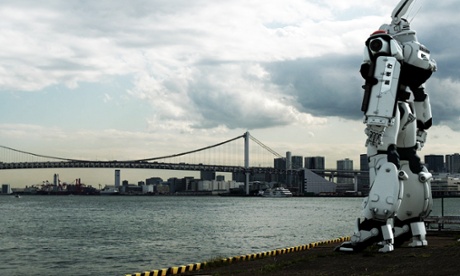
It turns out it is possible to go beyond the “uncanny valley” – that phenomenon whereby something looks a little bit off kilter in CGI re-creations of human faces. Anime veteran Mamoru Oshii moves fully into live action for his latest feature The Next Generation Patlabor: Tokyo War, and uncovers a new realm of oddness: the real, apeing the artificial that aped the real.
Every hair flick, lighting flare and camera angle is just as rigorously stylised and rhetorical as in Ghost in the Shell, the groundbreaking 1995 feature that made his name, and the result is often laughably forced. Characters make bizarrely slow movements into flattering lighting, or hold lengthy dialogue scenes back-to-back on opposite sides of chain-link fencing without ever looking at each other. This might work in hyper-cool anime, but here it adds up to a kind of mesmerisingly self-regarding noir kabuki.
There’s plenty of this in the typically (for Oshii) laborious setup to The Next Generation Patlabor, a continuation of his late 1980s/1990s Patlabor manga and anime series about a police heavy-mech unit.
Reeling from a failed military coup, Tokyo comes under attack from politically sympathetic terrorists using stealth helicopters. The mech department is falling into obsolescence – as the boss puts it, “like an appendix, it’s useless, but it still gives you pain” – until they’re called in to combat this new threat. It’s a scenario that feels influenced by Pacific Rim (itself subject to a fair amount of influence), though an ever-wordy Oshii screenplay customises it to local concerns, holding forth on the moribund state of contemporary Japan.
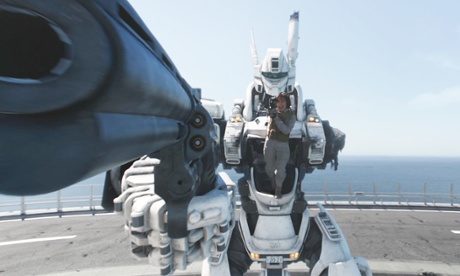
Thanks heavens it is counterbalanced with the slapstick humour that was a mainstay of the original Patlabor. But here it comes in such sporadic jolts – like the cash-strapped techies coming up with a new heavy weapon that looks like an overgrown Magnum .357. That, coupled with the direction, only makes everything seem even more off kilter.
Yet this ramshackle construction does eventually assume a pleasing rhythm, especially when the film finally unleashes a large-scale setpiece as the Patlabor team raids a warehouse, and the visuals are left to find their own way, unimpeded by annoying human realities. He’s not the first director of that persuasion (is he, Ridley?). If his anime-made-flesh is too obsessively art-directed, then perhaps it’s best seen as an extended exercise in cosplay performance art.