For decades, cancer drug development has largely been defined by a familiar objective: discover the next breakthrough therapy capable of changing the standard of care.
That pursuit remains as important as ever. Increasingly, however, researchers are recognizing that some of the most meaningful advances may come not from replacing existing treatments, but from helping them work better together.
The shift reflects a growing appreciation for the complexity of cancer itself.
Tumors evolve. They develop resistance to therapy, interact differently with the immune system, and often respond in highly individual ways from one patient to the next. Those realities have encouraged researchers to look beyond the traditional "one drug, one solution" model and instead explore how therapies with complementary mechanisms may produce stronger, more durable responses.
Combination therapy has become one of the fastest-growing areas of oncology research for precisely that reason.
Rather than viewing chemotherapy, immunotherapy, targeted medicines, or antibody-drug conjugates as competing approaches, scientists are increasingly investigating how they can be used together to address cancer from multiple directions simultaneously. The goal is not simply to add another treatment, but to create combinations that improve patient outcomes while building on therapies physicians already understand and routinely use.
That philosophy is beginning to influence clinical development across biotechnology.

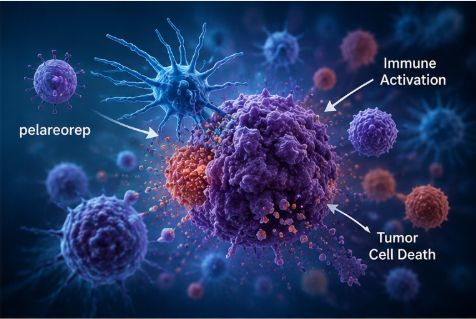
One example comes from Oncolytics Biotech (NASDAQ: ONCY), whose investigational immunotherapy candidate, pelareorep, is being studied alongside established cancer treatments rather than as a replacement for them. The company's research is centered on the idea that stimulating the body's immune response may enhance the effectiveness of existing standards of care.
That strategy can be seen in the company's ongoing REO 022 study involving patients with metastatic colorectal cancer.
Rather than asking whether pelareorep could replace current treatment, investigators evaluated whether adding the therapy to the established combination of FOLFIRI and bevacizumab could improve outcomes for patients with KRAS-mutant disease. The results encouraged further study. Patients receiving the combination achieved a median overall survival of 27.0 months and a median progression-free survival of 16.6 months, comparing favorably with historical experience reported for standard treatment alone. While those comparisons have important limitations and larger studies remain necessary, the findings have supported continued investigation of the combination approach.
The company's research has also recently gained regulatory momentum.
In July, the U.S. Food and Drug Administration granted Fast Track designation to pelareorep in combination with a checkpoint inhibitor for certain patients with advanced anal cancer whose disease has progressed following prior treatment. Fast Track designation is designed to facilitate development of therapies intended to address serious conditions with significant unmet medical needs, providing opportunities for more frequent communication with the FDA and the potential for a more efficient review process if future requirements are met.
The designation followed encouraging findings from the company's GOBLET study, where the combination demonstrated an objective response rate of approximately 30 percent, a median duration of response of approximately 15.5 months, and a 12-month overall survival rate of 82 percent. Although additional clinical development remains necessary, the results provided further support for continued evaluation of pelareorep across multiple cancer types.
Importantly, this trend extends far beyond any single company.
Across academic research centers and biotechnology organizations worldwide, hundreds of studies are evaluating combinations involving immunotherapies, targeted therapies, antibody-drug conjugates, chemotherapy, radiation, cellular therapies, and other emerging treatment platforms. Each investigation contributes to a broader understanding of how different mechanisms may complement one another against increasingly complex diseases.
Not every investigational therapy will ultimately succeed, and researchers remain appropriately cautious until larger clinical trials confirm early findings. Yet the broader direction of oncology appears increasingly clear. Future advances may come not only from discovering entirely new medicines, but also from understanding how to deploy existing and emerging therapies more intelligently.
For patients, physicians, and researchers alike, that represents an important evolution in cancer care. As combination medicine continues to mature, the next major breakthrough may be defined less by a single new drug than by how effectively multiple therapies work together to deliver better outcomes.