On the fifth floor of the new Whitney museum’s inaugural exhibition, America is Hard to See, is a photograph of a man in a leather jacket, smoking late at night. It’s the artist David Wojnarowicz photographed by his lover and collaborator Peter Hujar, cruising on the piers on the Hudson River, off New York’s meatpacking district.
Today, both men are long dead, felled in the Aids crisis along with Robert Mapplethorpe, another habituee of the area whose work is also in the show: a monochrone, tattered stars and stripes. Yet physically, their works have barely moved from the places they were created.
“Those pictures were made in the west side parking lots,” says the show’s curator Scott Rothkopf. “People used to cruise around the neighbourhood, so it influenced our thinking a lot as we made the exhibition. We’re aware the Hudson River is the place where so many of the artists arrived at Ellis Island – that’s within eyesight of this place.”
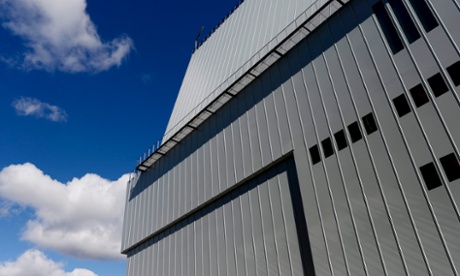
Designed by Renzo Piano, the new Whitney Museum of American Art stands in an area that used to be synonymous with sleaze, danger and the industrial butchers that gave the area its name.
Today the Meatpacking district is filled with posh hotels and expensive boutiques, along with the High Line, one of New York’s most popular tourist attractions – over five million people visited it last year. Only a few meatpacking companies are left, including one directly to the north of the new Whitney, and seemingly destined to be swallowed up by it – the gallery has first refusal if the city of New York, who owns the land it stands on, decides to sell.
The new gallery, which has moved from its former home on the Upper East Side after outgrowing it, pays tribute to the downtown artists of the past while attracting the tourists who now throng the area. Opening to the public on 1 May, it is situated between the High Line and the Hudson.
“We’re part of a different kind of urban situation than we were on the Upper East Side,” says Rothkopf. “That was a much quieter neighbourhood, more designed as a building to be closed from the city and this is a building to let the city in.”
If the city does come in, as it seems destined to do, Rothkopf says the Whitney is up for the challenge of managing it without overcrowding the exhibitions. They have recruited Adrian Hardwicke from London’s Tate Modern and put him in charge of visitor experience.
“We don’t want a lot of scansions and barriers and glass on all our paintings and we’re expecting with larger crowds that we’ll have to work hard to preserve that,” says Rothkopf. “We’re offering timed tickets, limiting our numbers in terms of what we hope will provide a great visitor experience.”
Will he allow selfies? “We’re going to allow pictures, I don’t think we’re going to allow selfie sticks,” says Rothkopf, who got to grips with the phenomenon when curating Jeff Koons: A Retrospective, the Whitney’s final exhibition in its former building.
Formerly, the Whitney did not allow photography. But, Rothkopf says, “we understood that for some people that was limiting their pleasure of coming – they liked being there less if they couldn’t take a selfie. With Jeff’s show, we understood how the experience of the show was so mediated with people’s ability to take pictures and share them with the world that we wanted to allow that to happen, so long as it was respectful and safe to the art and the audience.”
The new Whitney is in an area super-served with commercial galleries, including the biggest dealers in the world, but the museum’s director Adam D Weinberg says that its mission is different. “Most of the commercial galleries are about 10 blocks away. It’s great that they’re nearby but they’re slightly at arm’s length. Their ultimate goal is to support the artist financially, but the function of a museum is civic and public and it’s not for profit.”
The Whitney does not intend to shy away from controversy, with an exhibition by Laura Poitras scheduled later this year. Poitras’s documentary about Edward Snowden, Citizenfour, recently won an Academy award; her relationship with the Whitney started when her work featured in their 2012 biennial.
Putting on a Poitras exhibition, says Rothkopf, “signals our commitment and fearlessness in the face of political issues, and that’s something that goes back to the 30s” – the Whitney opened in 1931. “We want this to be a place of dialogue and debate.”
This lack of fear of controversy is underlined by the fact that the inaugural exhibition includes a picture by Richard Prince, of a naked, prepubescent Brooke Shields, that was taken down after a police visit when exhibited at Tate Modern in 2009.
“We wanted the show to be challenging in a thought-provoking way,” says Rothkopf. “It’s a crucial part of the vision of the institution even to be a little bit disputatious in a way, and that’s something we’re actively trying to seek, not as a way of shocking people for no good reason, but to encourage conversation.”
Weinberg says that the Whitney will add cultural heft to a the meatpacking district. “I think it will make it a much more interesting neighbourhood and not just a shopping and party destination.”
Speaking at the launch, Piano said that when entering the gallery, visitors enter “a world of art and freedom ... it makes freedom visible and talks to the city” in a zone he described as between New York City and, to the west, “the rest of the world.”