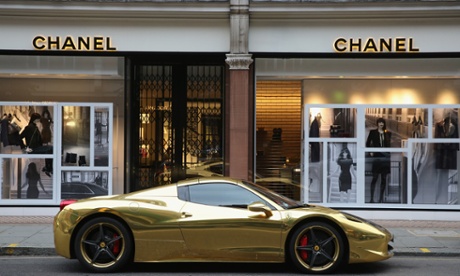
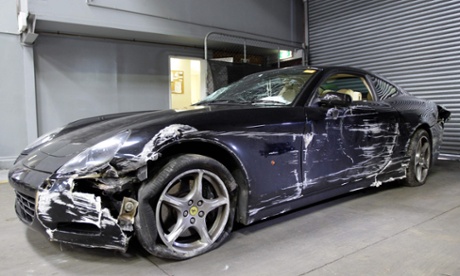
We passed the wrecked Ferraris on our way to celebrate at a London restaurant famous for its Flaming Ferraris, a cocktail designed for young bankers. In the cab were four young bankers, a senior banker, and myself. We had earlier in the week been told our year-end bonuses.
The senior banker, already with three afternoon beers in him, nodded to the wrecked Ferrari, its hood bent around a lightpost: “January in London, when pimpled bankers blow their bonuses on cars they can’t drive to try and impress women who can’t think.”
The four young bankers laughed nervously. Two had just purchased expensive sports cars.
It had been a good year, and bonuses had been large. After three rounds of Flaming Ferraris and ordering one of everything from the menu, just because, the senior banker wanted to wager for the bill that was in the thousands. “Make a list of who will be quitting on Tuesday?”
“Why Tuesday?”
“It’s Cash Tuesday, you morons. The day bonus checks clear. The day you can take your money and run.”
The senior banker lost the wager, but he never paid. He quit that Tuesday to join another bank. Two weeks later he bought himself a Porsche.
The staggering sums of money bankers get paid, often in the tens of millions, comes in a single bonus payout at the end of each year. A huge check that “hits your bank account” in the middle of winter.
Bonuses, and the culture of bonuses, are responsible for much of Wall Street’s past indulgences. Bonuses immediately reward bankers with cash, which the bankers never given back when mistakes are made. Bonuses reward short-term successes without regard to long-term consequences. It is an asymmetry that, not surprisingly, encourages reckless behavior.
Bonuses are the soap operas of Wall Street – talked about, and bragged about, and lied about, endlessly.
Six years after the financial crisis, the bonus soap opera might finally be coming to an end. On Monday, William Dudley, the president of the New York Fed, unleashed a blistering attack on the culture of banks and bank bonuses.
Dudley advocates for an overhaul in bank compensation. He wants to eliminate the immediate cash bonuses, and replace them with bonds that take into regard the long-term consequences of bankers’ actions.
That is anathema to the current banking culture that is all about getting paid in cash, and getting the cash now.
Bankers love cash. Cash is certain, unlike the market. Cash is yours, to do whatever you want with it. Cash can buy homes, pay for private schools, be given to charities. Or it can pay for a $67,000 meal, or buy a Ferrari that you can drive into a lightpole.
Most importantly, cash can’t be taken back. Even if you make deals that lose $1bn the next year and your bank loses $50bn and is bailed out by the government.
In the giant firm I worked for as a trader, much of the $50bn in losses that pushed the firm into a government bailout came from only a few rows of people. About 100 senior bankers jeopardized a firm of 235,000 people.
From 2003 to 2006 members of those rows received bonuses between $3m and $10m annually. In 2007 they were fired – but with enough money to never work again.
In 2009, when our bank was in the headlines and effectively in the hands of the government, there was intense scrutiny, by the media and politicians, on large cash bonuses. So a large portion of our bonuses was paid in special bank shares. Shares that were issued in March of the following year that could be sold immediately, only seconds after being issued. You could even choose to have the shares sold for you by the Citi Equity Trading desk, so they never really touched your brokerage account as shares. They looked like cash, behaved like cash, but were not called that.
The media and politicians didn’t notice.
For bankers that was the best part of the financial crisis, and for politicians and regulators the worst.
There have been other attempts to try and stop the lunacy of bankers being paid millions while losing billions for their firms and being bailed out.
In Europe regulators are requiring limits on bonuses. The bankers are responding in a very bankerly fashion, finding loopholes and flaws to get around the regulations. European banks are awarding bankers something new, an allowance, that comes bi-weekly like a salary, but is variable like a bonus.
This new type of bonus is paid not once in the winter of the following year, but spread out over the whole next year. It’s like buying a Ferrari on an instalment plan.
Bankers always have a way around when it comes to paying themselves.
Just limiting the amount of bankers’ bonuses, as the Europeans are advocating, although it might feel good, is unlikely to do much of anything to change the corrupt culture of banking.
The size of the bonuses is less the problem. It is the manner in which they are paid: in cash for immediate use on Ferraris, either flaming or wrecked.
Immediate cash bonuses immediately absolve bankers of anything that came before, allowing them to move forward and forget. It further distances the fiduciary responsibility between banker and the firm. It makes them hired guns, encouraging them to think for themselves, and rewards short-sighted thinking.
It encourages an attitude of “take the money and run”.
The US regulators, with Dudley’s speech on Monday, understand this.
His suggested changes will finally force bankers, and banks, to live with the consequences of their decisions.
You will have fewer crashed Ferraris and far more healthy banks.


.png?w=600)