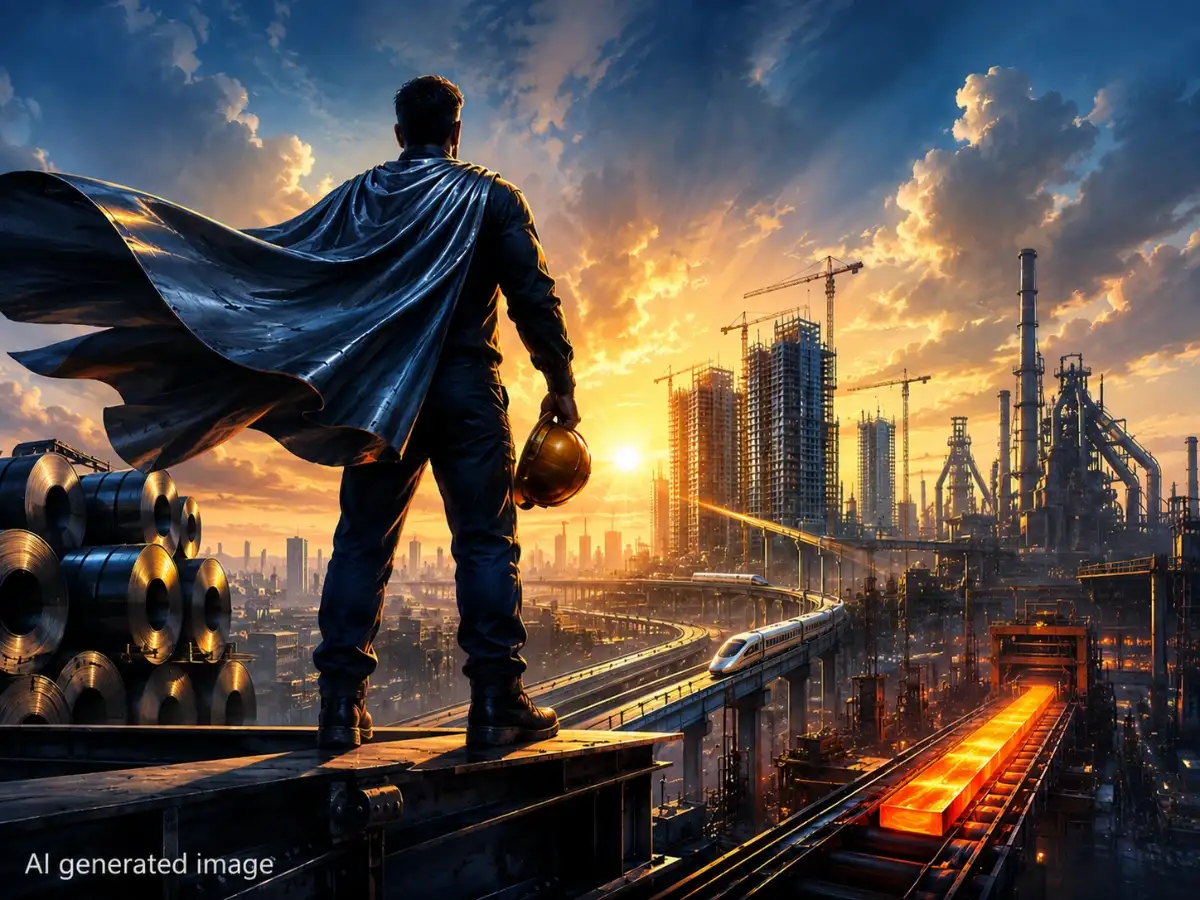
For more than two decades, China's breakneck urbanisation and construction boom dictated the fortunes of the global steel industry.
Today, as Chinese steel demand slows and miners search for new growth markets, attention is increasingly shifting to India.
Executives from BHP and Rio Tinto this week pointed to India and Southeast Asia as the next major centres of steel demand growth, arguing that infrastructure spending, industrialisation and urbanisation could help offset weaker consumption in China.
Indians consumed just 108 kg of finished steel per person in 2024-25, less than one-fifth of China's 601 kg and roughly half the global average of 215 kg, according to data from the Joint Plant Committee under India's Steel Minstry showed. The gap underscores why global miners and steelmakers see India as the industry's one of the most important growth markets.
But if India is poised to become the industry's next growth story, it is unlikely to follow the same script.
A different starting point
The optimism surrounding India stems from a simple reality: steel consumption remains relatively low for an economy of its size.
India produced about 165 million tonnes of crude steel last year, according to the Steel Ministry's report, and aims to raise capacity dramatically over the coming decades. Per-capita steel consumption remains a fraction of levels seen in China during its peak construction years, suggesting substantial room for growth as incomes rise and urbanisation accelerates.
"India and ASEAN will decisively emerge as the next engines of steel demand growth," said Vinod Kumar, partner and manufacturing sector leader at PwC India.
But, he added, the growth should be viewed as incremental rather than a replication of China's historic expansion.
Unlike China in the early 2000s, India is not embarking on a once-in-a-generation property boom. Instead, steel demand is being driven by a broader mix of infrastructure projects, manufacturing expansion and urban development.
Infrastructure remains the largest consumer of steel, accounting for roughly 60%-65% of demand, while manufacturing is emerging as an increasingly important contributor as companies expand production under government-backed industrial programmes.
The execution challenge
China's rise as a steel powerhouse was underpinned by an ability to rapidly mobilise land, capital and labour for industrial projects.
India's growth story is likely to be more gradual.
Large manufacturing and infrastructure projects frequently face delays linked to land acquisition, environmental approvals and local opposition. Property ownership can be fragmented, regulations vary across states and industrial projects often take years to move from approval to execution.
The challenges are particularly visible in eastern India, home to some of the country's largest steel-producing regions and mineral reserves.
Industry executives say these hurdles do not derail projects but often lengthen investment cycles in ways that China largely avoided during its period of industrial expansion. That means India's steel growth may ultimately prove more durable, but also less explosive.
Investments in China “were made by state-owned enterprises that rapidly added capacity,” Rajat Gupta, a Mumbai-based senior partner at consultancy McKinsey & Co told Bloomberg. “India is substantially private-driven,” he added.
Building factories, not apartments
Perhaps the biggest difference lies in what will consume the steel.
China's steel boom was overwhelmingly tied to residential construction and property development. Apartment complexes, commercial real estate and city-building projects drove enormous demand for steel products.
India's growth is increasingly being shaped by manufacturing ambitions.
Prime Minister Narendra Modi's "Make in India" initiative aims to transform the country into a global manufacturing hub, encouraging investments across automobiles, engineering goods, electronics and industrial equipment.
The government's infrastructure push is equally significant. Capital expenditure allocations have risen steadily over the past decade, funding highways, ports, airports, freight corridors and high-speed rail projects. The result is a steel demand profile that is likely to be more diversified than China's was.
The raw-material dilemma
India's steel ambitions also face a challenge that China largely did not. The country has abundant iron ore reserves but remains heavily dependent on imported metallurgical coal, an essential ingredient for blast furnace steelmaking.
India may be the world's second-largest steel producer, but the gap with China remains vast. India produced 149.4 million tonnes of crude steel in 2024, according to provisional World Steel Association data, compared with China's 1,005.1 million tonnes.
In other words, China produced nearly seven times more steel than India last year. Japan and the United States, the third- and fourth-largest producers, manufactured 84 million tonnes and 79.5 million tonnes respectively, highlighting India's emergence as the clear second pillar of global steelmaking even as it remains far behind China in scale.
Finished steel imports more than doubled to 9.55 million tonnes in 2024-25 from 4.75 million tonnes in 2020-21, while exports fell to 4.86 million tonnes from 10.78 million tonnes over the same period.
As a result, India became a net importer of 4.69 million tonnes of finished steel in 2024-25, the largest trade deficit in the period. Preliminary data for April-July 2025-26, however, show a modest reversal, with exports of 1.70 million tonnes slightly exceeding imports of 1.67 million tonnes, making India a marginal net exporter once again.
As steel production expands, Indian companies are increasingly looking abroad to secure supplies, with Australia remaining a major source alongside the United States, Canada, Mongolia, Russia and emerging suppliers such as Mozambique. The search for raw materials is becoming more urgent as the government pursues its long-term target of producing 500 million tonnes of steel by 2047.
At the same time, declining ore quality, high mine premiums and auction-linked mining costs could create additional pressures on domestic producers.
Unlike China, which spent decades securing overseas mineral assets as demand exploded, India is trying to build supply chains while simultaneously scaling production.
Growth under a carbon microscope
Another major distinction is timing.
China built much of its steel industry before climate concerns became a central policy issue. India does not have that luxury.
The country's steelmakers are being asked to expand production while simultaneously lowering emissions.
According to a draft government policy reviewed by Reuters, India plans to reduce carbon emissions from steel production to about 2 tonnes of carbon dioxide per tonne of finished steel by the middle of the next decade, from current levels of roughly 2.65 tonnes.
The pressure has intensified following the European Union's carbon border tariff, which imposes charges on imports of carbon-intensive products.
As a result, future growth is expected to involve greater use of scrap steel, gas-based steelmaking and cleaner production technologies.
India, in effect, is attempting to build a larger steel industry while also making it greener.
Not a replacement, but a new chapter
For miners such as BHP and Rio Tinto, India's rise offers an increasingly important source of future demand as China matures.
Yet analysts caution against viewing India as a direct substitute for China.
"China's share remains substantial enough to pull down global demand as it cannot be compensated by positive demand momentum from India and other Asian countries," said Sehul Bhatt, director at Crisil Intelligence.
Even so, the industry sees little alternative.
China's era of steel-led expansion is fading. India is where much of the next wave of demand growth will originate.
But the country's rise will be shaped less by a property frenzy and more by manufacturing, infrastructure, resource security and decarbonisation.
That makes India's steel story not a replay of China's, but an altogether different chapter in the evolution of the global steel industry.