In 2000, world leaders came together and agreed to the eight millennium development goals – an unprecedented framework under which we have seen incredible progress against poverty and other challenges faced by the world’s most poor.
But the world has changed radically in the last 15 years and we must now expand on progress, build on existing momentum and learn from the lessons the MDGs have offered us.
The new goals must apply to all countries
The sustainable development agenda cannot only be about a handful of poor countries but must instead be a universal – concerned with the rights of all people, everywhere. We can no longer adhere to a framework that is prescribed by the world’s most developed and powerful nations and used to measure the value and progress of developing nations. Instead we need to emphasise shared responsibilities for a shared future of hope, opportunity and dignity for all.
Both developed and developing countries will have to do their part and commit to good governance, rule of law and the fight against corruption in order to realise the post-2015 development agenda. But universality does not mean uniformity. The targets and indicators that will accompany the future development goals should be tailored to ensure that they are relevant and responsive to every country and region. This will require a bold and inclusive process.
Business-as-usual at the UN is neither desirable nor feasible
The UN is an organisation of sovereign member states, with its own rules and procedures that have often allowed for limited representation of other groups. But the post-2015 discussions have so far seen unprecedented outreach, allowing for increased participation from a wide range of stakeholders.
The sustainable development goals will require huge resources and this will have serious implications on our existing business models. We must rethink how the UN and the multitude of actors deliver value and remain a relevant and effective partner to support member states.
In part, that is about giving up the ‘fire brigade approach’ to development and looking again at root causes. Democracy says: “I’ve got to shift in four years and in [that time] I’ve got to deliver a dividend and so I can’t really think about the root causes - that’s going to take a couple of decades.” So we have to build institutions that do that and allow politicians to come in and out but the institutions stay and the basic services get done.
The requirement to be ‘fit-for-purpose’ should change government, donors and civil society
For a while now there have been many in civil society who have got onto a production line of expectations in terms of funding and what they deliver in return. This will have to change.
We need to do things differently to respond to the people we say we are trying to represent. Being fit for purpose is going to change the way people fund, the skill sets that you have and yes, you do have to change but, no, you don’t have to worry about your job. There is plenty to do.
This applies equally but differently to donors and governments who will find that the integration and synergies in the way targets are set will take powers and resources and mandates away from people and organisations who have always worked in silos.
We must redefine private sector partnership
The private sector also has responsibilities and all must work in partnership, within and across sectors. Indeed, partnership is critical but means so much more than just collaboration. Partnership is about the integration of visions, values, plans, accountability, resources and knowledge sharing. How many of our public institutions and private organisations can claim to be in true partnership?
A realistic yet ambitious agenda starts with four things
- An inspirational vision for the future, made plain in a declaration.
- A practical plan for that declaration laid out in an integrated set of goals, targets and indications.
- Adequate means to implement the plan and a renewed global partnership for development.
- And to ensure promises made become actions delivered, a framework to be able to monitor and review implementation.
Involve young people now
Young people give me most optimism. They have vision and energy. Many of us who are responsible [for leading transformation in development] like to think that we have vision, but we certainly don’t have the same energy. We must figure out a way to let young people play their part now, without negating our own responsibilities towards them.
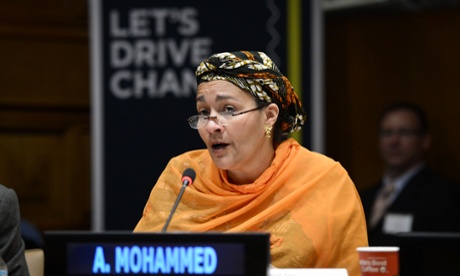
Amina J Mohammed is the special adviser to the UN secretary general on post-2015 development planning
Read more stories like this:
- Citizen voice in post-2015 goals: is anyone listening?
-
All that glitters...why growth and development aren’t the same thing
-
MDGs failed to include human rights - will we make that mistake again?
Join our community of development professionals and humanitarians. Follow @GuardianGDP on Twitter.