
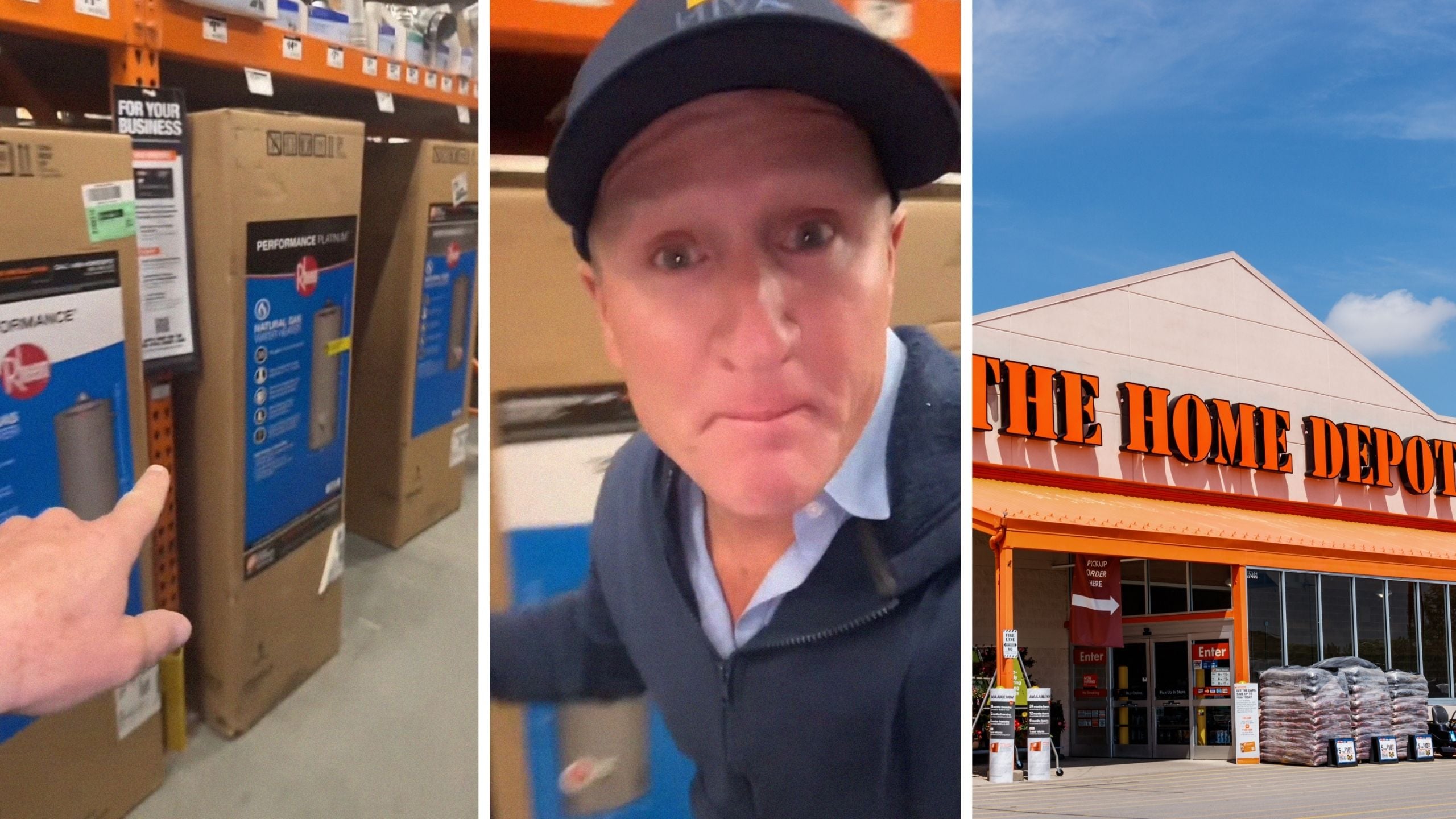
Buying a new water heater isn’t something most people plan for until the old one gives out. When that happens, a quick run to Home Depot or Lowe’s feels like the fastest fix.
One plumber on TikTok says that convenience comes with trade-offs most homeowners never see until something goes wrong.
Plumber Shares Why You Shouldn’t Buy Home Depot Water Heater
TikTok account The Twin Home Experts (@twinhomeexperts), a brother duo known for their home repair advice, recently posted a video breaking down why they don’t recommend water heaters sold at big-box stores.
One of the brothers films inside a Home Depot aisle, pointing directly at a boxed Rheem natural gas water heater.
“You’re gonna wanna know this before you buy a water heater here at a big box store,” he says. “Most people don’t know that a big box store water heater, the internal parts are made completely different versus a pro grade.”
He starts with the flue, the internal passage that vents heat and exhaust. “Big box stores will cut cost by giving you a shorter flue,” he says. “The pro grade has a longer flue. This is going to create way more efficiency with the longer one versus the short one.”
Next, he moves to the tank itself and pressure limits. While all water heaters include glass liners, he claims big-box versions can’t handle the same pressure as professional-grade models. “If this thing ever got high pressure, then you’re gonna get a big explosion causing a major leak,” he says.
Then he brings up what he calls the most important component: the anode rod.
“Most people don’t know this, but the anode rod is the most critical component on a water heater,” he says. “This anode rod protects the water heater tank from rusting out.”
He claims big-box store models usually use aluminum anode rods instead of magnesium. “The magnesium is gonna give you more of a long-lasting protection,” he says. He adds that people dealing with sulfur or “rotten egg” smells often use zinc-aluminum rods instead.
What he doesn’t fully explain in the video is that both aluminum and magnesium anode rods are standard in the industry, depending on water chemistry.
Magnesium rods are more aggressive at preventing corrosion in soft water, while aluminum rods perform better in hard water and resist rapid breakdown.
So the presence of aluminum doesn’t automatically mean lower quality, but it does change how the tank behaves over time.
Are His Claims True?
Some of the general points he makes track with what consumer experts have reported for years, especially when it comes to efficiency.
According to Consumer Reports, one of the biggest differences between water heater types comes down to how much energy they use, not just where they’re sold. Heat pump water heaters, sometimes called hybrid models, pull heat from the surrounding air instead of generating it through electric resistance.
They look like standard tank heaters but include a heat pump unit on top. Most still include backup electric elements for peak demand.
Consumer Reports says heat pump water heaters are “conservatively” at least twice as efficient as traditional electric water heaters. Energy Star estimates these models use about 70 percent less energy than standard electric units. For a family of four, that can translate to roughly $550 per year in energy savings, or about $5,600 over the lifetime of the heater.
The main drawback remains cost. Home Depot estimates the total purchase and installation for heat pump water heaters between $2,500 and $5,000. Heater-only prices for common sizes fall between $1,449 and $1,950, with some premium models exceeding $5,000. Federal and state incentives can reduce that, but the upfront price still keeps many buyers in the big-box aisle.
On the explosion claim, experts agree that pressure-related water heater explosions are extremely rare. Every unit sold in the U.S., regardless of grade, includes a mandated temperature and pressure relief valve designed to prevent dangerous buildup. When explosions do occur, they usually involve manufacturing defects, failed safety valves, or improper installation, not routine operation.
Commenters Are Split
The video pulled in a wave of reactions, with homeowners, contractors, and longtime DIYers pushing back on some of the warnings.
“I’m still rocking my 40 gallon Home Depot hot water tank. I bought 16 years ago and installed it myself,” one person wrote.
“They all have a MANDATED pressure relief. Pro or not. Your water heater will not explode from pressure…,” another said.
@twinhomeexperts BEFORE you buy a water heater from a big box store, you need to hear this #homedepot #productreview #buyingtips #waterheaters ♬ Intro – Mad Dog
“My last standard water heater lasted 17 years. Never flushed it,” someone else added.
Others didn’t dispute the efficiency claims but said cost remains the real deciding factor for most households. For many buyers, the difference between $1,200 and $4,000 upfront outweighs long-term savings.
We’ve reached out to Twin Home Experts, Home Depot, and Rheem via email for comment.
Have a tip we should know? [email protected]